
应用NSGA-II算法获取基于电池的水下无线传感器节点中的充电电流-时间权衡曲线。
Application of NSGA-II to Obtain the Charging Current-Time Tradeoff Curve in Battery Based Underwater Wireless Sensor Nodes.
作者信息
Rodríguez García Daniel, Montiel-Nelson Juan-A, Bautista Tomás, Sosa Javier
机构信息
Institute for Applied Microelectronics (IUMA), University of Las Palmas de Gran Canaria, 35015 Las Palmas de Gran Canaria, Spain.
出版信息
Sensors (Basel). 2021 Aug 6;21(16):5324. doi: 10.3390/s21165324.
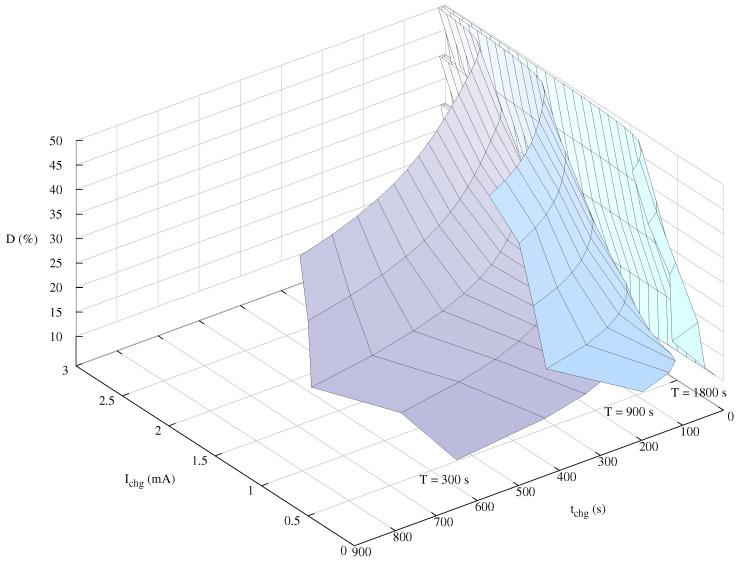
In this paper, a novel application of the Nondominated Sorting Genetic Algorithm II (NSGA II) is presented for obtaining the charging current-time tradeoff curve in battery based underwater wireless sensor nodes. The selection of the optimal charging current and times is a common optimization problem. A high charging current ensures a fast charging time. However, it increases the maximum power consumption and also the cost and complexity of the power supply sources. This research studies the tradeoff curve between charging currents and times in detail. The design exploration methodology is based on a two nested loop search strategy. The external loop determines the optimal design solutions which fulfill the designers' requirements using parameters like the sensor node measurement period, power consumption, and battery voltages. The inner loop executes a local search within working ranges using an evolutionary multi-objective strategy. The experiments proposed are used to obtain the charging current-time tradeoff curve and to exhibit the accuracy of the optimal design solutions. The exploration methodology presented is compared with a bisection search strategy. From the results, it can be concluded that our approach is at least four times better in terms of computational effort than a bisection search strategy. In terms of power consumption, the presented methodology reduced the required power at least 3.3 dB in worst case scenarios tested.
本文提出了非支配排序遗传算法II(NSGA II)的一种新应用,用于获取基于电池的水下无线传感器节点中的充电电流-时间权衡曲线。选择最佳充电电流和次数是一个常见的优化问题。高充电电流可确保快速充电时间。然而,它会增加最大功耗以及电源的成本和复杂性。本研究详细探讨了充电电流和时间之间的权衡曲线。设计探索方法基于双嵌套循环搜索策略。外部循环使用诸如传感器节点测量周期、功耗和电池电压等参数来确定满足设计者要求的最佳设计方案。内部循环使用进化多目标策略在工作范围内执行局部搜索。所提出的实验用于获取充电电流-时间权衡曲线,并展示最佳设计方案的准确性。将所提出的探索方法与二分搜索策略进行了比较。从结果可以得出结论,就计算量而言,我们的方法比二分搜索策略至少好四倍。在功耗方面,在所测试的最坏情况下,所提出的方法至少降低了3.3 dB的所需功率。



 Zotero 插件