Institute for Psychology - Department of Clinical Psychology and Psychotherapy, Goethe University Frankfurt, Varrentrappstr. 40-42, 60486, Frankfurt am Main, Germany.
Trials. 2020 Jan 6;21(1):20. doi: 10.1186/s13063-019-3815-4.
Depression is a widespread disorder with severe impacts for individuals and society, especially in its chronic form. Current treatment approaches for persistent depression have focused primarily on reducing negative affect and have paid little attention to promoting positive affect. Previous studies have shown that metta meditation increases positive affect in chronically depressed patients. Results from previous trials provide evidence for the efficacy of a stand-alone metta meditation group treatment in combination with mindfulness-based approaches. Further research is needed to better understand the implementation of meditation practice into everyday life. Therefore, mindfulness and metta meditation in a group setting are combined with individual cognitive behavioral therapy (CBT) into a new, low-intensity, cost-effective treatment ("MeCBT") for chronic depression.
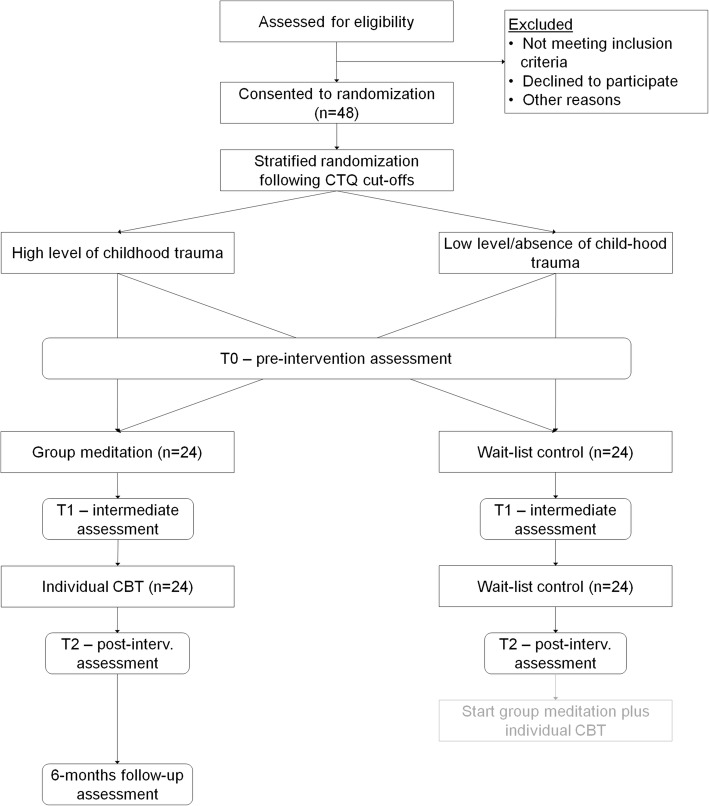
METHODS/DESIGN: In this single-center, randomized, observer-blinded, parallel-group clinical trial we will test the efficacy of MeCBT in reducing depression compared to a wait-list control condition. Forty-eight participants in a balanced design will be allocated randomly to a treatment group or a wait-list control group. Metta-based group meditation will be offered in eight weekly sessions and one additional half-day retreat. Subsequent individual CBT will be conducted in eight fortnightly sessions. Outcome measures will be assessed at four time points: before intervention (T0); after group meditation (T1); after individual CBT (T2); and, in the treated group only, at 6-month follow-up (T3). Changes in depressive symptoms (clinician rating), assessed with the Quick Inventory of Depressive Symptoms (QIDS-C) are the primary outcome. We expect a significant decline of depressive symptoms at T2 compared to the wait-list control group. Secondary outcome measures include self-rated depression, mindfulness, benevolence, rumination, emotion regulation, social connectedness, social functioning, as well as behavioral and cognitive avoidance. We will explore changes at T1 and T2 in all these secondary outcome variables.
To our knowledge this is the first study to combine a group program focusing on Metta meditation with state-of-the art individual CBT specifically tailored to chronic depression. Implications for further refinement and examination of the treatment program are discussed.
ISRCTN, ISRCTN97264476. Registered 29 March 2018 (applied on 14 December 2017)-retrospectively registered.
抑郁症是一种广泛存在的疾病,对个人和社会都有严重影响,尤其是在慢性形式下。目前针对持续性抑郁症的治疗方法主要集中在减轻负性情绪上,而很少关注促进正性情绪。先前的研究表明,慈心冥想可以增加慢性抑郁症患者的正性情绪。先前试验的结果为单独的慈心冥想组治疗与基于正念的方法相结合的疗效提供了证据。需要进一步的研究来更好地理解将冥想练习融入日常生活。因此,正念和慈心冥想在小组环境中与个体认知行为疗法(CBT)结合,形成一种新的、低强度、具有成本效益的慢性抑郁症治疗方法(“MeCBT”)。
方法/设计:在这项单中心、随机、观察者盲、平行组临床试验中,我们将测试 MeCBT 与等待名单对照相比,在减轻抑郁症方面的疗效。在平衡设计中,将 48 名参与者随机分配到治疗组或等待名单对照组。以八周为一个周期,提供基于慈心的团体冥想八次,并增加一次半天的静修。随后进行八次两周一次的个体 CBT。在四个时间点评估结果测量:干预前(T0);团体冥想后(T1);个体 CBT 后(T2);仅在治疗组,在 6 个月随访时(T3)。以临床医生评定的抑郁症状快速清单(QIDS-C)评估的抑郁症状变化是主要结果。我们预计与等待名单对照组相比,T2 时抑郁症状会显著下降。次要结果测量包括自我报告的抑郁、正念、仁慈、反刍、情绪调节、社交联系、社交功能,以及行为和认知回避。我们将探索所有这些次要结果变量在 T1 和 T2 时的变化。
据我们所知,这是第一项将专注于慈心冥想的团体计划与专门针对慢性抑郁症的最新个体 CBT 相结合的研究。讨论了对治疗方案的进一步改进和检查的影响。
ISRCTN,ISRCTN97264476。2018 年 3 月 29 日注册(2017 年 12 月 14 日申请)-回溯注册。