Medical Biochemistry, Amsterdam UMC-Location AMC, Amsterdam, The Netherlands.
Pathology, CARIM, Maastricht, The Netherlands.
BMJ Open Diabetes Res Care. 2019 Dec 17;7(1):e000829. doi: 10.1136/bmjdrc-2019-000829. eCollection 2019.
Obesity-associated metabolic dysfunction increases the risk of multiple diseases such as type 2 diabetes and cardiovascular disease. The importance of the co-stimulatory CD40-CD40L dyad in diet-induced obesity (DIO), with opposing phenotypes arising when either the receptor (aggravating) or the ligand (protective) is deleted, has been described previously. The functions of CD40 and CD40L are cell type dependent. As co-stimulation via T cell-mediated CD40L is essential for driving inflammation, we here investigate the role of T cell CD40L in DIO.
CD4CreCD40L mice on a C57BL/6 background were generated and subjected to DIO by administration of 15 weeks of high fat diet (HFD).
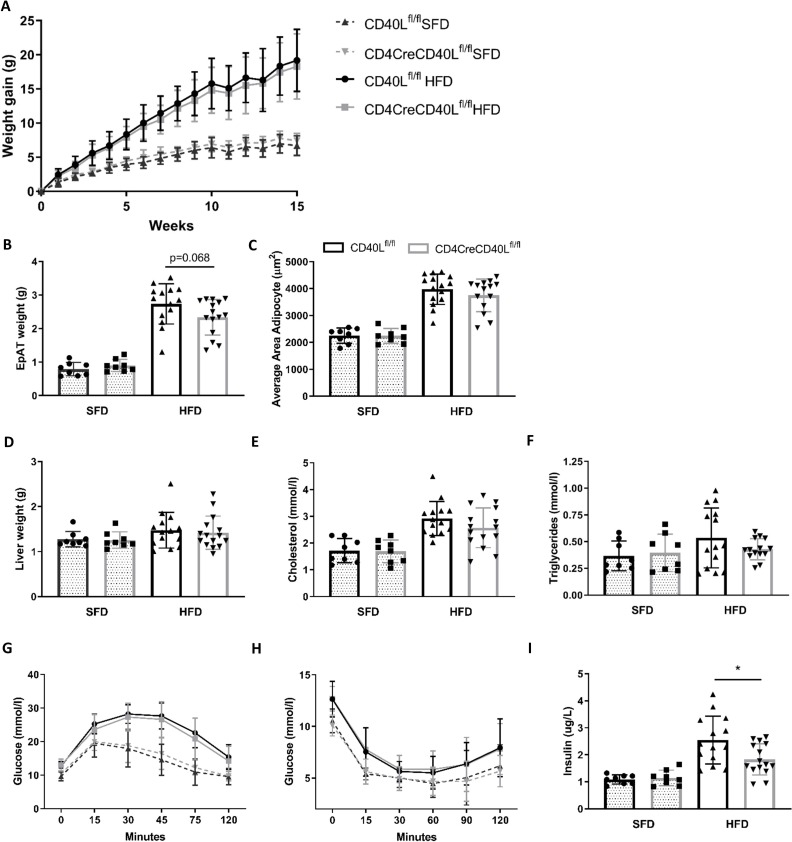
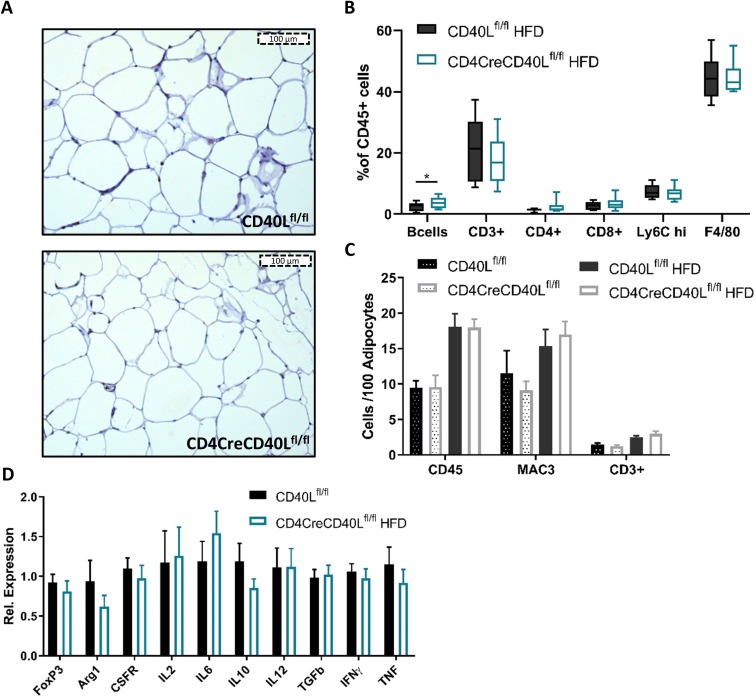
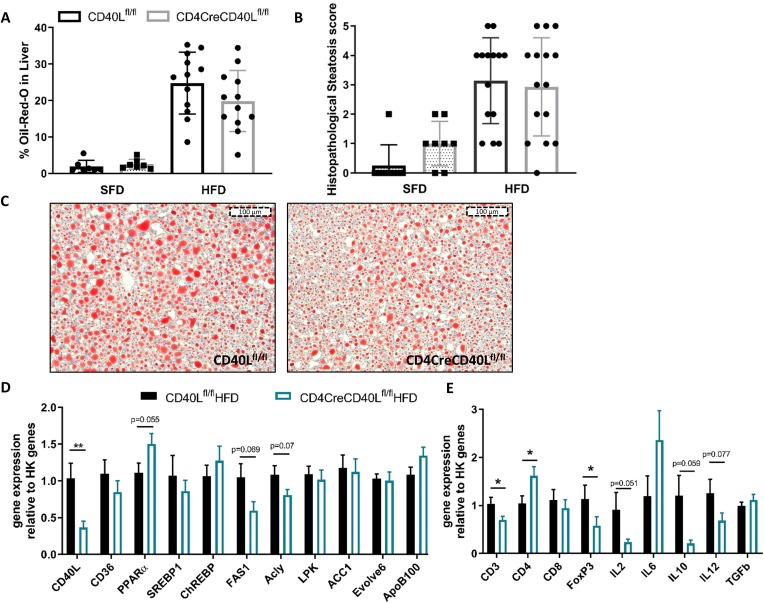
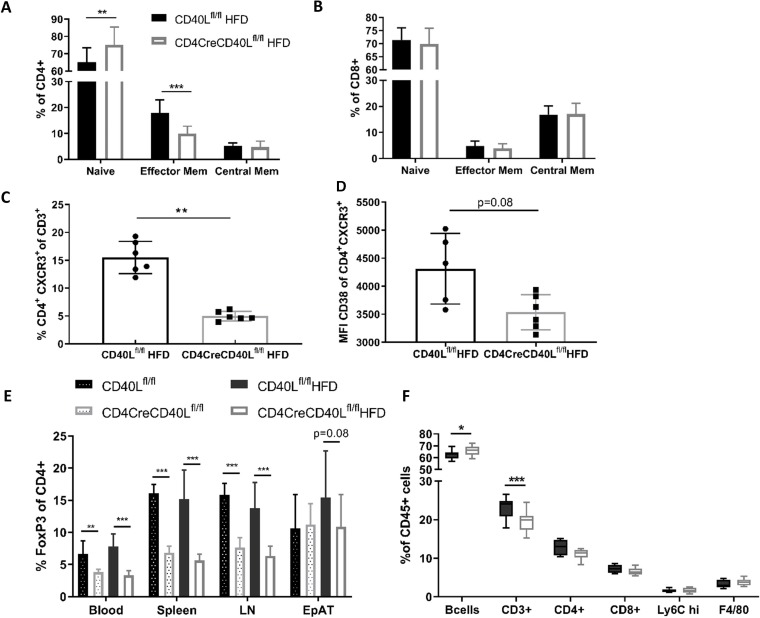
HFD-fed CD4CreCD40L mice had similar weight gain, adipocyte sizes, plasma cholesterol and triglyceride levels as their wild-type (WT) counterparts. Insulin and glucose tolerance were comparable, although CD4CreCD40L mice did have a decreased plasma insulin concentration, suggesting a minor improvement of insulin resistance. Furthermore, although the degree of hepatosteatosis was similar in both genotypes, the gene expression of fatty acid synthase 1 and ATP-citrate lyase had decreased, whereas expression of peroxisome proliferator-activated receptor-α had increased in livers of CD4CreCD40L mice, suggesting decreased hepatic lipid uptake in absence of T cell CD40L.Moreover, CD4CreCD40L mice displayed significantly lower numbers of effector memory CD4 T cells and regulatory T cells in blood and lymphoid organs compared with WT. However, immune cell composition and inflammatory status of the adipose tissue was similar in CD4CreCD40L and WT mice.
T cell CD40L deficiency results in a minor improvement of insulin sensitivity and hepatic steatosis in DIO, despite the strong decrease in effector T cells and regulatory T cells in blood and lymphoid organs. Our data indicate that other CD40L-expressing cell types are more relevant in the pathogenesis of obesity-associated metabolic dysfunction.
肥胖相关的代谢功能障碍会增加 2 型糖尿病和心血管疾病等多种疾病的风险。先前已经描述了共刺激 CD40-CD40L 二聚体在饮食诱导肥胖(DIO)中的重要性,当受体(加重)或配体(保护)缺失时,会出现相反的表型。CD40 和 CD40L 的功能取决于细胞类型。由于 T 细胞介导的 CD40L 通过共刺激对于驱动炎症至关重要,因此我们在此研究 T 细胞 CD40L 在 DIO 中的作用。
在 C57BL/6 背景下生成 CD4CreCD40L 小鼠,并通过给予 15 周高脂肪饮食(HFD)来使其发生 DIO。
HFD 喂养的 CD4CreCD40L 小鼠的体重增加、脂肪细胞大小、血浆胆固醇和甘油三酯水平与野生型(WT)小鼠相似。胰岛素和葡萄糖耐量相当,尽管 CD4CreCD40L 小鼠的血浆胰岛素浓度降低,表明胰岛素抵抗略有改善。此外,尽管两种基因型的肝脂肪变性程度相似,但 CD4CreCD40L 小鼠的脂肪酸合酶 1 和三磷酸柠檬酸裂解酶的基因表达降低,而过氧化物酶体增殖物激活受体-α的表达增加,表明在没有 T 细胞 CD40L 的情况下肝脏脂质摄取减少。此外,与 WT 相比,CD4CreCD40L 小鼠的血液和淋巴器官中的效应记忆 CD4 T 细胞和调节性 T 细胞数量明显减少。然而,CD4CreCD40L 和 WT 小鼠的脂肪组织的免疫细胞组成和炎症状态相似。
尽管血液和淋巴器官中的效应 T 细胞和调节性 T 细胞数量明显减少,但 T 细胞 CD40L 缺乏可导致 DIO 中的胰岛素敏感性和肝脂肪变性略有改善。我们的数据表明,其他表达 CD40L 的细胞类型在肥胖相关代谢功能障碍的发病机制中更为重要。