Institute for Cardiovascular Prevention (IPEK), Ludwig-Maximilians-Universität, Munich, Germany.
German Centre for Cardiovascular Research (DZHK), partner site Munich Heart Alliance, Munich, Germany.
Nat Commun. 2021 Jun 18;12(1):3754. doi: 10.1038/s41467-021-23909-z.
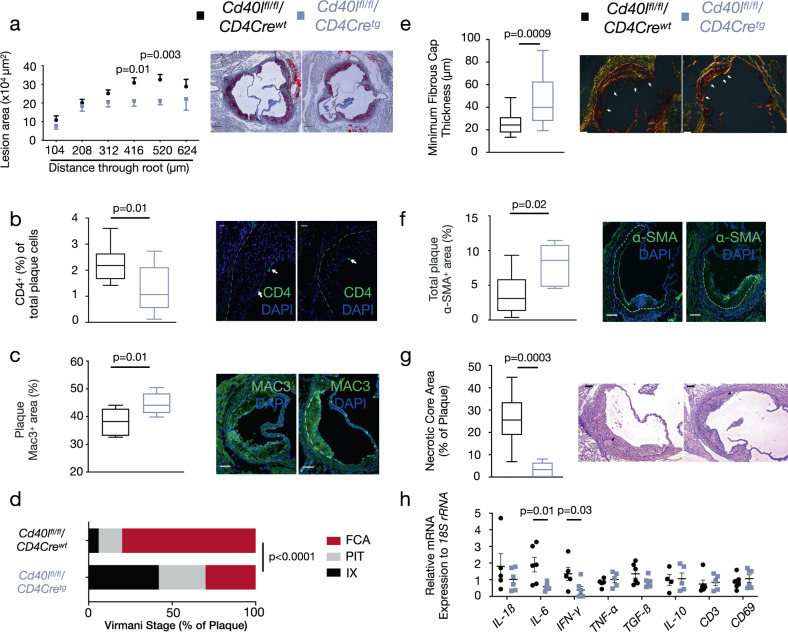
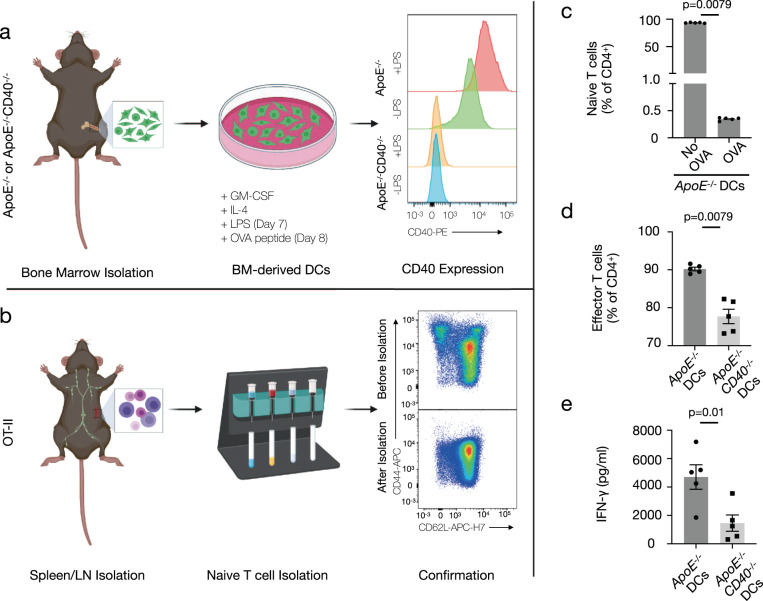
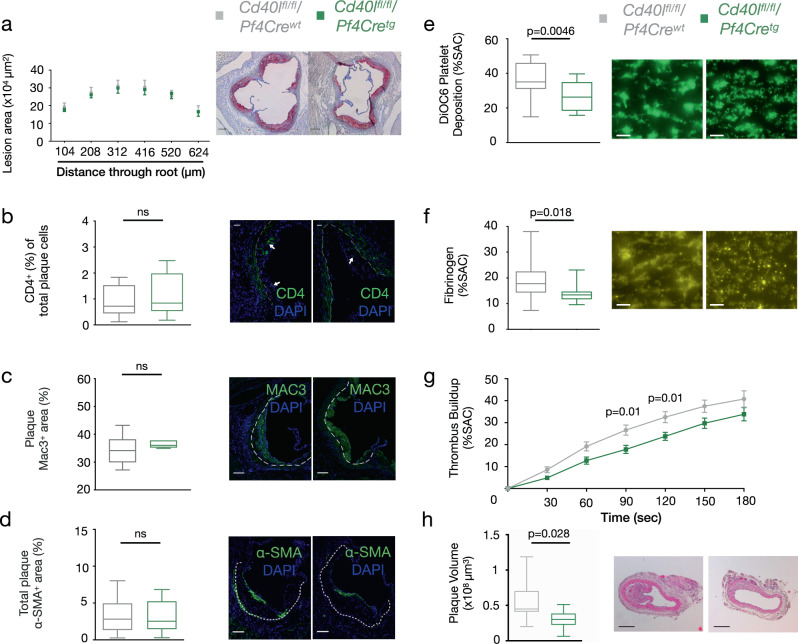
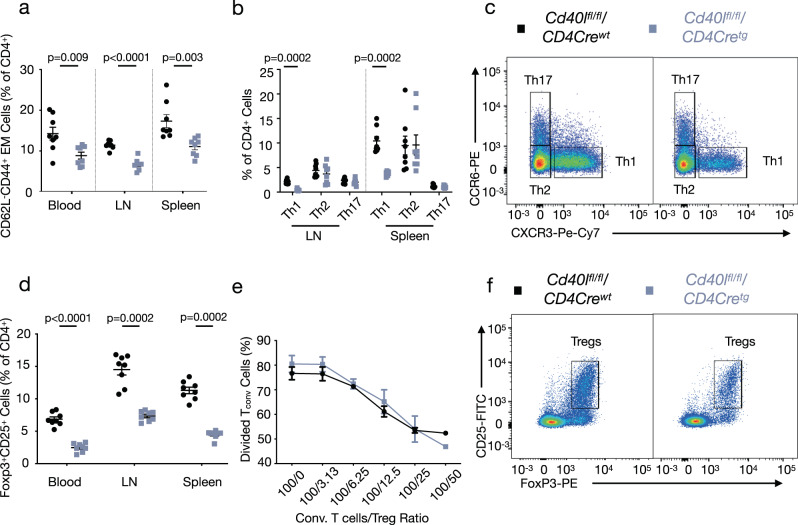
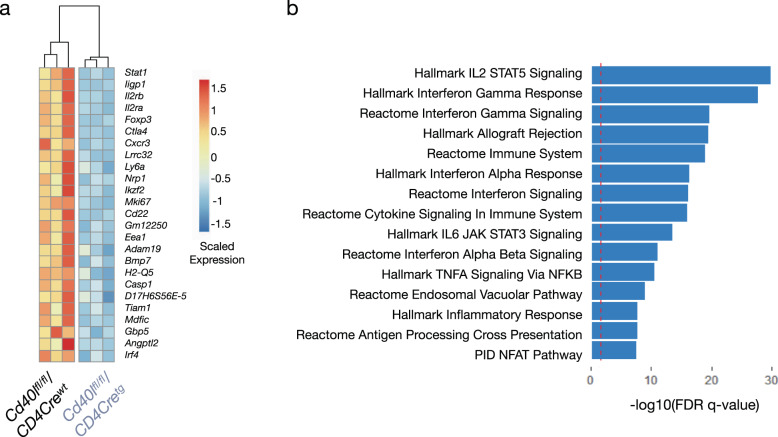
Atherosclerosis is a major underlying cause of cardiovascular disease. Previous studies showed that inhibition of the co-stimulatory CD40 ligand (CD40L)-CD40 signaling axis profoundly attenuates atherosclerosis. As CD40L exerts multiple functions depending on the cell-cell interactions involved, we sought to investigate the function of the most relevant CD40L-expressing cell types in atherosclerosis: T cells and platelets. Atherosclerosis-prone mice with a CD40L-deficiency in CD4 T cells display impaired Th1 polarization, as reflected by reduced interferon-γ production, and smaller atherosclerotic plaques containing fewer T-cells, smaller necrotic cores, an increased number of smooth muscle cells and thicker fibrous caps. Mice with a corresponding CD40-deficiency in CD11c dendritic cells phenocopy these findings, suggesting that the T cell-dendritic cell CD40L-CD40 axis is crucial in atherogenesis. Accordingly, sCD40L/sCD40 and interferon-γ concentrations in carotid plaques and plasma are positively correlated in patients with cerebrovascular disease. Platelet-specific deficiency of CD40L does not affect atherogenesis but ameliorates atherothrombosis. Our results establish divergent and cell-specific roles of CD40L-CD40 in atherosclerosis, which has implications for therapeutic strategies targeting this pathway.
动脉粥样硬化是心血管疾病的主要潜在原因。先前的研究表明,抑制共刺激 CD40 配体(CD40L)-CD40 信号轴可显著减轻动脉粥样硬化。由于 CD40L 根据涉及的细胞-细胞相互作用发挥多种功能,我们试图研究在动脉粥样硬化中最相关的表达 CD40L 的细胞类型的功能:T 细胞和血小板。在 CD4 T 细胞中缺乏 CD40L 的动脉粥样硬化易感小鼠表现出 Th1 极化受损,表现为干扰素-γ产生减少,并且动脉粥样硬化斑块较小,其中 T 细胞较少,坏死核心较小,平滑肌细胞数量增加,纤维帽较厚。具有相应的 CD11c 树突状细胞中 CD40 缺乏的小鼠表现出这些发现的表型,表明 T 细胞-树突状细胞 CD40L-CD40 轴在动脉粥样形成中至关重要。因此,在患有脑血管疾病的患者中,颈动脉斑块和血浆中的 sCD40L/sCD40 和干扰素-γ浓度呈正相关。血小板特异性缺乏 CD40L 不会影响动脉粥样硬化形成,但可改善动脉粥样硬化血栓形成。我们的研究结果确立了 CD40L-CD40 在动脉粥样硬化中的不同和细胞特异性作用,这对靶向该途径的治疗策略具有重要意义。