Radioisotope Research Center, Institute for Radiation Research, Osaka University, Suita, Japan.
Radiation Biology and Medical Genetics, Department of Genome Biology, Graduate School of Medicine, Osaka University, Suita, Japan.
Genes Cells. 2020 Feb;25(2):124-138. doi: 10.1111/gtc.12746. Epub 2020 Feb 5.
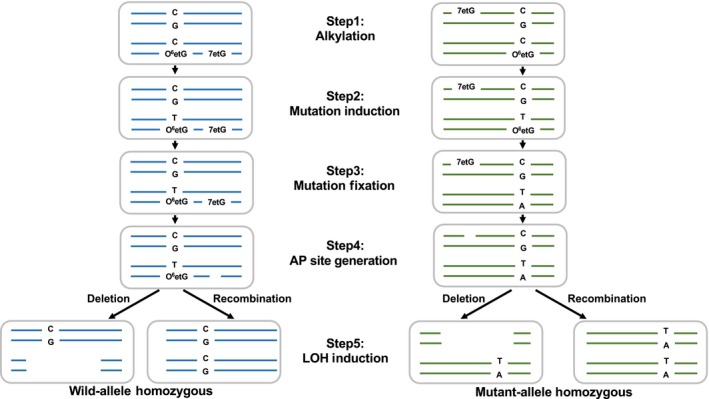
Translesion synthesis (TLS) polymerases mediate DNA damage bypass during replication. The TLS polymerase Rev1 has two important functions in the TLS pathway, including dCMP transferase activity and acting as a scaffolding protein for other TLS polymerases at the C-terminus. Because of the former activity, Rev1 bypasses apurinic/apyrimidinic sites by incorporating dCMP, whereas the latter activity mediates assembly of multipolymerase complexes at the DNA lesions. We generated rev1 mutants lacking each of these two activities in Oryzias latipes (medaka) fish and analyzed cytotoxicity and mutagenicity in response to the alkylating agent diethylnitrosamine (DENA). Mutant lacking the C-terminus was highly sensitive to DENA cytotoxicity, whereas mutant with reduced dCMP transferase activity was slightly sensitive to DENA cytotoxicity, but exhibited a higher tumorigenic rate than wild-type fish. There was no significant difference in the frequency of DENA-induced mutations between mutant with reduced dCMP transferase activity and wild-type cultured cell. However, loss of heterozygosity (LOH) occurred frequently in cells with reduced dCMP transferase activity. LOH is a common genetic event in many cancer types and plays an important role on carcinogenesis. To our knowledge, this is the first report to identify the involvement of the catalytic activity of Rev1 in suppression of LOH.
跨损伤合成(TLS)聚合酶在复制过程中介导 DNA 损伤绕过。TLS 聚合酶 Rev1 在 TLS 途径中有两个重要功能,包括 dCMP 转移酶活性和作为 C 末端其他 TLS 聚合酶的支架蛋白。由于前者的活性,Rev1 通过掺入 dCMP 绕过无嘌呤/无嘧啶位点,而后者的活性介导在 DNA 损伤处多聚合酶复合物的组装。我们在鱼类(斑马鱼)中生成了缺乏这两种活性的 rev1 突变体,并分析了对烷化剂二乙基亚硝胺(DENA)的细胞毒性和诱变作用。缺乏 C 末端的突变体对 DENA 细胞毒性高度敏感,而具有降低的 dCMP 转移酶活性的突变体对 DENA 细胞毒性略有敏感,但比野生型鱼表现出更高的肿瘤形成率。在具有降低的 dCMP 转移酶活性的突变体和野生型培养细胞之间,DENA 诱导的突变频率没有显著差异。然而,在具有降低的 dCMP 转移酶活性的细胞中经常发生杂合性丢失(LOH)。LOH 是许多癌症类型中的常见遗传事件,在致癌作用中起重要作用。据我们所知,这是首次报道鉴定 Rev1 的催化活性参与抑制 LOH。