Department of Paediatrics, Medical University of Vienna.
Centre for Thrombosis and Hemostasis, Skane University Hospital, Malmö, Sweden.
Haematologica. 2021 Jan 1;106(1):123-129. doi: 10.3324/haematol.2019.239160.
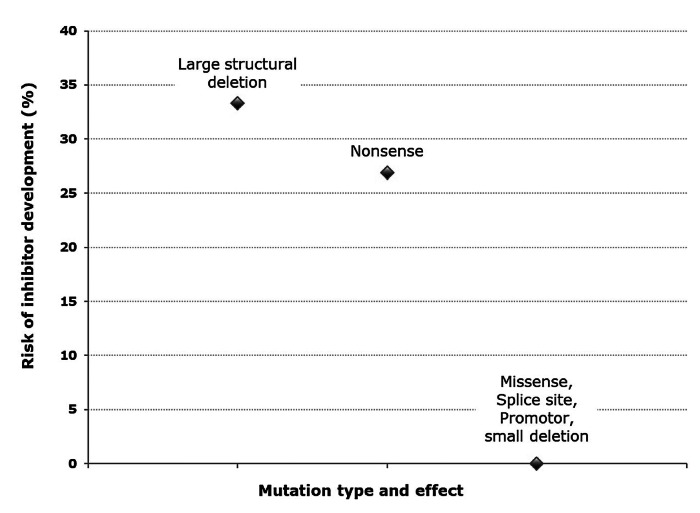
The incidence of FIX inhibitors in severe hemophilia B (SHB) is not well defined. Frequencies of 3-5% have been reported but most studies to date were small, including patients with different severities, and without prospective follow-up for inhibitor incidence. Study objective was to investigate inhibitor incidence in patients with SHB followed up to 500 exposure days (ED), the frequency of allergic reactions, and the relationship with genotypes. Consecutive previously untreated patients (PUPs) with SHB enrolled into the PedNet cohort were included. Detailed data was collected for the first 50 ED, followed by annual collection of inhibitor status and allergic reactions. Presence of inhibitors was defined by at least two consecutive positive samples. Additionally, data on factor IX gene mutation was collected. 154 PUPs with SHB were included; 75% were followed until 75 ED, and 43% until 500 ED. Inhibitors developed in 14 patients (7 high-titre). Median number of ED at inhibitor manifestation was 11 (IQR 6.5-36.5). Cumulative inhibitor incidence was 9.3% (95%CI 4.4-14.1) at 75 ED, and 10.2% (5.1-15.3) at 500 ED. Allergic reactions occurred in 4 (28.6%) inhibitor patients. Missense mutations were most frequent (46.8%) overall but not associated with inhibitors. Nonsense mutations and deletions with large structural changes comprised all mutations among inhibitor patients and were associated with an inhibitor risk of 26.9% and 33.3%, respectively. In an unselected, well-defined cohort of PUPs with SHB, cumulative inhibitor incidence was 10.2% at 500 ED. Nonsense mutations and large deletions were strongly associated with the risk of inhibitor development. The PedNet Registry is registered at clinicaltrials.gov; identifier: NCT02979119.
在重度乙型血友病 (SHB) 患者中,FIX 抑制剂的发病率尚未明确。据报道,其发病率为 3-5%,但迄今为止的大多数研究规模较小,包括不同严重程度的患者,且未对抑制剂的发病率进行前瞻性随访。本研究的目的是调查接受了 500 个暴露日 (ED) 随访的 SHB 患者的抑制剂发病率、过敏反应的发生频率,以及与基因型的关系。该研究纳入了来自 PedNet 队列的连续未经治疗的初治患者 (PUP)。在最初的 50 个 ED 中详细收集数据,之后每年收集抑制剂状态和过敏反应数据。至少连续两次阳性样本定义为存在抑制剂。此外,还收集了因子 IX 基因突变的数据。该研究共纳入了 154 例 SHB 的 PUP,其中 75% 随访至 75 ED,43% 随访至 500 ED。14 例患者 (7 例为高滴度) 出现了抑制剂。在出现抑制剂的患者中,中位 ED 数为 11(6.5-36.5)。在 75 ED 时,累积抑制剂发病率为 9.3% (95%CI 4.4-14.1),在 500 ED 时为 10.2% (5.1-15.3)。在出现抑制剂的患者中,有 4 例 (28.6%) 发生了过敏反应。错义突变总体上最为常见 (46.8%),但与抑制剂无关。无义突变和大结构改变缺失包含了所有抑制剂患者的突变,且与抑制剂风险分别为 26.9%和 33.3%相关。在一个未选择的、定义明确的 SHB PUP 队列中,在 500 ED 时累积抑制剂发病率为 10.2%。无义突变和大片段缺失与抑制剂发生风险密切相关。该 PedNet 登记处已在 clinicaltrials.gov 注册;标识符:NCT02979119。