Urology Department, Urology Research Institute, Organ Transplantation Centre, West China Hospital, Sichuan University, Chengdu, China.
Front Immunol. 2019 Dec 20;10:2912. doi: 10.3389/fimmu.2019.02912. eCollection 2019.
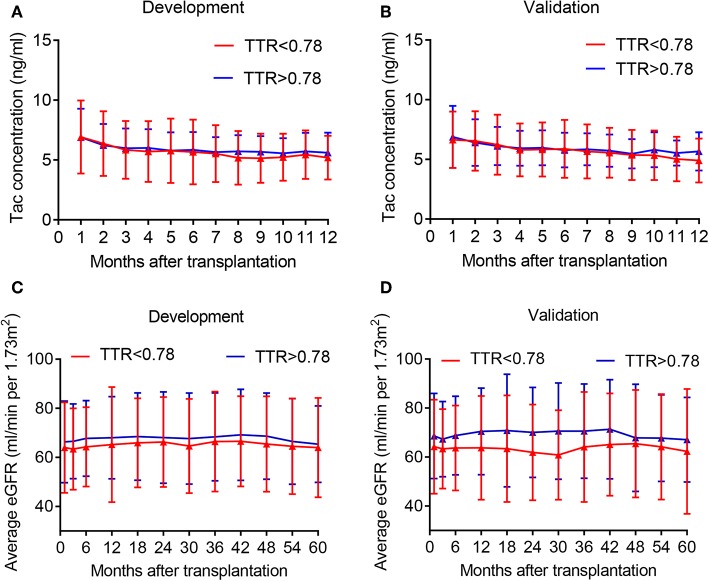
The aim of the present study was to investigate the impact of time in therapeutic range TTR on long-term outcomes of living kidney transplants. We included 1,241 living kidney transplants and randomized them into development and validation cohorts with a ratio of 2:1. The tacrolimus TTR percentage was calculated by linear interpolation with a target range (5-10 ng/ml months 0-3, 4-8 ng/ml months 4-12). The optimal TTR cutoff was estimated by the receiver operating characteristic curve analysis on the basis of acute rejection (AR) within 12 months in the development cohort. Outcomes were analyzed between patients with high TTR and low TTR in the development and validation cohorts, respectively. The TTR was also compared with other tacrolimus measures. The optimal TTR cutoff value was 78%. In the development cohort, patients with TTR > 78% had significantly higher rejection- and infection-free survival. TTR < 78% was an independent risk factor for AR (OR: 2.97, 95%CI: 1.82-4.84) and infection (OR: 1.55, 95%CI: 1.08-2.22). Patient and graft survival were significantly higher in those with TTR>78%, and TTR<78% was associated with graft loss (OR: 3.2, 95%CI: 1.38-7.42) and patient death (OR: 6.54, 95%CI: 1.34-31.77). These findings were confirmed in the validation cohort. Furthermore, we divided all included patients into a high and low TTR group. TTR was more strongly associated with patient and graft survival than mean level, standard deviation, and intrapatient variability (IPV). Increasing the TTR of tacrolimus in the first year was associated with improved long-term outcomes in living kidney transplants, and TTR may be a novel valuable strategy to monitor tacrolimus exposure.
本研究旨在探讨治疗范围内时间(TTR)对活体肾脏移植长期结局的影响。我们纳入了 1241 例活体肾脏移植,并将其随机分为开发和验证队列,比例为 2:1。他克莫司 TTR 百分比通过线性内插计算,目标范围为(5-10ng/ml 个月 0-3,4-8ng/ml 个月 4-12)。在开发队列中,基于 12 个月内急性排斥反应(AR),通过接收者操作特征曲线分析来估计最佳 TTR 截止值。在开发和验证队列中,分别分析高 TTR 和低 TTR 患者之间的结局。还比较了 TTR 与其他他克莫司指标的差异。最佳 TTR 截止值为 78%。在开发队列中,TTR>78%的患者排斥和感染无复发生存率显著较高。TTR<78%是 AR(OR:2.97,95%CI:1.82-4.84)和感染(OR:1.55,95%CI:1.08-2.22)的独立危险因素。TTR>78%的患者患者和移植物存活率显著较高,而 TTR<78%与移植物丢失(OR:3.2,95%CI:1.38-7.42)和患者死亡(OR:6.54,95%CI:1.34-31.77)相关。这些发现在验证队列中得到了证实。此外,我们将所有纳入的患者分为高 TTR 和低 TTR 组。与平均水平、标准差和患者内变异性(IPV)相比,TTR 与患者和移植物存活率的相关性更强。第一年增加他克莫司 TTR 与活体肾脏移植的长期结局改善相关,TTR 可能是监测他克莫司暴露的一种新的有价值策略。