Department of Hematology, Oncology, Rheumatology and Clinical Immunology, University Hospital Tübingen, Tübingen, Germany.
Department of Immunology, Institute for Cell Biology, University of Tübingen, Tübingen, Germany.
Front Immunol. 2019 Dec 20;10:3004. doi: 10.3389/fimmu.2019.03004. eCollection 2019.
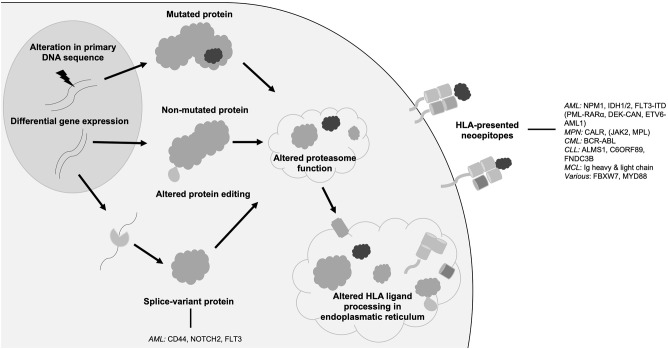
Neoantigens derive from non-synonymous somatic mutations in malignant cells. Recognition of neoantigens presented via human leukocyte antigen (HLA) molecules on the tumor cell surface by T cells holds promise to enable highly specific and effective anti-cancer immune responses and thus neoantigens provide an exceptionally attractive target for immunotherapy. While genome sequencing approaches already enable the reliable identification of somatic mutations in tumor samples, the identification of mutation-derived, naturally HLA-presented neoepitopes as targets for immunotherapy remains challenging, particularly in low mutational burden cancer entities, including hematological malignancies. Several approaches have been utilized to identify neoepitopes from primary tumor samples. Besides whole genome sequencing with subsequent prediction of potential mutation-derived HLA ligands, mass spectrometry (MS) allows for the only unbiased identification of naturally presented mutation-derived HLA ligands. The feasibility of characterizing and targeting these novel antigens has recently been demonstrated in acute myeloid leukemia (AML). Several immunogenic, HLA-presented peptides derived from mutated Nucleophosmin 1 (NPM1) were identified, allowing for the generation of T-cell receptor-transduced NPM1-specific T cells with anti-leukemic activity in a xenograft mouse model. Neoantigen-specific T-cell responses have also been identified for peptides derived from mutated isocitrate dehydrogenase (IDH), and specific T-cell responses could be induced by IDH peptide vaccination. In this review, we give a comprehensive overview on known neoantigens in hematological malignancies, present possible prediction and discovery tools and discuss their role as targets for immunotherapy approaches.
新抗原源自恶性细胞中的非同义体细胞突变。T 细胞识别肿瘤细胞表面 HLA 分子呈递的新抗原有望实现高度特异性和有效的抗肿瘤免疫反应,因此新抗原为免疫治疗提供了一个极具吸引力的目标。虽然基因组测序方法已经能够可靠地鉴定肿瘤样本中的体细胞突变,但作为免疫治疗靶点的突变衍生、天然 HLA 呈递的新表位的鉴定仍然具有挑战性,尤其是在突变负担低的癌症实体中,包括血液恶性肿瘤。已经采用了几种方法从原发性肿瘤样本中鉴定新表位。除了进行全基因组测序并随后预测潜在的突变衍生 HLA 配体外,质谱 (MS) 还允许唯一地无偏鉴定天然呈递的突变衍生 HLA 配体。这些新抗原的特征和靶向的可行性最近在急性髓系白血病 (AML) 中得到了证明。从突变核磷蛋白 1 (NPM1) 鉴定出几种免疫原性的 HLA 呈递肽,允许生成具有抗白血病活性的转导 NPM1 特异性 TCR 的 T 细胞,在异种移植小鼠模型中。还鉴定出源自突变异柠檬酸脱氢酶 (IDH) 的肽的新抗原特异性 T 细胞反应,并且可以通过 IDH 肽疫苗接种诱导特异性 T 细胞反应。在这篇综述中,我们全面概述了血液恶性肿瘤中的已知新抗原,介绍了可能的预测和发现工具,并讨论了它们作为免疫治疗方法靶点的作用。