Matthan Nirupa R, Wylie-Rosett Judith, Xue Xiaonan, Gao Qi, Groisman-Perelstein Adriana E, Diamantis Pamela M, Ginsberg Mindy, Mossavar-Rahmani Yasmin, Barger Kathryn, Lichtenstein Alice H
Cardiovascular Nutrition Laboratory, Jean Mayer USDA Human Nutrition Research Center on Aging at Tufts University, Boston, MA, USA.
Department of Epidemiology & Population Health, Albert Einstein College of Medicine, Bronx, NY, USA.
Curr Dev Nutr. 2019 Dec 2;4(1):nzz138. doi: 10.1093/cdn/nzz138. eCollection 2020 Jan.
Developing dietary strategies to prevent excess weight gain during childhood is critical to stem the current obesity epidemic and associated adverse cardiometabolic consequences.
We aimed to assess how participation in a family-based weight-management intervention affected nutrient biomarkers and cardiometabolic risk factors (CMRFs) in children (7-12 y old; = 321) with baseline BMI score (BMI) ≥85th percentile.
This was a secondary analysis from a randomized-controlled, parallel-arm clinical trial. Families of children, recruited from a largely Hispanic population, were assigned to Standard Care (SC; American Academy of Pediatrics overweight/obesity recommendations), or SC + Enhanced Program (SC + EP; 8 skill-building cores, monthly support sessions, targeted diet/physical activity strategies). Nutrient biomarkers (plasma carotenoids, fat-soluble vitamins, RBC fatty acid profiles, desaturase indexes) and CMRFs were measured in archived blood samples collected at baseline and the end of the 1-y intervention.
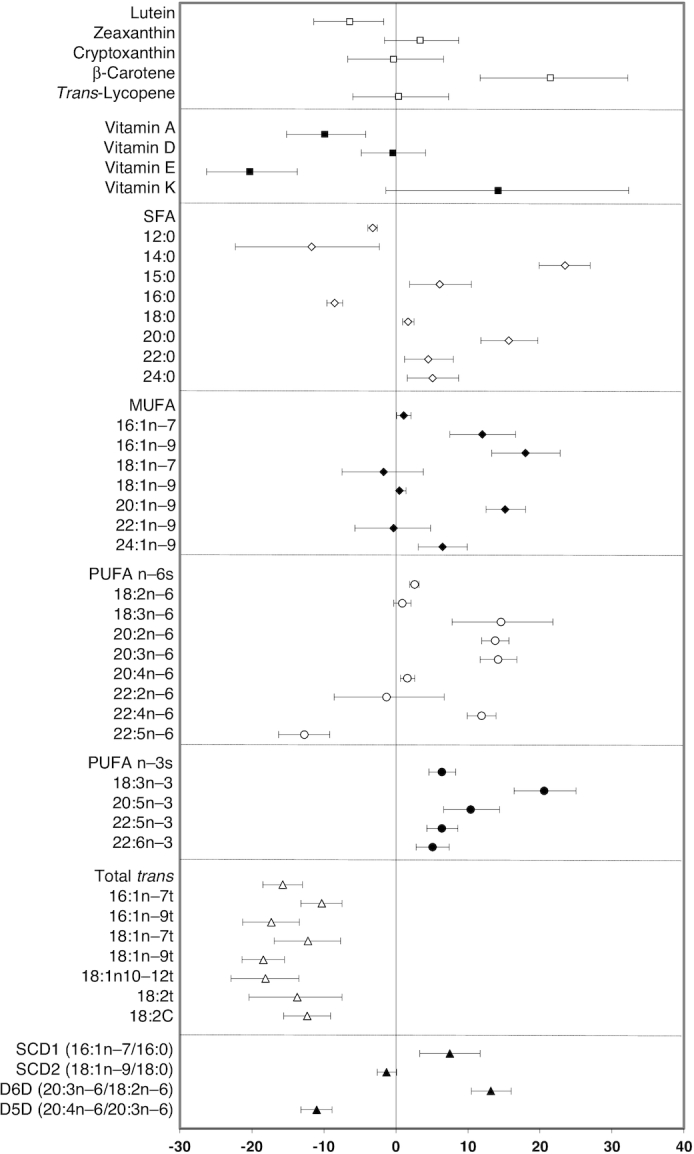
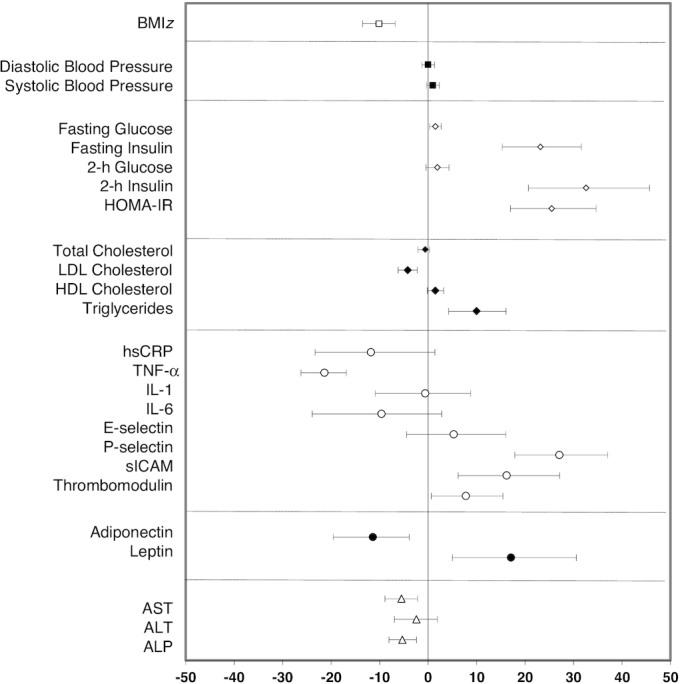
Children in both groups had significantly lower fatty acid and higher pentadecylic acid (15:0), PUFA n-3, and β-carotene concentrations, indicative of decreased hydrogenated fat and increased dairy, vegetable oil, fish, and fruit/vegetable intake, respectively. Similar changes were seen in de novo lipogenesis and desaturase indexes, as well as CMRFs (BMI, lipid profile, inflammation, adipokines, liver enzymes) in both groups. Using multiple logistic regression, increase in carotenoids and decrease in endogenously synthesized SFA, MUFA, PUFA n-6, and desaturase indexes were associated with improvements in BMI, blood pressure, lipid profile, glucose metabolism, inflammatory biomarkers, adipokines, and liver enzymes. fatty acids were associated with improvements in BMI, glucose metabolism, and leptin, with less favorable effects on inflammatory markers and adiponectin.
Providing targeted family-based behavioral counseling, as part of SC, can help overweight/obese children adopt healthier eating patterns that are associated with modest improvements in BMI and several CMRFs. Limited additional benefit was observed with SC + EP. These results provide critical data to design subsequent interventions to increase the impact of family-based obesity prevention programs.This trial was registered at clinicaltrials.gov as NCT00851201.
制定饮食策略以预防儿童期体重过度增加对于遏制当前的肥胖流行及相关不良心脏代谢后果至关重要。
我们旨在评估参与一项基于家庭的体重管理干预措施如何影响基线BMI z评分(BMI)≥第85百分位数的7至12岁儿童(n = 321)的营养生物标志物和心脏代谢风险因素(CMRFs)。
这是一项来自随机对照平行组临床试验的二次分析。从主要为西班牙裔的人群中招募的儿童家庭被分配至标准护理组(SC;美国儿科学会超重/肥胖推荐方案)或标准护理 + 强化项目组(SC + EP;8个技能培养核心、每月支持课程、针对性的饮食/身体活动策略)。在基线和1年干预结束时采集的存档血样中测量营养生物标志物(血浆类胡萝卜素、脂溶性维生素、红细胞脂肪酸谱、去饱和酶指数)和CMRFs。
两组儿童的γ-亚麻酸显著降低,十五烷酸(15:0)、多不饱和脂肪酸n-3和β-胡萝卜素浓度升高,分别表明氢化脂肪减少以及乳制品、植物油、鱼类和水果/蔬菜摄入量增加。两组在从头脂肪生成、去饱和酶指数以及CMRFs(BMI、血脂谱、炎症、脂肪因子、肝酶)方面均出现了类似变化。使用多元逻辑回归分析,类胡萝卜素增加以及内源性合成的饱和脂肪酸、单不饱和脂肪酸、多不饱和脂肪酸n-6和去饱和酶指数降低与BMI、血压、血脂谱、葡萄糖代谢、炎症生物标志物、脂肪因子和肝酶的改善相关。γ-亚麻酸与BMI、葡萄糖代谢和瘦素的改善相关,对炎症标志物和脂联素的影响较小。
作为标准护理措施的一部分,提供针对性的基于家庭的行为咨询可帮助超重/肥胖儿童采用更健康的饮食模式,这与BMI和多种CMRFs的适度改善相关。SC + EP组观察到的额外益处有限。这些结果为设计后续干预措施以增强基于家庭的肥胖预防项目的效果提供了关键数据。本试验在clinicaltrials.gov上注册,注册号为NCT00851201。