Department of Periodontics, School of Stomatology, China Medical University, Shenyang, China.
Int J Oral Sci. 2020 Jan 14;12(1):4. doi: 10.1038/s41368-019-0071-0.
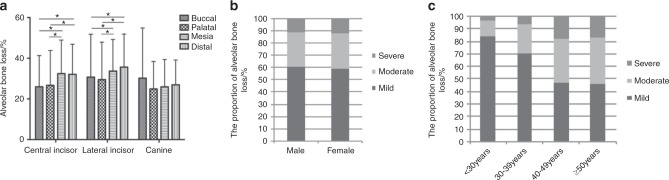
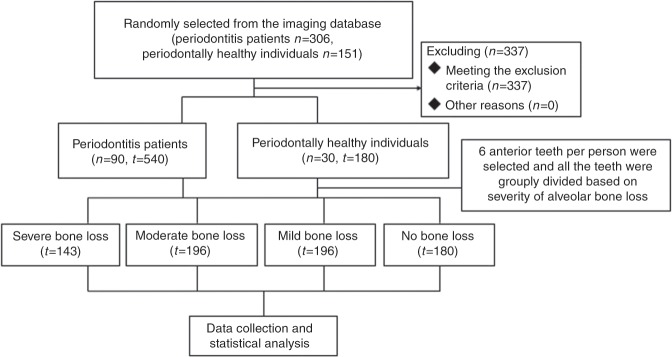
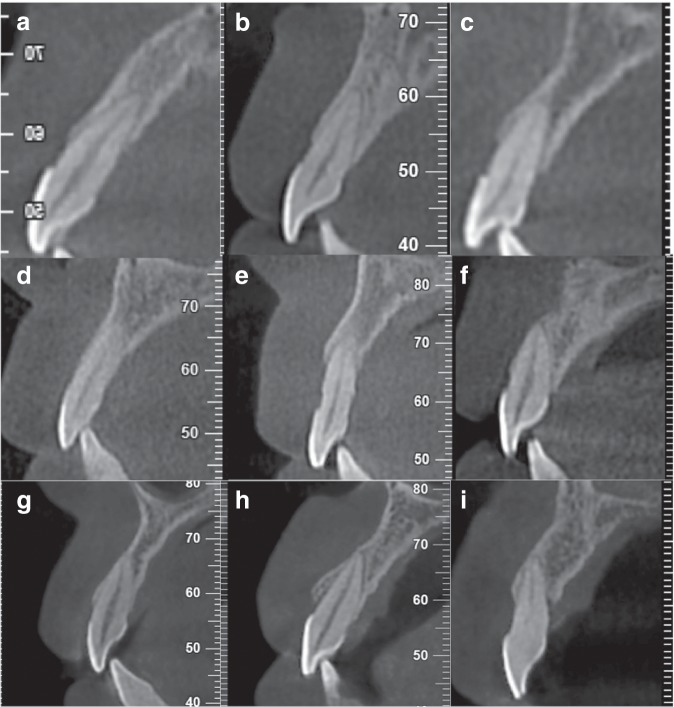
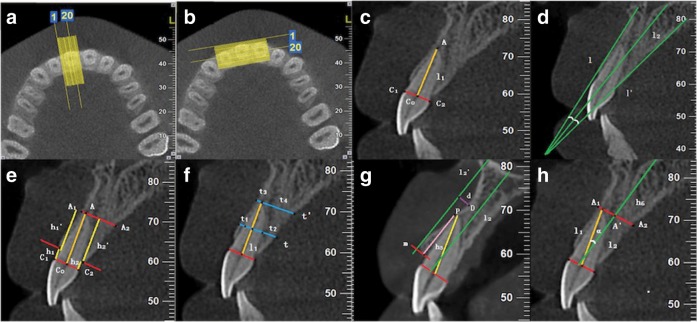
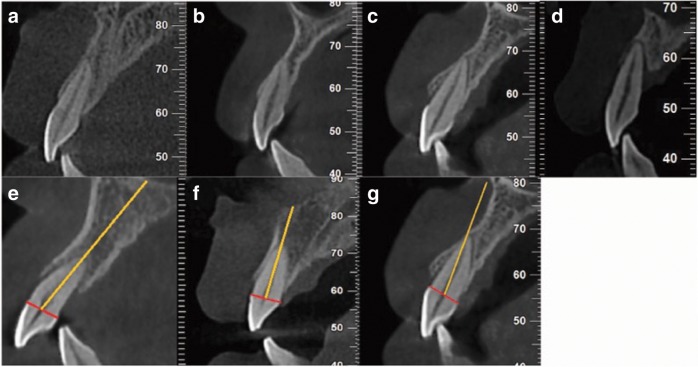
The morphology of the alveolar bone at the maxillary anterior teeth in periodontitis patients was evaluated by cone-beam computed tomography (CBCT) to investigate the distribution of alveolar defects and provide guidance for clinical practice. Ninety periodontitis patients and 30 periodontally healthy individuals were selected to determine the morphology of the alveolar bone at the maxillary anterior teeth according to the degree of bone loss, tooth type, sex and age. The differences in the dimensions between periodontitis patients and healthy individuals were compared, and the distribution of alveolar bone defects was analyzed. A classification system was established regarding the sagittal positions and angulations of the teeth. The buccal residual bone was thicker and the lingual bone was thinner in the periodontitis patients than in the periodontally healthy individuals, and there were differences between the different tooth types, sexes and age subgroups. The buccal undercut was close to the alveolar ridge, while fenestration was reduced and the apical bone height was higher in periodontitis patients than in periodontally healthy individuals. The apical bone height increased with the aggravation of bone loss and age. The proportions of different sagittal positions changed with the aggravation of bone loss. Moreover, the teeth moved more buccally regarding the positions of the maxillary anterior teeth. The morphology of the alveolar bone at the maxillary anterior teeth differed between periodontitis patients and healthy individuals, and the differences were related to the degree of bone loss, tooth type, sex and age.
通过锥形束 CT(CBCT)评估牙周炎患者上颌前牙牙槽骨的形态,以研究牙槽骨缺损的分布情况,为临床实践提供指导。选取 90 例牙周炎患者和 30 例牙周健康者,根据骨丧失程度、牙型、性别和年龄确定上颌前牙牙槽骨的形态。比较牙周炎患者与健康者之间各维度的差异,分析牙槽骨缺损的分布情况。建立了一种关于牙齿矢状位置和倾斜度的分类系统。与牙周健康者相比,牙周炎患者的颊侧剩余骨较厚,舌侧骨较薄,不同牙型、性别和年龄亚组之间存在差异。颊侧骨缺损接近牙槽嵴,而牙周炎患者的开窗减少,根尖骨高度增加。根尖骨高度随骨丧失和年龄的加重而增加。不同矢状位置的比例随骨丧失程度的加重而变化。此外,上颌前牙的位置移动更偏向颊侧。牙周炎患者和健康者上颌前牙牙槽骨形态不同,差异与骨丧失程度、牙型、性别和年龄有关。