Reeder Sophia M, Reuschel Emma L, Bah Mamadou A, Yun Kun, Tursi Nicholas J, Kim Kevin Y, Chu Jacqueline, Zaidi Faraz I, Yilmaz Ilknur, Hart Robert J, Perrin Benjamin, Xu Ziyang, Humeau Laurent, Weiner David B, Aly Ahmed S I
The Vaccine Center, Wistar Institute, Philadelphia, PA 19104, USA.
Perelman School of Medicine, University of Pennsylvania, Philadelphia, PA 19104, USA.
Vaccines (Basel). 2020 Jan 10;8(1):21. doi: 10.3390/vaccines8010021.
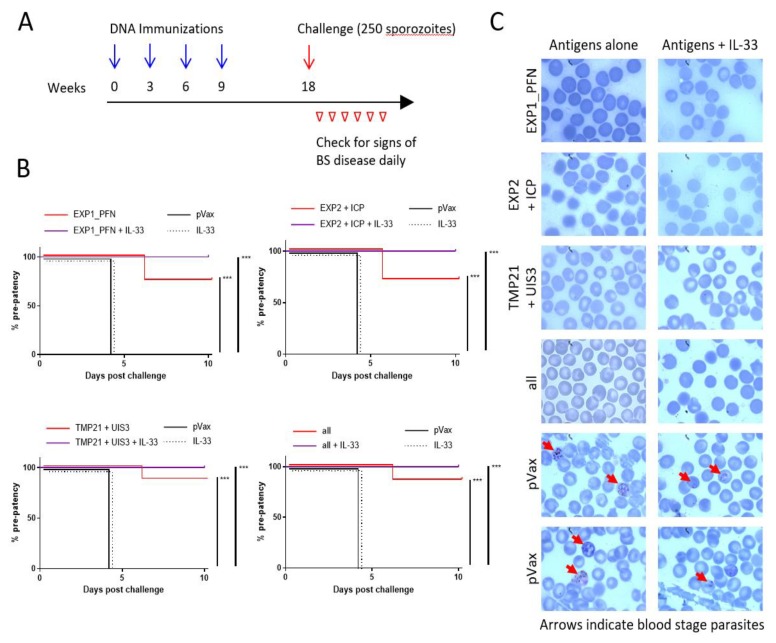
The need for a malaria vaccine is indisputable. A single vaccine for pre-erythrocytic stages targeting the major sporozoite antigen circumsporozoite protein (CSP) has had partial success. Additionally, CD8+ T cells targeting liver-stage (LS) antigens induced by live attenuated sporozoite vaccines were associated with protection in human challenge experiments. To further evaluate protection mediated by LS antigens, we focused on exported pre-erythrocytic proteins (exported protein 1 (EXP1), profilin (PFN), exported protein 2 (EXP2), inhibitor of cysteine proteases (ICP), transmembrane protein 21 (TMP21), and upregulated in infective sporozoites-3 (UIS3)) expressed in all species and designed optimized, synthetic DNA (synDNA) immunogens. SynDNA antigen cocktails were tested with and without the molecular adjuvant plasmid IL-33. Immunized animals developed robust T cell responses including induction of antigen-specific liver-localized CD8+ T cells, which were enhanced by the co-delivery of plasmid IL-33. In total, 100% of mice in adjuvanted groups and 71%-88% in non-adjuvanted groups were protected from blood-stage disease following sporozoite challenge. This study supports the potential of synDNA LS antigens as vaccine components for malaria parasite infection.
疟疾疫苗的需求是无可争议的。一种针对主要子孢子抗原环子孢子蛋白(CSP)的用于红细胞前期阶段的单一疫苗已取得部分成功。此外,减毒活子孢子疫苗诱导的靶向肝期(LS)抗原的CD8 + T细胞在人体激发实验中与保护作用相关。为了进一步评估LS抗原介导的保护作用,我们聚焦于在所有物种中均表达的输出性红细胞前期蛋白(输出蛋白1(EXP1)、肌动蛋白结合蛋白(PFN)、输出蛋白2(EXP2)、半胱氨酸蛋白酶抑制剂(ICP)、跨膜蛋白21(TMP21)以及感染性子孢子中上调蛋白3(UIS3)),并设计了优化的合成DNA(synDNA)免疫原。对含有和不含有分子佐剂质粒IL-33的synDNA抗原混合物进行了测试。免疫动物产生了强烈的T细胞反应,包括诱导抗原特异性肝定位CD8 + T细胞,质粒IL-33的共同递送增强了这种反应。在子孢子攻击后,佐剂组中100%的小鼠以及非佐剂组中71%-88%的小鼠免受血期疾病的侵害。本研究支持了synDNA LS抗原作为疟原虫感染疫苗成分的潜力。