Vaccine and Immunotherapy Center, The Wistar Institute, Philadelphia, PA 19104, United States; Perelman School of Medicine, University of Pennsylvania, Philadelphia, PA 19104, United States.
Inovio Pharmaceuticals, Plymouth Meeting, PA 19422, United States.
EBioMedicine. 2018 Sep;35:97-105. doi: 10.1016/j.ebiom.2018.08.027. Epub 2018 Aug 30.
Despite vigorous and ongoing efforts, active immunizations have yet to induce broadly neutralizing antibodies (bNAbs) against HIV-1. An alternative approach is to achieve prophylaxis with long-term expression of potent biologic HIV-1 inhibitors with Adeno-associated Virus (AAV), which could however be limited by hosts' humoral and cellular responses. An approach that facilitates in vivo production of these complex molecules independent of viral-vectored delivery will be a major advantage.
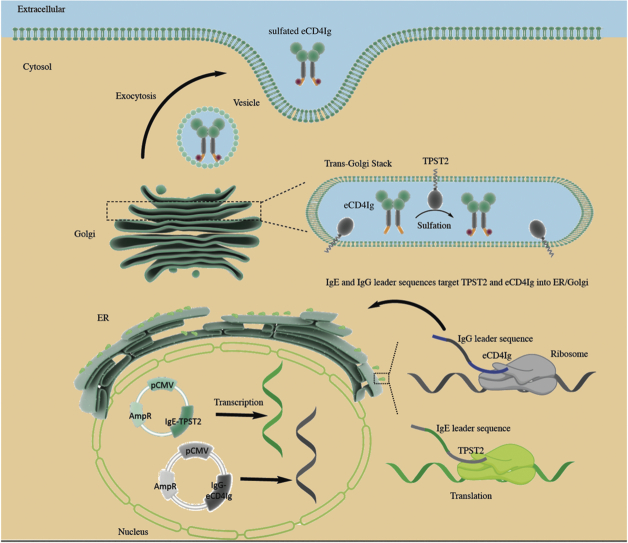
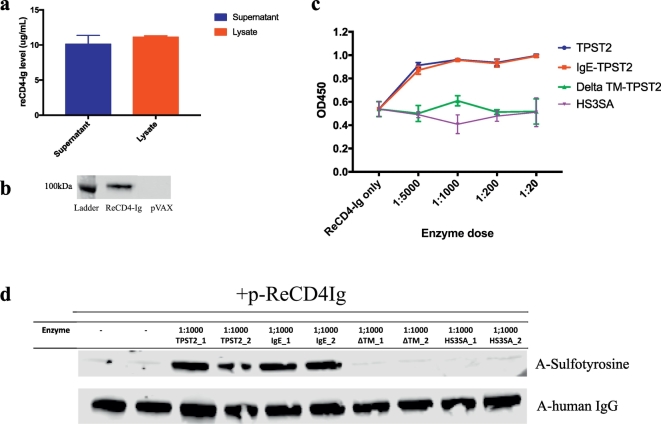
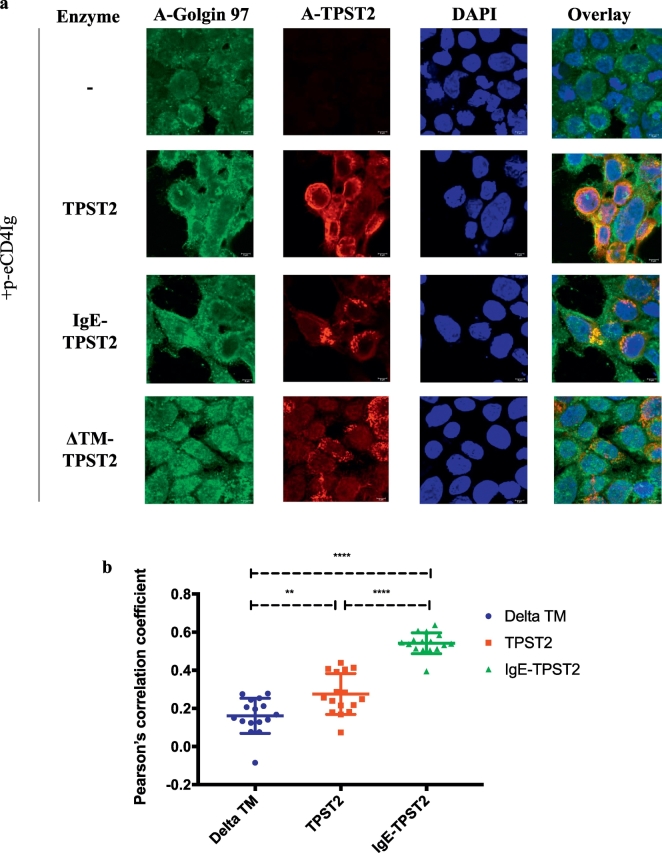
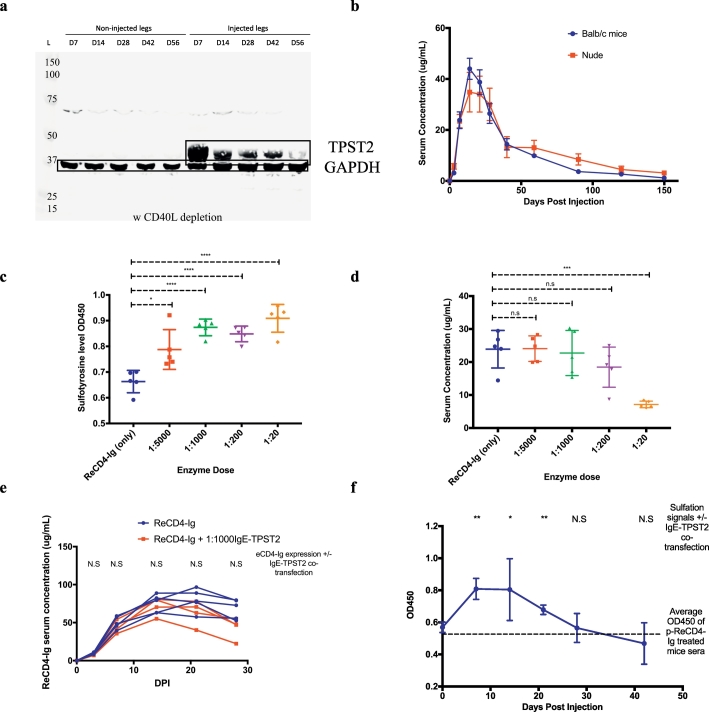
We used synthetic DNA and electroporation (DNA/EP) to deliver an anti-HIV-1 immunoadhesin eCD4-Ig in vivo. In addition, we engineered a TPST2 enzyme variant (IgE-TPST2), characterized its intracellular trafficking patterns and determined its ability to post-translationally sulfate eCD4-Ig in vivo.
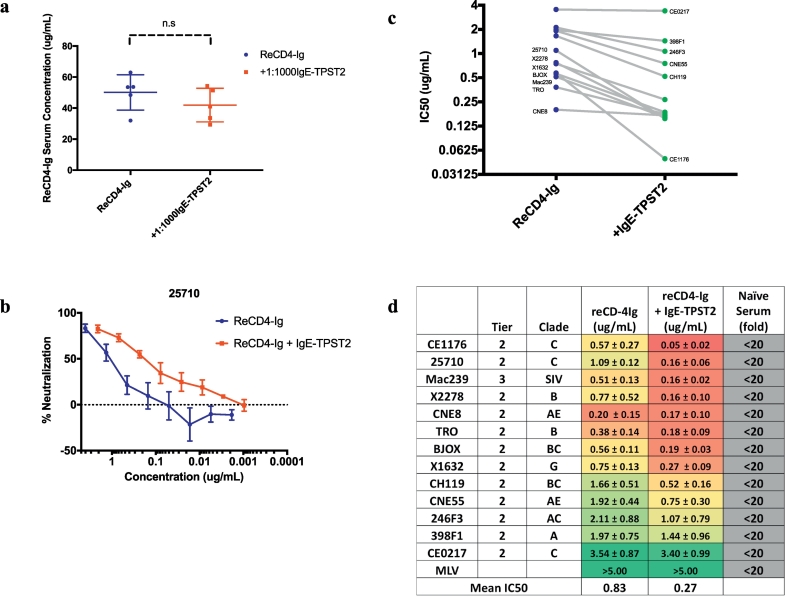
With a single round of DNA injection, a peak expression level of 80-100μg/mL was observed in mice 14 days post injection (d.p.i). The engineered IgE-TPST2 enzyme trafficked efficiently to the Trans-Golgi Network (TGN). Co-administrating low dose of plasmid IgE-TPST2 with plasmid eCD4-Ig enhanced the potency of eCD4-Ig by three-fold in the ex vivo neutralization assay against the global panel of HIV-1 pseudoviruses.
This work provides a proof-of-concept for delivering anti-HIV-1 immunoadhesins by advanced nucleic acid technology and modulating protein functions in vivo with targeted enzyme-mediated post-translational modifications.
This work is supported by NIH IPCAVD Grant U19 Al109646-04, Martin Delaney Collaboration for HIV Cure Research and W.W. Smith Charitable Trust.
尽管进行了积极且持续的努力,但主动免疫仍未能诱导针对 HIV-1 的广泛中和抗体 (bNAbs)。另一种方法是通过腺相关病毒 (AAV) 长期表达有效的生物 HIV-1 抑制剂来实现预防,然而,这可能会受到宿主体液和细胞反应的限制。一种能够促进这些复杂分子在体内产生而不依赖于病毒载体递送的方法将是一个主要优势。
我们使用合成 DNA 和电穿孔 (DNA/EP) 在体内递送抗 HIV-1 免疫黏附蛋白 eCD4-Ig。此外,我们设计了一种 TPST2 酶变体 (IgE-TPST2),研究了其细胞内运输模式,并确定了其在体内对 eCD4-Ig 进行翻译后硫酸化的能力。
在单次 DNA 注射后,在注射后 14 天(d.p.i),小鼠中观察到 80-100μg/mL 的峰值表达水平。工程化的 IgE-TPST2 酶有效地运输到 Trans-Golgi Network (TGN)。与质粒 eCD4-Ig 共同给予低剂量的质粒 IgE-TPST2 在体外中和试验中增强了 eCD4-Ig 对全球 HIV-1 假病毒组的效力,增强了三倍。
这项工作为通过先进的核酸技术递送抗 HIV-1 免疫黏附蛋白并通过靶向酶介导的翻译后修饰在体内调节蛋白功能提供了概念验证。
这项工作得到 NIH IPCAVD 授予 U19 Al109646-04、Martin Delaney 合作治疗 HIV 治愈研究和 W.W. Smith 慈善信托基金的支持。