National Institute of Insurance against Accidents at Work-Department of Occupational and Environmental Medicine, Epidemiology and Hygiene, 00078 Monte Porzio Catone, Italy.
Unit of Obstetrics and Gynecology, San Raffaele Scientific Institute, 20132 Milan, Italy.
Int J Environ Res Public Health. 2020 Jan 13;17(2):489. doi: 10.3390/ijerph17020489.
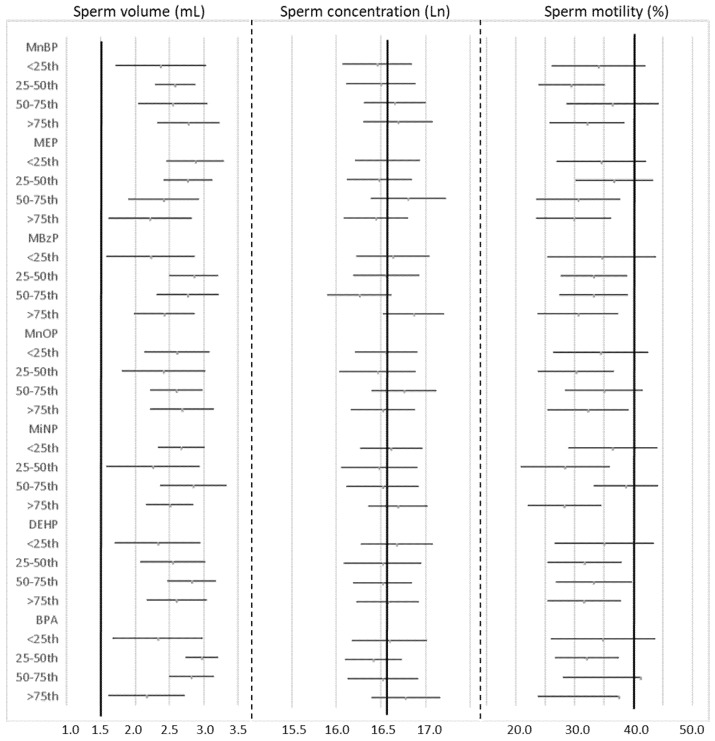
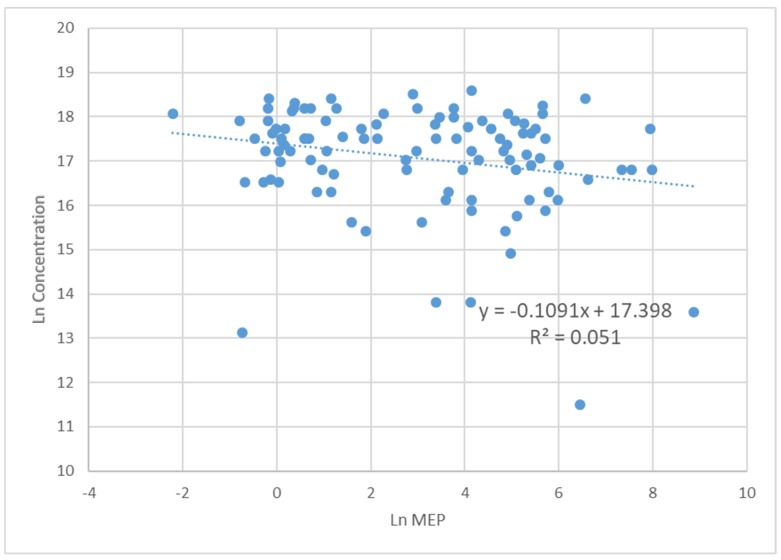
Among the possible risk factors for male reproduction, exposure to phthalates and alkylphenols is widely documented. This study evaluated the possible association between chemical exposure and the quality of the seminal fluid of 105 subjects in a fertility clinic. The urinary levels of seven phthalate metabolites (monoethylphthalate, MEP; monobenzylphthalate, MBzP; mono -butylphthalate, MnBP; mono-(2-ethylhexyl) phthalate, MEHP; mono(2-ethyl-5-hydroxyhexyl) phthalate, MEHHP; mono--octylphthalate, MnOP; mono-isononylphthalate, MiNP) and bisphenol A (BPA), were analysed by high performance liquid chromatography/tandem mass spectrometry HPLC/MS/MS. The regression analysis showed that the semen volume was positively associated with MnBP, MnOP and BPA levels while was negatively associated with MiNP levels. The sperm concentration had a significant inverse relationship with MEP levels. A negative association was found between the use of plastic containers for food storage ( = 0.037) and semen volume (3.06 vs. 2.30 mL as average values, never vs daily). A significant positive correlation emerged ( < 0.005) between the consumption of canned food and the levels of BPA (2.81 vs. 0.14 µg/g creat as average values, daily vs. never) and between the use of perfumes and levels of MEP (389.86 vs. 48.68 µg/g creat, as average values, daily vs. never). No further statistically significant associations were found, even considering the working activity. Some evidence emerged about the possible link between exposure and seminal fluid quality: further case/control or prospective studies will allow us to confirm this causality hypothesis.
在男性生殖的可能风险因素中,邻苯二甲酸酯和烷基酚的暴露已被广泛记录。本研究评估了化学暴露与 105 名生育诊所患者精液质量之间的可能关联。通过高效液相色谱/串联质谱法(HPLC/MS/MS)分析了 7 种邻苯二甲酸酯代谢物(单乙基邻苯二甲酸酯,MEP;单苄基邻苯二甲酸酯,MBzP;单丁基邻苯二甲酸酯,MnBP;单-(2-乙基己基)邻苯二甲酸酯,MEHP;单-(2-乙基-5-羟基己基)邻苯二甲酸酯,MEHHP;单-辛基邻苯二甲酸酯,MnOP;单-异壬基邻苯二甲酸酯,MiNP)和双酚 A(BPA)的尿液水平。回归分析表明,精液量与 MnBP、MnOP 和 BPA 水平呈正相关,与 MiNP 水平呈负相关。精子浓度与 MEP 水平呈显著负相关。使用塑料容器储存食物( = 0.037)与精液量(3.06 与 2.30 毫升的平均值,从不与每天)呈负相关。罐头食品的消费与 BPA 水平(2.81 与 0.14 µg/g 肌酐作为平均值,每天与从不)和香水的使用与 MEP 水平(389.86 与 48.68 µg/g 肌酐作为平均值,每天与从不)之间存在显著正相关( < 0.005)。即使考虑到工作活动,也没有发现其他具有统计学意义的关联。一些证据表明暴露与精液质量之间可能存在联系:进一步的病例/对照或前瞻性研究将使我们能够证实这一因果关系假说。