Center for Hearing and Deafness and Department of Communicative Disorders and Sciences, University at Buffalo, Buffalo, NY, 14214, USA.
Department of Pharmaceutical Sciences, College of Pharmacy, University of Nebraska Medical Center, Omaha, NE, 68198, USA.
Hear Res. 2020 Mar 15;388:107880. doi: 10.1016/j.heares.2019.107880. Epub 2020 Jan 3.
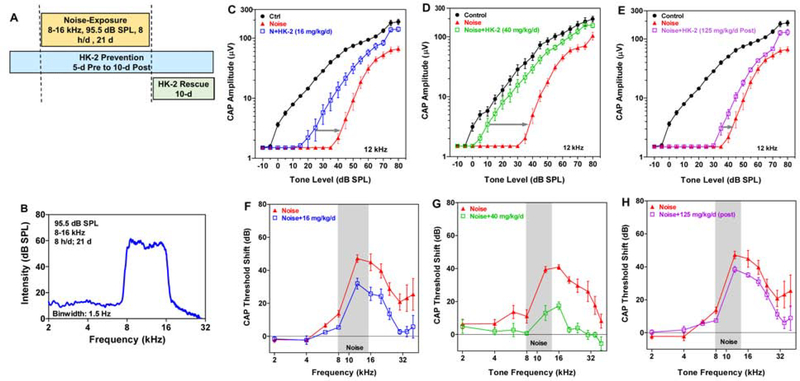
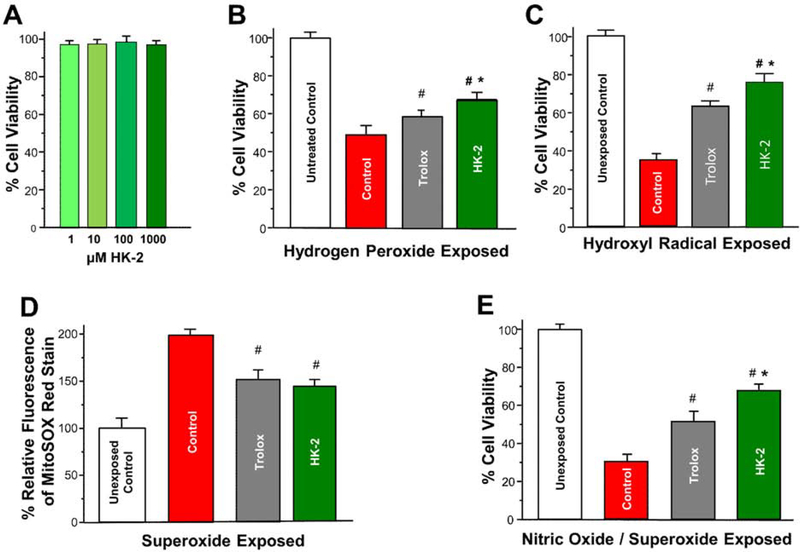
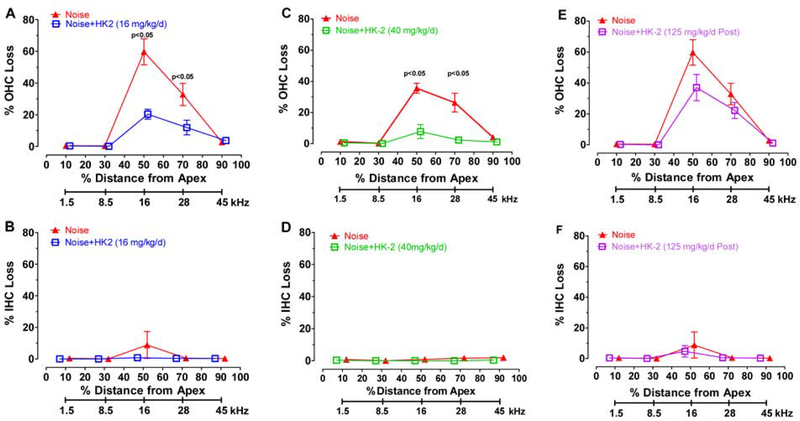
Oxidative stress is a major contributor to noise-induced hearing loss, the most common cause of hearing loss among military personnel and young adults. HK-2 is a potent, orally-active, multifunctional, redox-modulating drug that has been shown to protect against a wide range of neurological disorders with no observed side effects. HK-2 protected cochlear HEI-OC1 cells against various forms of experimentally-induced oxidative stressors similar to those observed during and after intense noise exposure. The mechanisms by which HK-2 protects cells is twofold, first by its ability to reduce oxidative stress generated by free radicals, and second, by its ability to complex biologically active transition metals such as Fe, thus reducing their availability to participate in the Fenton reaction where highly toxic hydroxyl radicals are generated. For the rat in vivo studies, HK-2 provided significant protection against noise-induced hearing loss and hair cell loss. Noise-induced hearing loss was induced by an 8-16 kHz octave band noises presented for 8 h/d for 21 days at an intensity of 95 dB SPL. In the Prevention study, HK-2 was administered orally beginning 5 days before the start of the noise and ending 10 days after the noise. Treatment with HK-2 dose-dependently reduced the amount of noise-induced hearing impairment, reflected in the cochlear compound action potential, and noise-induced hair cell loss. In a subsequent Rescue experiment in which HK-2 was administered for 10 days starting after the noise was turned off, HK-2 also significantly reduced the amount of hearing impairment, but the effect size was substantially less than in the Prevention studies. HK-2 alone did not adversely affect HEI-OC1 cell viability, nor did it cause any adverse changes in rat body weight, behavior, cochlear function or hair cell integrity. Thus, HK-2 is a novel, safe, orally-deliverable and highly effective otoprotective compound with considerable potential for preventing hearing loss from noise and other hearing disorders linked to excessive oxidative stress.
氧化应激是噪声性听力损失的主要原因,也是军事人员和年轻人听力损失的最常见原因。HK-2 是一种有效的、口服活性的、多功能的、氧化还原调节药物,已被证明可预防多种神经紊乱,且无观察到的副作用。HK-2 可保护耳蜗 HEI-OC1 细胞免受各种形式的实验性氧化应激,这些应激类似于在强烈噪声暴露期间和之后观察到的应激。HK-2 保护细胞的机制有两种,首先是通过其减少自由基产生的氧化应激的能力,其次是通过其与生物活性过渡金属(如 Fe)络合的能力,从而降低它们参与 Fenton 反应的能力,在 Fenton 反应中会产生高毒性的羟自由基。在体内大鼠研究中,HK-2 对噪声性听力损失和毛细胞损失提供了显著的保护。噪声性听力损失是通过 8-16 kHz 倍频带噪声以 95 dB SPL 的强度每天 8 小时暴露 21 天诱导的。在预防研究中,HK-2 在噪声开始前 5 天开始口服给药,并在噪声结束后 10 天结束。HK-2 的剂量依赖性治疗降低了噪声诱导的听力损伤的程度,这反映在耳蜗复合动作电位和噪声诱导的毛细胞损失中。在随后的挽救实验中,在关闭噪声后开始用 HK-2 治疗 10 天,HK-2 也显著降低了听力损伤的程度,但效果明显小于预防研究。HK-2 本身不会对 HEI-OC1 细胞活力产生不利影响,也不会导致大鼠体重、行为、耳蜗功能或毛细胞完整性的任何不良变化。因此,HK-2 是一种新型、安全、可口服和高效的耳保护化合物,具有预防噪声性听力损失和其他与过度氧化应激相关的听力障碍的巨大潜力。