Department of Otolaryngology, Sun Yat-sen Memorial Hospital, Sun Yat-sen University, Guangzhou, Guangdong, China; Guangdong Provincial Key Laboratory of Malignant Tumor Epigenetics and Gene Regulation, Sun Yat-sen Memorial Hospital, Sun Yat-sen University, Guangzhou, Guangdong, China; Institute of Hearing and Speech-Language Science, Sun Yat-sen University, Guangzhou 510120, China; Department of Pathology and Laboratory Medicine, The Medical University of South Carolina, Charleston, SC, USA.
Department of Otolaryngology, Sun Yat-sen Memorial Hospital, Sun Yat-sen University, Guangzhou, Guangdong, China; Shenshan Medical Center, Memorial Hospital of Sun Yat-sen University, Shanwei, Guangdong, China; Institute of Hearing and Speech-Language Science, Sun Yat-sen University, Guangzhou 510120, China.
Biomed Pharmacother. 2023 Oct;166:115399. doi: 10.1016/j.biopha.2023.115399. Epub 2023 Aug 31.
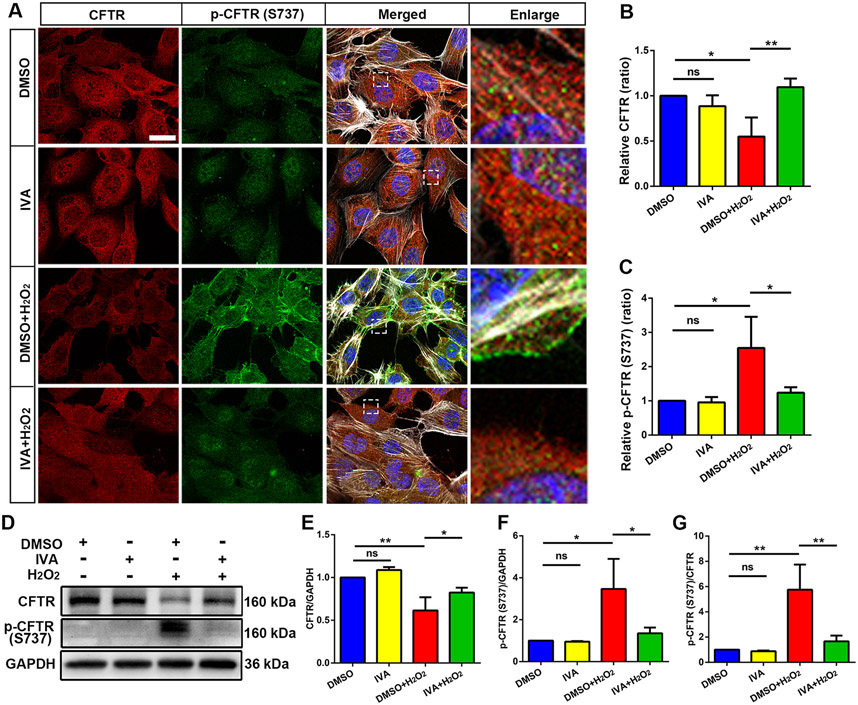
Over-production of reactive oxygen species (ROS) in the inner ear can be triggered by a variety of pathological events identified in animal models after traumatic noise exposure. Our previous research found that inhibition of the AMP-activated protein kinase alpha subunit (AMPKα) protects against noise-induced cochlear hair cell loss and hearing loss by reducing ROS accumulation. However, the molecular pathway through which AMPKα exerts its antioxidative effect is still unclear. In this study, we have investigated a potential target of AMPKα and ROS, cystic fibrosis transmembrane conductance regulator (CFTR), and the protective effect against noise-induced hair cell loss of an FDA-approved CFTR potentiator, ivacaftor, in FVB/NJ mice, mouse explant cultures, and HEI-OC1 cells. We found that noise exposure increases phosphorylation of CFTR at serine 737 (p-CFTR, S737), which reduces wildtype CFTR function, resulting in oxidative stress in cochlear sensory hair cells. Pretreatment with a single dose of ivacaftor maintains CFTR function by preventing noise-increased p-CFTR (S737). Furthermore, ivacaftor treatment increases nuclear factor E2-related factor 2 (Nrf2) expression, diminishes ROS formation, and attenuates noise-induced hair cell loss and hearing loss. Additionally, inhibition of noise-induced AMPKα activation by compound C also diminishes p-CFTR (S737) expression. In line with these in-vivo results, administration of hydrogen peroxide to cochlear explants or HEI-OC1 cells increases p-CFTR (S737) expression and induces sensory hair cell or HEI-OC1 cell damage, while application of ivacaftor halts these effects. Although ivacaftor increases Nrf2 expression and reduces ROS accumulation, cotreatment with ML385, an Nrf2 inhibitor, abolishes the protective effects of ivacaftor against hydrogen-peroxide-induced HEI-OC1 cell death. Our results indicate that noise-induced sensory hair cell damage is associated with p-CFTR. Ivacaftor has potential for treatment of noise-induced hearing loss by maintaining CFTR function and increasing Nrf2 expression for support of redox homeostasis in sensory hair cells.
内耳中活性氧(ROS)的过度产生可能由创伤性噪声暴露后在动物模型中鉴定的各种病理事件引发。我们之前的研究发现,通过减少 ROS 积累,抑制 AMP 激活的蛋白激酶α亚单位(AMPKα)可防止噪声引起的耳蜗毛细胞损失和听力损失。然而,AMPKα发挥其抗氧化作用的分子途径仍不清楚。在这项研究中,我们研究了 AMPKα和 ROS 的一个潜在靶点囊性纤维化跨膜电导调节剂(CFTR),以及 FDA 批准的 CFTR 增效剂 ivacaftor 对噪声诱导的毛细胞损失的保护作用,在 FVB/NJ 小鼠、小鼠外植体培养物和 HEI-OC1 细胞中。我们发现,噪声暴露会增加 CFTR 丝氨酸 737 位的磷酸化(p-CFTR,S737),从而降低野生型 CFTR 的功能,导致耳蜗感觉毛细胞发生氧化应激。单次给予 ivacaftor 预处理可通过防止噪声增加的 p-CFTR(S737)来维持 CFTR 功能。此外,ivacaftor 处理增加核因子 E2 相关因子 2(Nrf2)的表达,减少 ROS 的形成,并减轻噪声诱导的毛细胞损失和听力损失。此外,化合物 C 抑制噪声诱导的 AMPKα激活也会减少 p-CFTR(S737)的表达。与这些体内结果一致,给予耳蜗外植体或 HEI-OC1 细胞过氧化氢会增加 p-CFTR(S737)的表达并诱导感觉毛细胞或 HEI-OC1 细胞损伤,而给予 ivacaftor 可阻止这些作用。虽然 ivacaftor 增加 Nrf2 的表达并减少 ROS 的积累,但 Nrf2 抑制剂 ML385 的共同处理会消除 ivacaftor 对过氧化氢诱导的 HEI-OC1 细胞死亡的保护作用。我们的结果表明,噪声诱导的感觉毛细胞损伤与 p-CFTR 有关。通过维持 CFTR 功能和增加 Nrf2 表达以支持感觉毛细胞的氧化还原稳态,ivacaftor 具有治疗噪声性听力损失的潜力。