Department of Medical Biochemistry and Biophysics, Umeå University, SE-901 87 Umeå, Sweden.
Clinical Memory Research Unit, Department of Clinical Sciences Malmö, Lund University, 21428 Malmö, Sweden.
Biomolecules. 2020 Jan 14;10(1):134. doi: 10.3390/biom10010134.
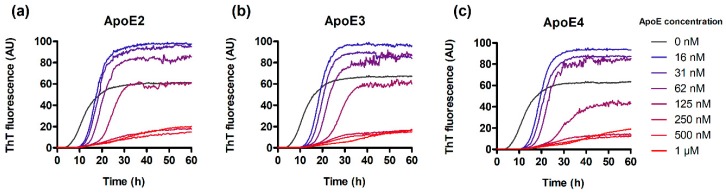
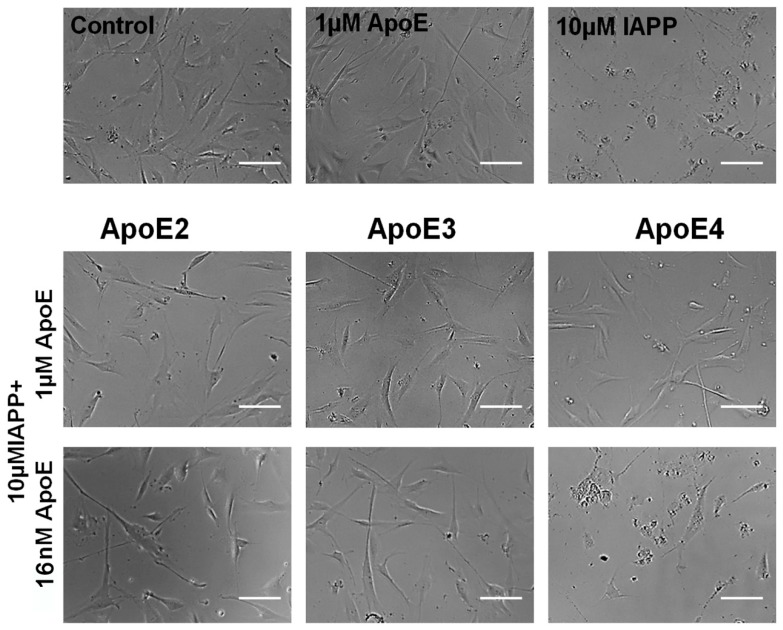
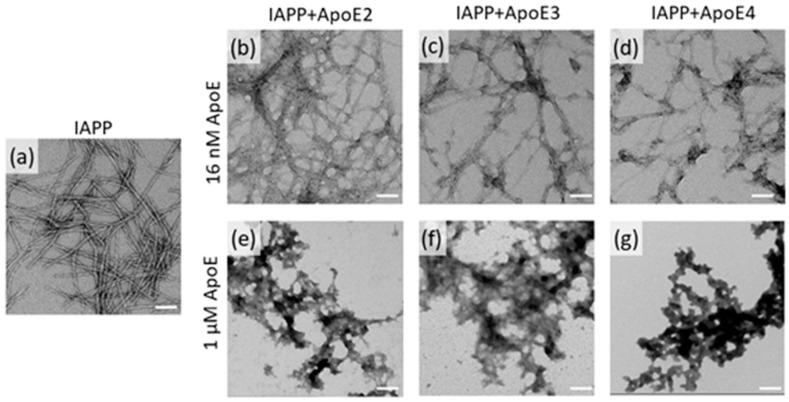
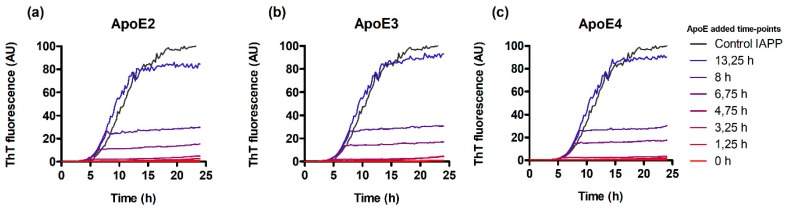
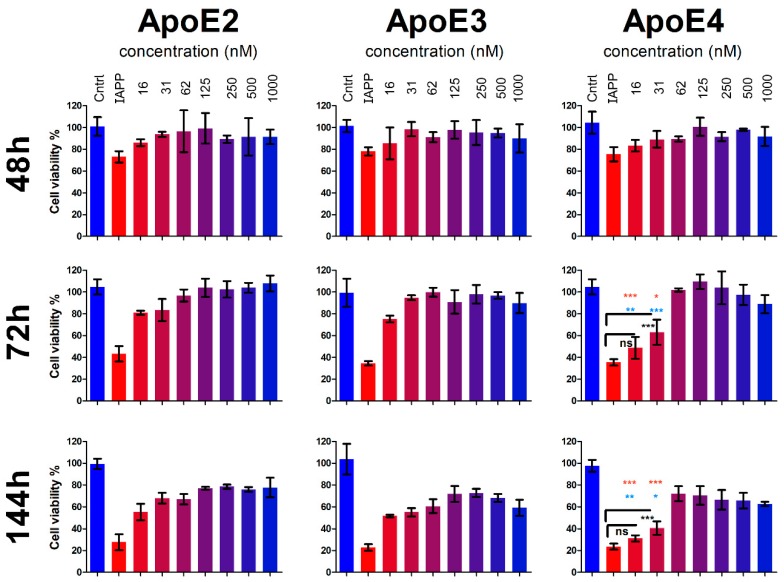
Apolipoprotein E (ApoE) has become a primary focus of research after the discovery of its strong linkage to Alzheimer's disease (AD), where the ApoE4 variant is the highest genetic risk factor for this disease. ApoE is commonly found in amyloid deposits of different origins, and its interaction with amyloid-β peptide (Aβ), the hallmark of AD, is well known. However, studies on the interaction of ApoEs with other amyloid-forming proteins are limited. Islet amyloid polypeptide (IAPP) is an amyloid-forming peptide linked to the development of type-2 diabetes and has also been shown to be involved in AD pathology and vascular dementia. Here we studied the impact of ApoE on IAPP aggregation and IAPP-induced toxicity on blood vessel pericytes. Using both in vitro and cell-based assays, we show that ApoE efficiently inhibits the amyloid formation of IAPP at highly substoichiometric ratios and that it interferes with both nucleation and elongation. We also show that ApoE protects the pericytes against IAPP-induced toxicity, however, the ApoE4 variant displays the weakest protective potential. Taken together, our results suggest that ApoE has a generic amyloid-interfering property and can be protective against amyloid-induced cytotoxicity, but there is a loss of function for the ApoE4 variant.
载脂蛋白 E(ApoE)在发现其与阿尔茨海默病(AD)强烈相关后成为研究的重点,其中 ApoE4 变体是该疾病的最高遗传风险因素。ApoE 通常存在于不同来源的淀粉样沉积物中,其与淀粉样β肽(Aβ)的相互作用,AD 的标志,是众所周知的。然而,关于 ApoEs 与其他淀粉样形成蛋白相互作用的研究有限。胰岛淀粉样多肽(IAPP)是一种与 2 型糖尿病发展有关的淀粉样形成肽,也被证明与 AD 病理学和血管性痴呆有关。在这里,我们研究了 ApoE 对 IAPP 聚集和 IAPP 诱导的血管周细胞毒性的影响。使用体外和基于细胞的测定法,我们表明 ApoE 以高度亚化学计量的比例有效地抑制 IAPP 的淀粉样形成,并且它干扰成核和延伸。我们还表明 ApoE 可保护周细胞免受 IAPP 诱导的毒性,但 ApoE4 变体显示出最弱的保护潜力。总之,我们的结果表明 ApoE 具有通用的淀粉样蛋白干扰特性,可以抵抗淀粉样蛋白诱导的细胞毒性,但 ApoE4 变体的功能丧失。