Research Institute of Agriculture and Life Sciences, Seoul National University, Seoul 08826, Korea.
Department of Agricultural Biology, Seoul National University, Seoul 08826, Korea.
Toxins (Basel). 2020 Jan 14;12(1):47. doi: 10.3390/toxins12010047.
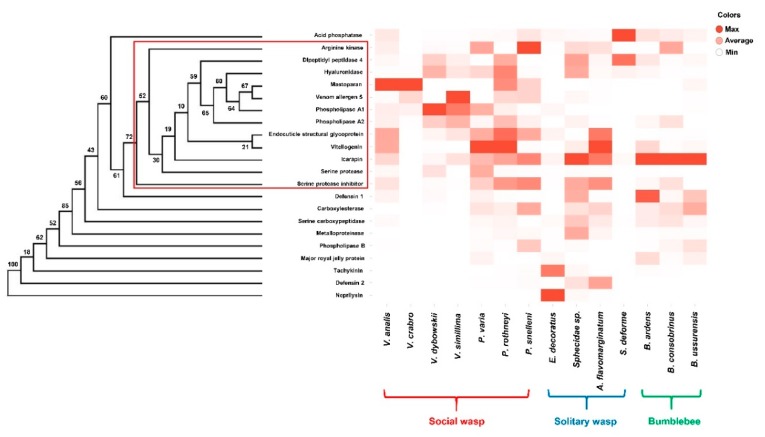
To identify and compare venom components and expression patterns, venom gland-specific transcriptome analyses were conducted for 14 Aculeate bees and wasps. TPM (transcripts per kilobase million) values were normalized using the average transcription level of a reference housekeeping gene (dimethyladenosine transferase). Orthologous venom component genes across the 14 bee and wasp species were identified, and their relative abundance in each species was determined by comparing normalized TPM values. Based on signal sequences in the transcripts, the genes of novel venom components were identified and characterized to encode potential allergens. Most of the allergens and pain-producing factors (arginine kinase, hyaluronidase, mastoparan, phospholipase A1, phospholipase A2, and venom allergen 5) showed extremely high expression levels in social wasps. Acid phosphatase, neprilysin, and tachykinin, which are known allergens and neurotoxic peptides, were found in the venom glands of solitary wasps more often than in social wasps. In the venom glands of bumblebees, few or no transcripts of major allergens or pain-producing factors were identified. Taken together, these results indicate that differential expression patterns of the venom genes in some Aculeate species imply that some wasps and bumblebee species have unique groups of highly expressed venom components. Some venom components reflected the Aculeate species phylogeny, but others did not. This unique evolution of specific venom components in different groups of some wasps and bumblebee species might have been shaped in response to both ecological and behavioral influences.
为了鉴定和比较毒液成分和表达模式,对 14 种螫刺蜂和胡蜂的毒液腺进行了特异性转录组分析。使用参考管家基因(二甲基腺苷转移酶)的平均转录水平对 TPM(每百万转录本中的转录本)值进行归一化。在 14 种蜜蜂和胡蜂物种中鉴定出了同源毒液成分基因,并通过比较归一化 TPM 值来确定它们在每种物种中的相对丰度。根据转录本中的信号序列,鉴定并表征了新的毒液成分基因,以编码潜在的过敏原。大多数过敏原和致痛因子(精氨酸激酶、透明质酸酶、蜂毒素、磷脂酶 A1、磷脂酶 A2 和毒液过敏原 5)在社会性胡蜂中表现出极高的表达水平。酸性磷酸酶、脑啡肽酶和速激肽是已知的过敏原和神经毒性肽,在独居胡蜂的毒液腺中比在社会性胡蜂中更常见。在大黄蜂的毒液腺中,很少或没有鉴定出主要过敏原或致痛因子的转录本。总之,这些结果表明,一些螫刺物种毒液基因的差异表达模式表明,一些胡蜂和大黄蜂物种具有独特的高度表达毒液成分群体。一些毒液成分反映了螫刺物种的系统发育,但其他毒液成分则没有。这种不同的毒液成分在一些胡蜂和大黄蜂物种的特定群体中的独特进化可能是对生态和行为影响的反应。