Curriculum in Bioinformatics and Computational Biology, University of North Carolina at Chapel Hill, Chapel Hill, North Carolina, United States of America.
Department of Genetics, University of North Carolina at Chapel Hill, Chapel Hill, North Carolina, United States of America.
PLoS Genet. 2020 Jan 21;16(1):e1008537. doi: 10.1371/journal.pgen.1008537. eCollection 2020 Jan.
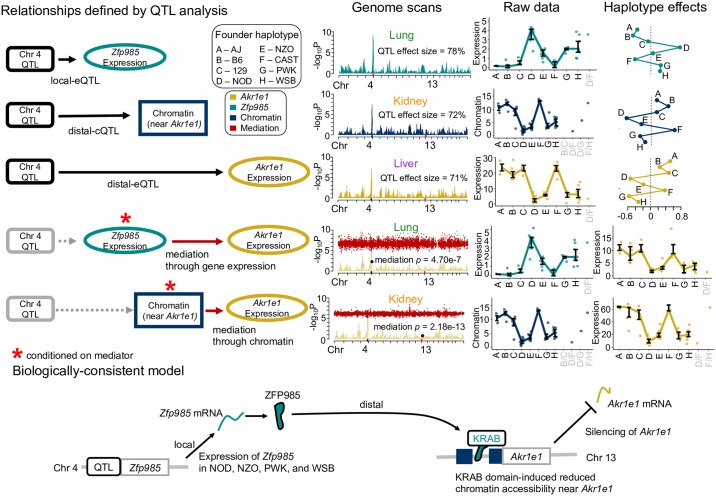
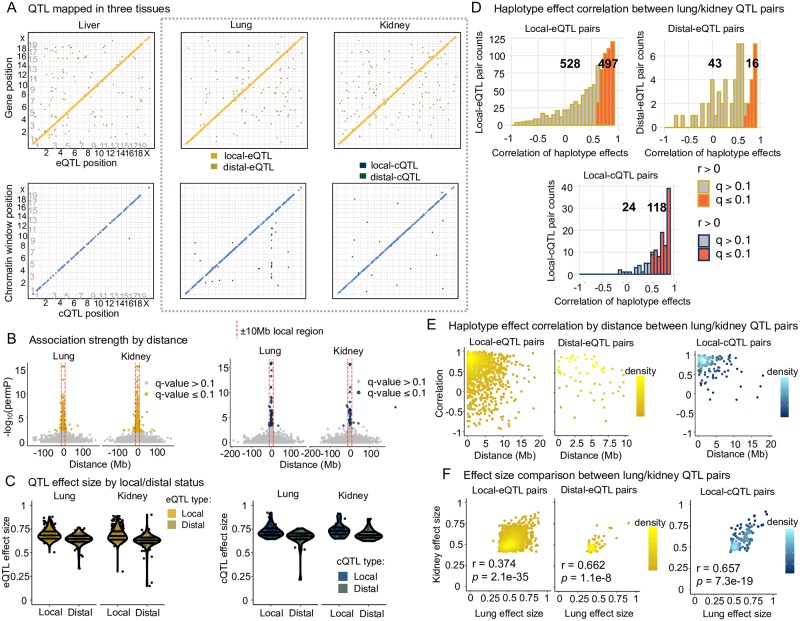
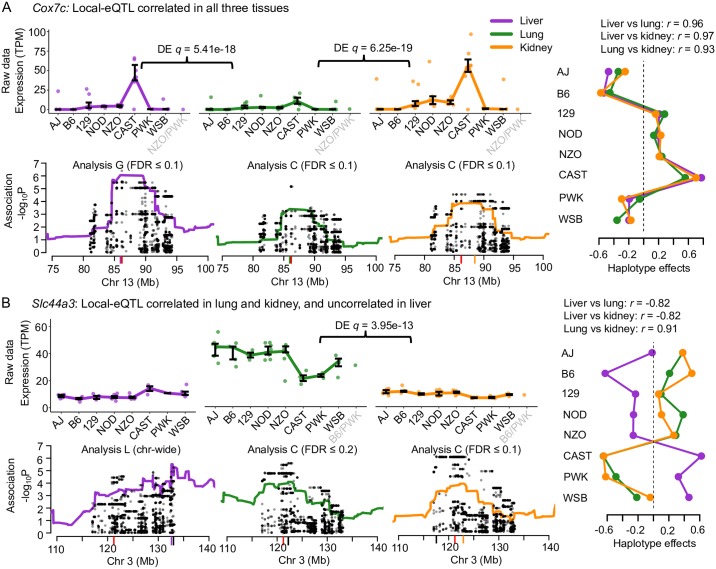
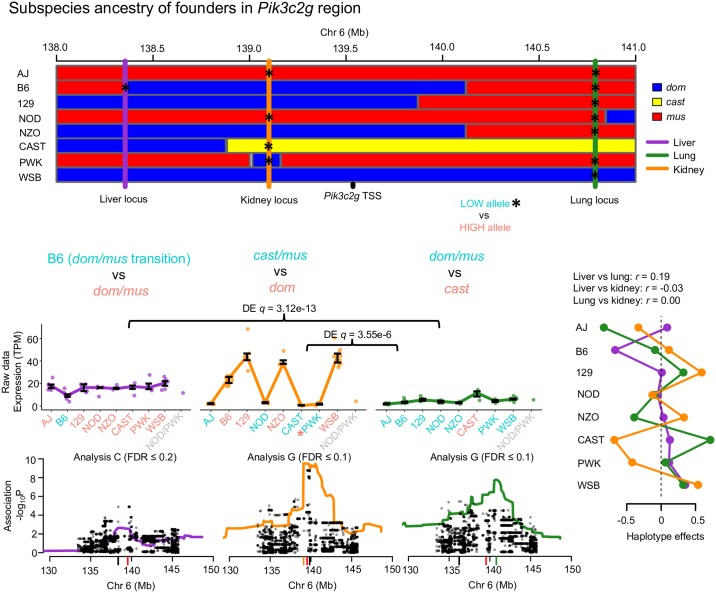
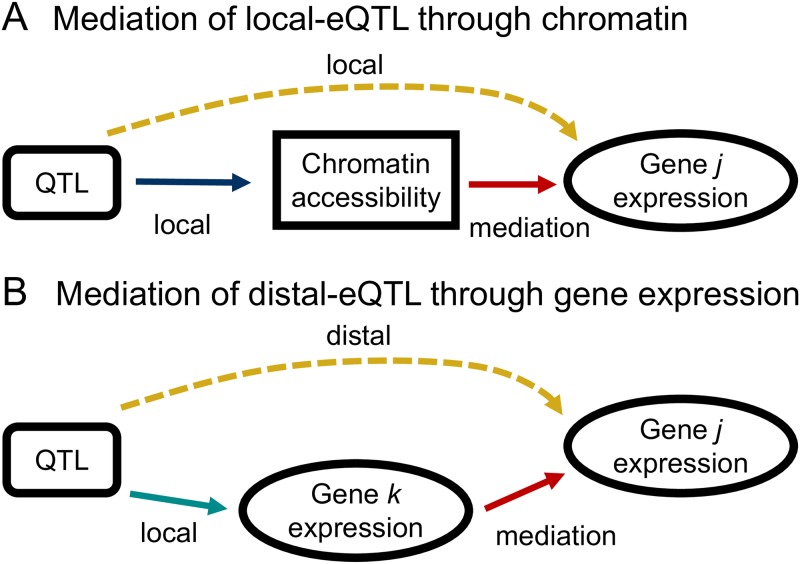
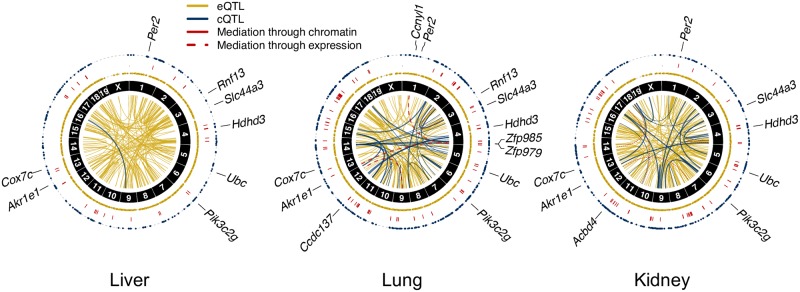
Gene transcription profiles across tissues are largely defined by the activity of regulatory elements, most of which correspond to regions of accessible chromatin. Regulatory element activity is in turn modulated by genetic variation, resulting in variable transcription rates across individuals. The interplay of these factors, however, is poorly understood. Here we characterize expression and chromatin state dynamics across three tissues-liver, lung, and kidney-in 47 strains of the Collaborative Cross (CC) mouse population, examining the regulation of these dynamics by expression quantitative trait loci (eQTL) and chromatin QTL (cQTL). QTL whose allelic effects were consistent across tissues were detected for 1,101 genes and 133 chromatin regions. Also detected were eQTL and cQTL whose allelic effects differed across tissues, including local-eQTL for Pik3c2g detected in all three tissues but with distinct allelic effects. Leveraging overlapping measurements of gene expression and chromatin accessibility on the same mice from multiple tissues, we used mediation analysis to identify chromatin and gene expression intermediates of eQTL effects. Based on QTL and mediation analyses over multiple tissues, we propose a causal model for the distal genetic regulation of Akr1e1, a gene involved in glycogen metabolism, through the zinc finger transcription factor Zfp985 and chromatin intermediates. This analysis demonstrates the complexity of transcriptional and chromatin dynamics and their regulation over multiple tissues, as well as the value of the CC and related genetic resource populations for identifying specific regulatory mechanisms within cells and tissues.
跨组织的基因转录谱在很大程度上由调节元件的活性决定,其中大多数对应于可及染色质区域。调节元件的活性反过来又受到遗传变异的调节,导致个体之间的转录速率不同。然而,这些因素的相互作用还知之甚少。在这里,我们描述了 47 个协作交叉 (CC) 小鼠群体的三个组织——肝脏、肺和肾脏——中的表达和染色质状态动态,检查了这些动态的调节是由表达数量性状基因座 (eQTL) 和染色质数量性状基因座 (cQTL) 引起的。在 1101 个基因和 133 个染色质区域中检测到了等位基因效应在组织中一致的 QTL。还检测到了等位基因效应在组织中不同的 eQTL 和 cQTL,包括在所有三个组织中检测到的 Pik3c2g 的局部-eQTL,但具有不同的等位基因效应。利用来自多个组织的同一小鼠的基因表达和染色质可及性的重叠测量,我们使用中介分析来鉴定 eQTL 效应的染色质和基因表达中介。基于多个组织的 QTL 和中介分析,我们提出了一个因果模型,用于通过锌指转录因子 Zfp985 和染色质中介物来远距离调节参与糖原代谢的基因 Akr1e1。这种分析表明了转录和染色质动态及其在多个组织中的调节的复杂性,以及 CC 和相关遗传资源群体在识别细胞和组织内特定调节机制方面的价值。