Oreper Daniel, Schoenrock Sarah A, McMullan Rachel, Ervin Robin, Farrington Joseph, Miller Darla R, de Villena Fernando Pardo-Manuel, Valdar William, Tarantino Lisa M
Department of Genetics.
Bioinformatics and Computational Biology Curriculum, University of North Carolina, Chapel Hill, NC.
G3 (Bethesda). 2018 Nov 6;8(11):3447-3468. doi: 10.1534/g3.118.200135.
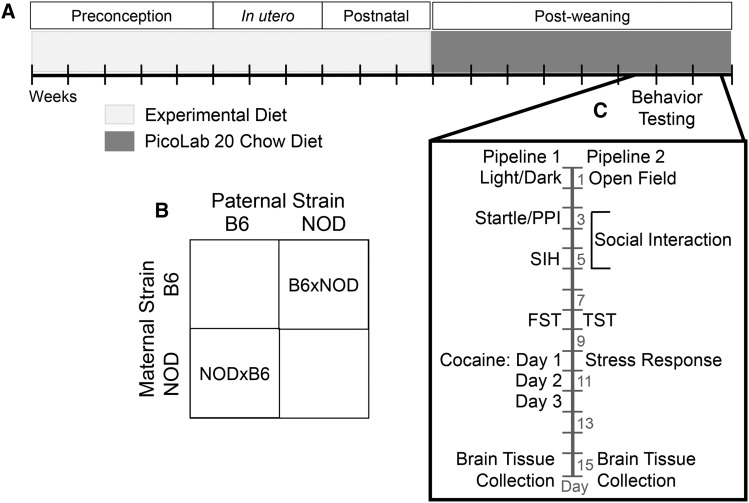
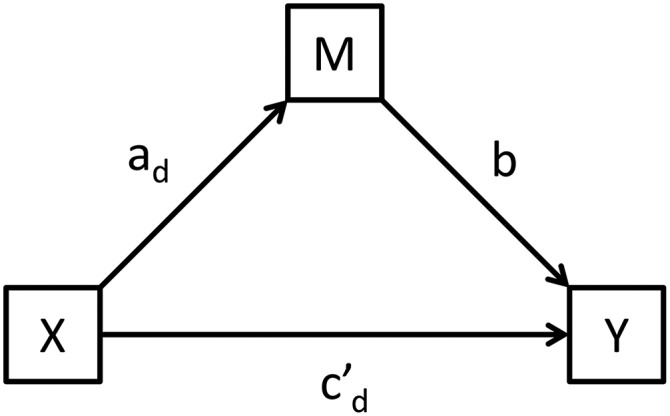
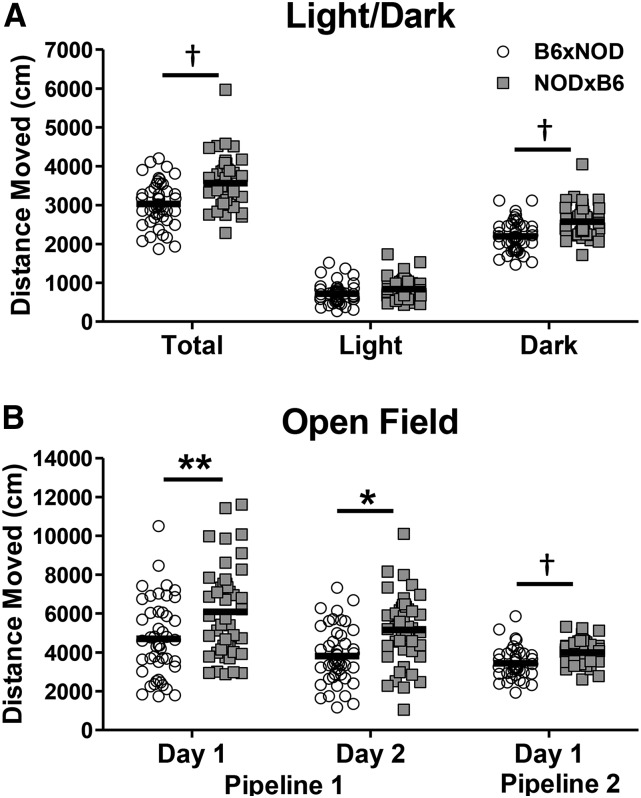
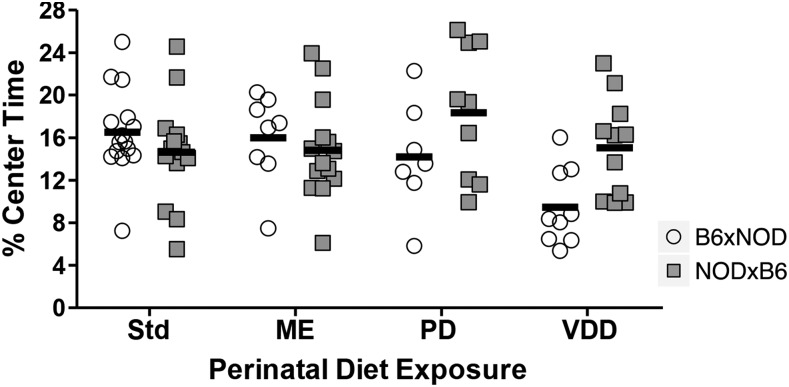
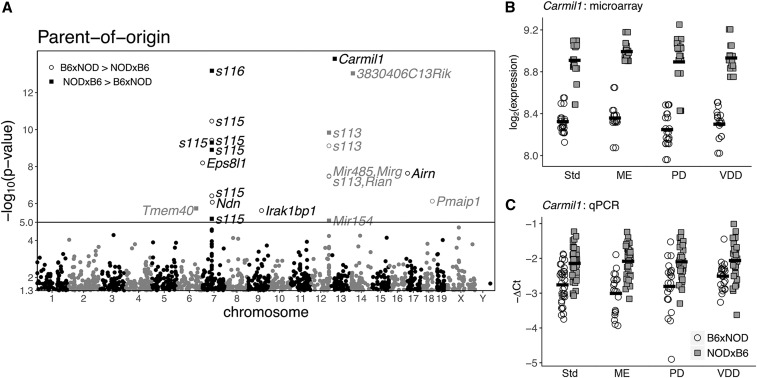
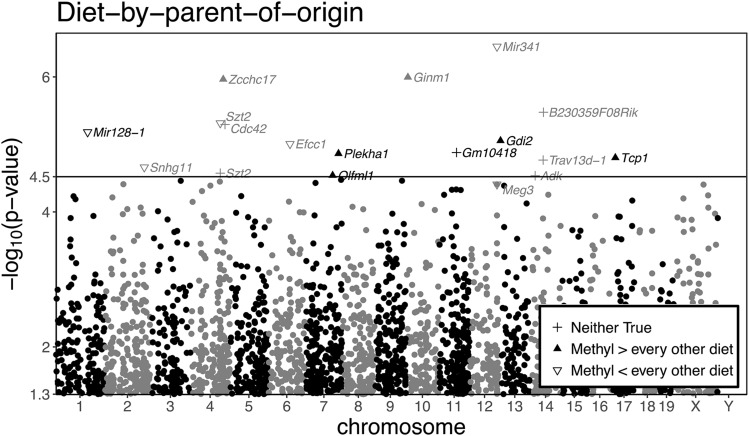
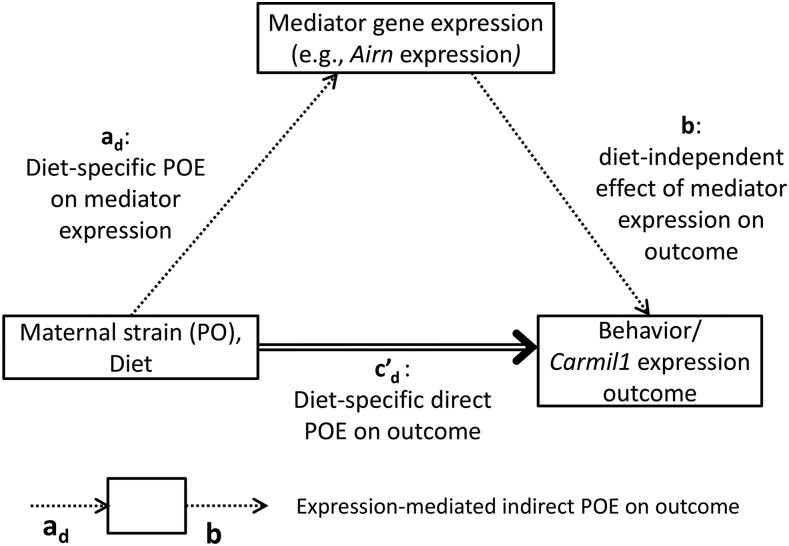
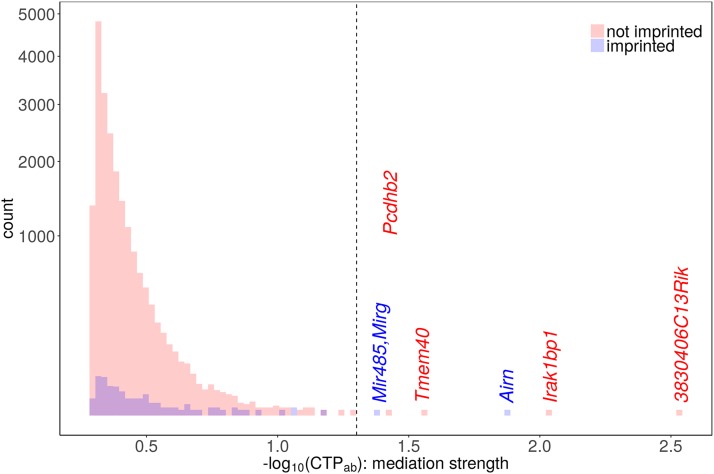
Parent-of-origin effects (POE) in mammals typically arise from maternal effects or imprinting. In some instances, such POE have been associated with psychiatric disorders, as well as with changes in a handful of animal behaviors. However, POE on complex traits such as behavior remain largely uncharacterized. Moreover, although both behavior and epigenetic effects are known to be modified by perinatal environmental exposures such as nutrient deficiency, the architecture of such environment-by-POE is mostly unexplored. To study POE and environment-by-POE, we employ a relatively neglected but especially powerful experimental system for POE-detection: reciprocal F1 hybrids (RF1s). We exposed female NOD/ShiLtJ×C57Bl/6J and C57Bl/6J×NOD/ShiLtJ mice, perinatally, to one of four different diets, then after weaning recorded a set of behaviors that model psychiatric disease. Whole-brain microarray expression data revealed an imprinting-enriched set of 15 genes subject to POE. The most-significant expression POE, on the non-imprinted gene (a.k.a. ), was validated using qPCR in the same and in a new set of mice. Several behaviors, especially locomotor behaviors, also showed POE. Bayesian mediation analysis suggested expression suppresses behavioral POE, and that the imprinted gene suppresses POE on expression. A suggestive diet-by-POE was observed on percent center time in the open field test, and a significant diet-by-POE was observed on one imprinted gene, , and on 16 non-imprinted genes. The relatively small, tractable set of POE and diet-by-POE detected on behavior and expression here motivates further studies examining such effects across RF1s on multiple genetic backgrounds.
哺乳动物中的亲本来源效应(POE)通常源于母体效应或印记。在某些情况下,此类POE与精神疾病以及少数动物行为的变化有关。然而,POE对行为等复杂性状的影响在很大程度上仍未得到充分表征。此外,尽管已知行为和表观遗传效应都会受到围产期环境暴露(如营养缺乏)的影响,但这种环境与POE相互作用的机制大多尚未被探索。为了研究POE以及环境与POE的相互作用,我们采用了一种相对被忽视但在检测POE方面特别强大的实验系统: reciprocal F1杂种(RF1s)。我们在围产期将雌性NOD/ShiLtJ×C57Bl/6J和C57Bl/6J×NOD/ShiLtJ小鼠暴露于四种不同饮食之一,断奶后记录了一组模拟精神疾病的行为。全脑微阵列表达数据揭示了一组15个受POE影响的富含印记的基因。使用qPCR在同一组和一组新的小鼠中验证了非印记基因(又名 )上最显著的表达POE。几种行为,尤其是运动行为,也表现出POE。贝叶斯中介分析表明 表达抑制行为POE,并且印记基因 抑制 表达上的POE。在旷场试验中观察到了关于中心时间百分比的环境与POE相互作用的暗示性结果,并且在一个印记基因 和16个非印记基因上观察到了显著的环境与POE相互作用。此处检测到的在行为和表达上相对较小且易于处理的POE以及环境与POE相互作用的结果,促使进一步研究在多个遗传背景下跨RF1s研究此类效应。