Department of Gynecology, University Medical Center Hamburg-Eppendorf, Martinistr. 52, 20246 Hamburg, Germany.
Department of Hematology and Oncology, University Medical Center Hamburg-Eppendorf, Martinistr. 52, 20246 Hamburg, Germany.
Int J Mol Sci. 2020 Jan 17;21(2):602. doi: 10.3390/ijms21020602.
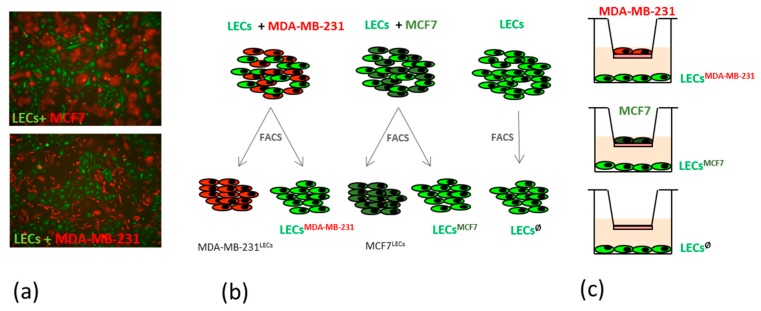
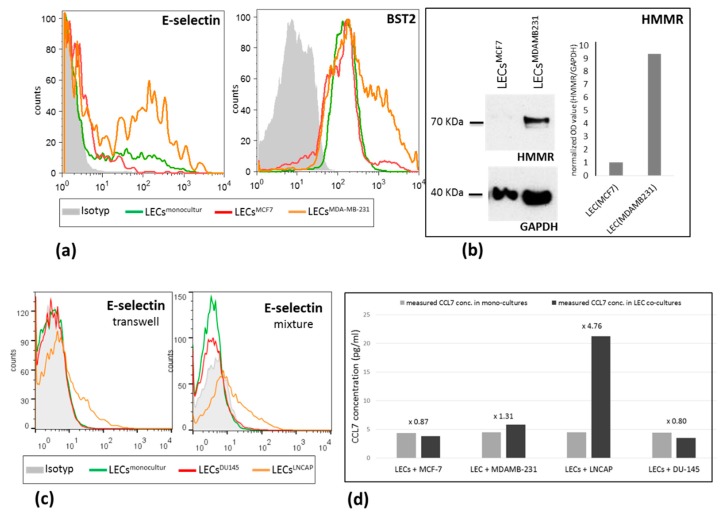
During the last few years, diverse studies have shown that tumors can actively interact with the lymphatic system and promote metastases development. In order to examine the molecular mechanisms involved in this interaction, we co-cultured tumor and lymphatic endothelial cells (LEC) and subsequently analyzed the molecular alterations of LECs. Therefore, LECs were co-cultivated with either a highly or weakly metastatic breast cancer cell line using contact (mixture) and non-contact (transwell) co-cultures. mRNA profiles from LECs were subsequently analyzed for genes specifically induced by highly metastatic tumor cells ("metastatic specific"). Among the up-regulated "metastatic specific" genes, we found candidates involved in cell cycle, cell adhesion and motility (BST2, E-selectin, and HMMR), cytokines (CCL7, CXCL6, CXCL1, and CSF2) and factors of the complement system (C1R, C3, and CFB). Among the down-regulated genes, we detected the hyaluronan receptor STAB2, angiogenic factor apelin receptor (APLNR), and the glycosylation enzyme MAN1A1. In an additional prostate cancer co-culture model, we could confirm a "metastatic specific" upregulation of E-selectin and CCL7 in LECs after interaction with the prostate cancer cell lines LNCAP (highly metastatic) and DU145 (weakly metastatic). These data allowed us to identify a set of genes regulated in LECs during in vitro communication with cancer cells, which might subsequently facilitate lymphatic metastasis.
在过去的几年中,各种研究表明肿瘤可以与淋巴系统积极相互作用并促进转移的发展。为了研究这种相互作用涉及的分子机制,我们共同培养了肿瘤和淋巴管内皮细胞(LEC),并随后分析了 LEC 的分子变化。因此,我们将 LEC 与高转移性或低转移性乳腺癌细胞系进行接触(混合)和非接触(transwell)共培养。随后分析 LEC 的 mRNA 图谱,以寻找高度转移性肿瘤细胞特异性诱导的基因(“转移性特异性”)。在上调的“转移性特异性”基因中,我们发现了涉及细胞周期、细胞粘附和运动的候选基因(BST2、E-选择素和 HMMR)、细胞因子(CCL7、CXCL6、CXCL1 和 CSF2)和补体系统的因子(C1R、C3 和 CFB)。在下调的基因中,我们检测到透明质酸受体 STAB2、血管生成因子 apelin 受体(APLNR)和糖基化酶 MAN1A1。在另外的前列腺癌共培养模型中,我们可以确认在 LEC 与前列腺癌细胞系 LNCAP(高转移性)和 DU145(低转移性)相互作用后,E-选择素和 CCL7 的“转移性特异性”上调。这些数据使我们能够鉴定出一组在 LEC 与癌细胞体外通讯过程中受到调节的基因,这些基因可能随后促进淋巴转移。