Department of Pathology and Molecular Medicine, Queen's University, Kingston, ON K7L 3N6, Canada.
Int J Mol Sci. 2020 Jan 17;21(2):626. doi: 10.3390/ijms21020626.
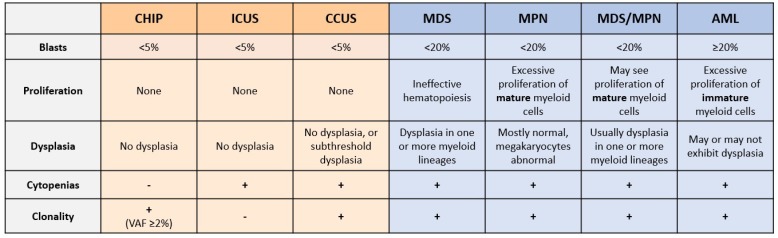
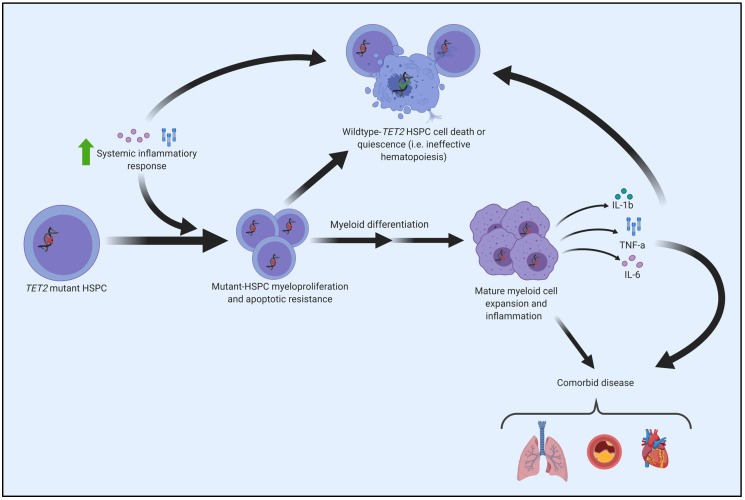
Acquired, inactivating mutations in Tet methylcytosine dioxygenase 2 () are detected in peripheral blood cells of a remarkable 5%-10% of adults greater than 65 years of age. They impart a hematopoietic stem cell advantage and resultant clonal hematopoiesis of indeterminate potential (CHIP) with skewed myelomonocytic differentiation. CHIP is associated with an overall increased risk of transformation to a hematological malignancy, especially myeloproliferative and myelodysplastic neoplasms (MPN, MDS) and acute myeloid leukemia (AML), of approximately 0.5% to 1% per year. However, it is becoming increasingly possible to identify individuals at greatest risk, based on CHIP mutational characteristics. CHIP, and particularly -mutant CHIP, is also a novel, significant risk factor for cardiovascular diseases, related in part to hyper-inflammatory, progeny macrophages carrying mutations. Therefore, somatic mutations contribute to myeloid expansion and innate immune dysregulation with age and contribute to prevalent diseases in the developed world-cancer and cardiovascular disease. Herein, we describe the impact of detecting mutations in the clinical setting. We also present the rationale and promise for targeting -mutant and other CHIP clones, and their inflammatory environment, as potential means of lessening risk of myeloid cancer development and dampening CHIP-comorbid inflammatory diseases.
在年龄大于 65 岁的成年人中,高达 5%-10%的人外周血细胞中可检测到 Tet 甲基胞嘧啶双加氧酶 2 ()获得性失活突变。它们赋予造血干细胞优势,并导致具有不确定潜能的克隆性造血 (CHIP)和偏倚的髓系分化。CHIP 与向血液系统恶性肿瘤(尤其是骨髓增生性和骨髓发育不良性肿瘤 (MPN、MDS) 和急性髓系白血病 (AML))转化的总体风险增加相关,每年约为 0.5%至 1%。然而,根据 CHIP 突变特征,越来越有可能识别出风险最大的个体。CHIP,特别是 -突变 CHIP,也是心血管疾病的一个新的重要危险因素,部分原因是携带 突变的高炎症、祖细胞巨噬细胞。因此,体细胞 突变导致髓系细胞扩增和固有免疫失调随着年龄的增长而发生,并导致发达国家普遍存在的疾病——癌症和心血管疾病。在此,我们描述了在临床环境中检测到 突变的影响。我们还介绍了针对 -突变和其他 CHIP 克隆及其炎症环境的原理和前景,作为降低髓系癌症发展风险和抑制 CHIP 合并炎症性疾病的潜在手段。