Department of Epidemiology and Health Statistics, Guangdong Pharmaceutical University, Guangzhou 510310, China.
School of Public Health and Community Medicine, The University of New South Wales, Sydney 2052, Australia.
Int J Environ Res Public Health. 2020 Jan 18;17(2):623. doi: 10.3390/ijerph17020623.
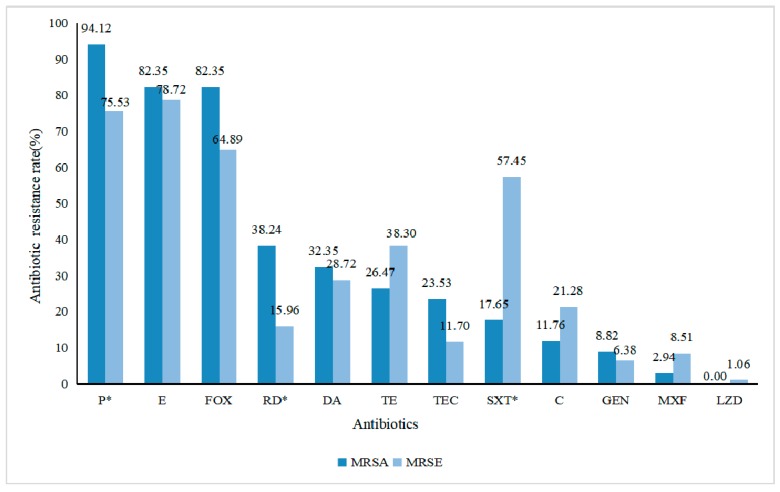
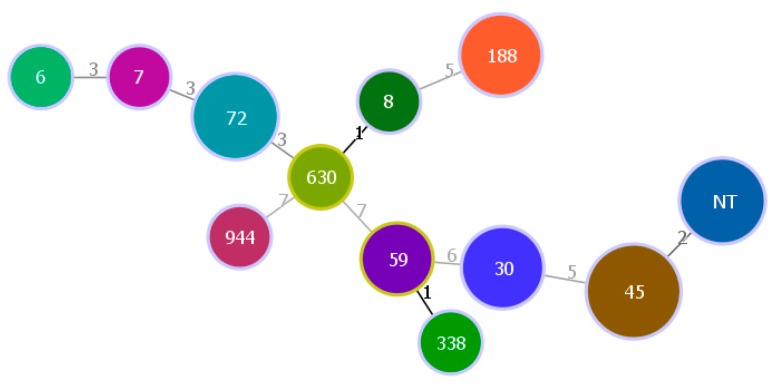
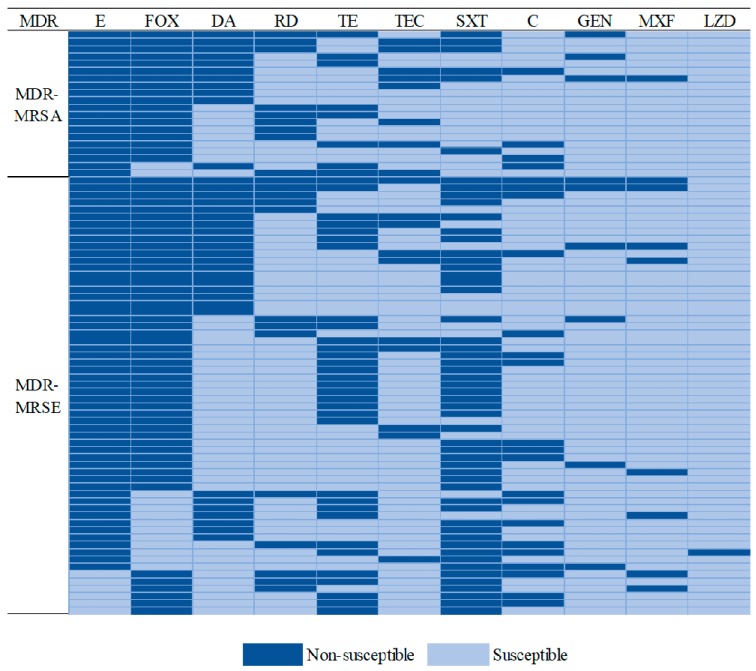
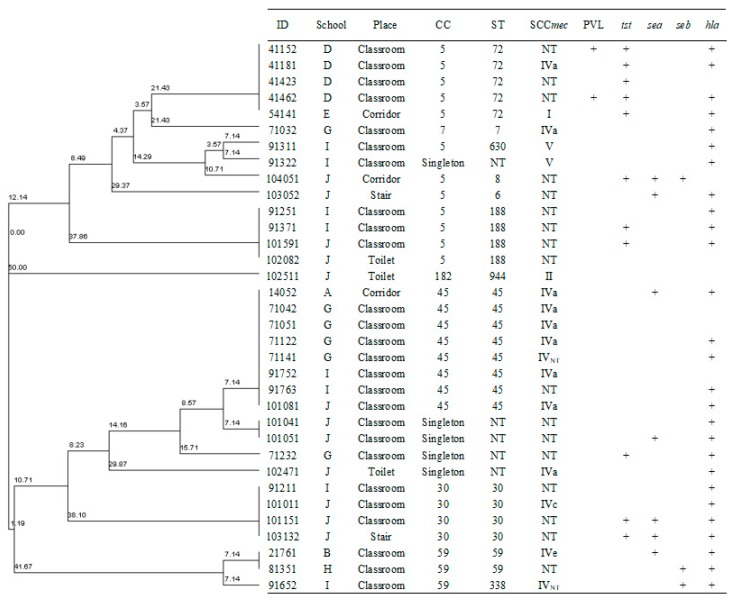
: Methicillin-resistant (MRSA) and (MRSE), the most prevalent causes of hospital-associated and community-associated infections, could exist on frequently touched surfaces. This study aims to determine the contamination prevalence and the characteristics of MRSA and MRSE isolated from secondary school environments. : We collected environmental samples from ten secondary schools in Guangzhou city between October 2016 and January 2017. The samples were confirmed for MRSA and MRSE isolates by using biochemical tests and polymerase chain reactions. Antimicrobial susceptibility testing was performed by the Kirby-Bauer disk diffusion method. Staphylococcal cassette chromosome mec (SCC) typing, toxin gene screening, and multilocus sequence typing (MLST) were performed to further characterize the isolates. Data were analyzed by two-sample proportion tests. : A total of 1830 environmental samples were collected. The prevalence of MRSA and MRSE contamination were 1.86% (34/1830) and 5.14% (94/1830), respectively. The proportions of multidrug resistance in both MRSA (58.82%) and MRSE (63.83%) isolates were high. Seven clonal complexes (CC) and 12 sequence types (ST) were identified, with the CC5 (35.29%) and ST45 (25.53%) being the most prevalent. We found that 44.12% of the MRSA isolates were community-acquired and the main type was ST45-SCC IV. We found that 5.88% and 32.35% of MRSA isolates were positive to Panton-Valentine leukocidin (PVL) and toxic shock syndrome toxin-1 () gene, respectively. No MRSE isolate was positive to the toxin genes. : Our findings raise potential public health concerns for environmental contamination of MRSA and MRSE in school environments. Surfaces of school environments may potentially provide a source for cross-contamination with these bacteria into the wider community.
耐甲氧西林金黄色葡萄球菌(MRSA)和耐甲氧西林表皮葡萄球菌(MRSE)是医院相关性和社区相关性感染的最常见原因,可能存在于经常接触的表面。本研究旨在确定从中小学环境中分离的 MRSA 和 MRSE 的污染流行率和特征。
我们于 2016 年 10 月至 2017 年 1 月期间从广州市的 10 所中学收集环境样本。使用生化试验和聚合酶链反应确认这些样本中是否存在 MRSA 和 MRSE 分离株。通过 Kirby-Bauer 纸片扩散法进行抗菌药敏试验。进行葡萄球菌盒式染色体 mec(SCC)分型、毒素基因筛选和多位点序列分型(MLST),以进一步对分离株进行特征描述。使用两样本比例检验对数据进行分析。
共收集 1830 份环境样本。MRSA 和 MRSE 污染的流行率分别为 1.86%(34/1830)和 5.14%(94/1830)。两种 MRSA(58.82%)和 MRSE(63.83%)分离株均表现出较高的多药耐药性比例。共鉴定出 7 个克隆复合体(CC)和 12 个序列类型(ST),其中 CC5(35.29%)和 ST45(25.53%)最为流行。我们发现,44.12%的 MRSA 分离株为社区获得性,主要类型为 ST45-SCCIV。我们发现,5.88%和 32.35%的 MRSA 分离株分别对杀白细胞素(PVL)和中毒性休克综合征毒素-1()基因呈阳性,而 MRSE 分离株均未对毒素基因呈阳性。
我们的研究结果表明,学校环境中存在 MRSA 和 MRSE 的环境污染可能会引起潜在的公共卫生关注。学校环境中的表面可能会成为这些细菌向更广泛社区传播的交叉污染源。