Institute of Construction Project Management, Collage of Civil Engineering & Architecture, Zhejiang University, Hangzhou 310058, China.
Department of Management Science, Bahria University Islamabad, Lahore Campus, Lahore 54600, Pakistan.
Int J Environ Res Public Health. 2020 Jan 19;17(2):635. doi: 10.3390/ijerph17020635.
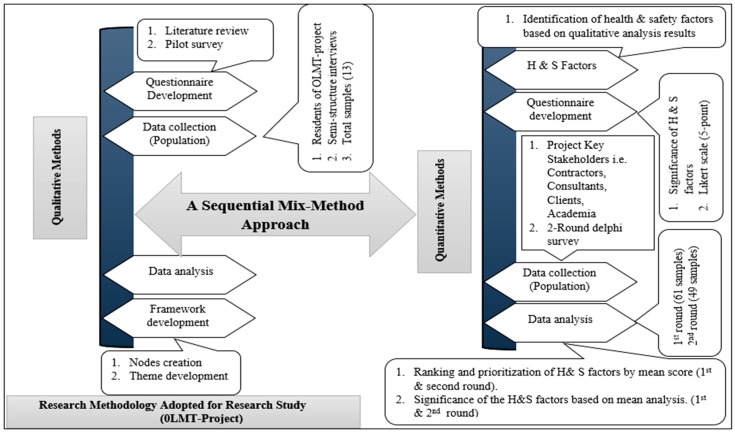
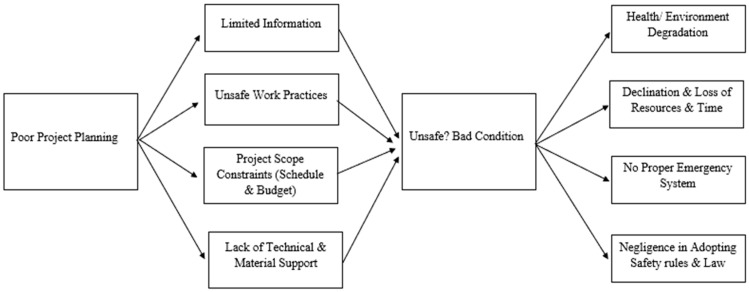
Urbanization is playing a key role in big cities of developing countries, which, in effect, is increasing the population. This study takes care of the mega infrastructure project (Orange Line Metro Train (OLMT)) to explore and identify the H&S (Health and Safety) factors that affect the local residents and the main key stakeholders working on the project. A Sequential Mixed-Method approach of the OLMT-project includes qualitative and quantitative methods were adopted. The data have been collected from the targeted population working on the OLMT-project through a questionnaire. The main key finding of the study indicates that poor planning and a lack of communication between the public and government led to frustration. The most significant factors that identified in the study were unsafe to work practice, project scope constraints, lack in technical and material support, unsafe/bad condition, health/environment degradation, declination and loss of resources and time, no proper emergency system, and negligence in adopting safety rules and laws. The study also revealed that the consensus should also be noticed between the key stakeholders (e.g., contractors, clients, safety officials, academia) in the second round of the Delphi survey of the project. The study findings will help the key stakeholders to prioritize their energies towards attaining zero levels of inadequate health and safety practices in infrastructure projects. The study outcomes can also be generalized for the other developing countries having a similar work scenario.
城市化在发展中国家的大城市中扮演着关键角色,这实际上增加了人口。本研究关注的是大型基础设施项目(橙线地铁列车(OLMT)),以探索和识别影响当地居民和参与项目的主要利益相关者的健康和安全(H&S)因素。OLMT 项目采用了顺序混合方法,包括定性和定量方法。通过问卷调查收集了参与 OLMT 项目的目标人群的数据。研究的主要发现表明,公众与政府之间缺乏规划和沟通导致了挫折感。研究中确定的最重要因素是不安全的工作实践、项目范围限制、缺乏技术和材料支持、不安全/恶劣的条件、健康/环境恶化、资源和时间的减少和损失、没有适当的应急系统以及忽视采用安全规则和法律。研究还表明,在项目的第二轮德尔菲调查中,关键利益相关者(例如承包商、客户、安全官员、学术界)之间也应该注意达成共识。研究结果将帮助主要利益相关者将精力集中在实现基础设施项目中不完善的健康和安全实践的零水平上。研究结果也可以推广到其他具有类似工作情况的发展中国家。