Sherbrooke Research and Development Center, Agriculture and Agri-Food Canada, Sherbrooke, QC, Canada.
Department of Biology, Université de Sherbrooke, Sherbrooke, QC, Canada.
Front Immunol. 2020 Jan 8;10:2874. doi: 10.3389/fimmu.2019.02874. eCollection 2019.
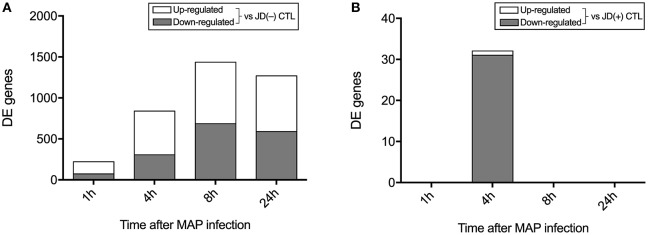
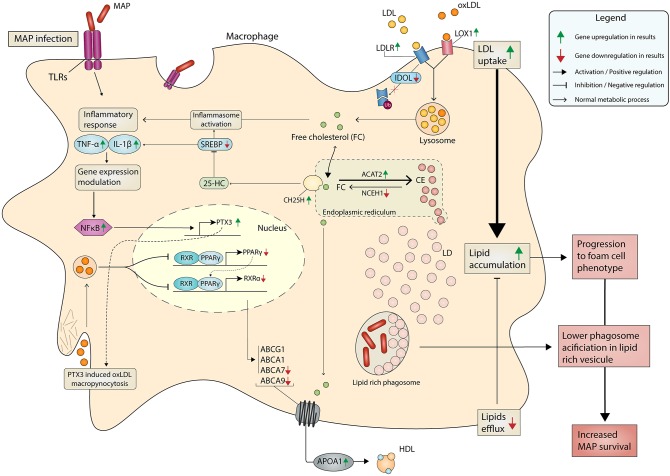
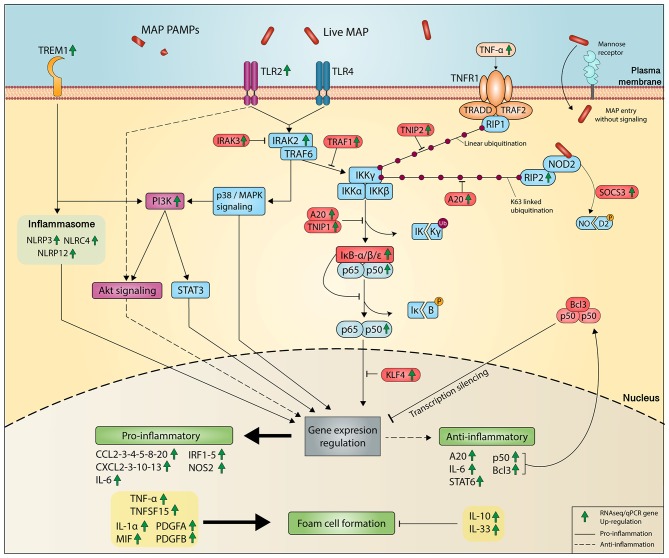
spp. (MAP) is the causative agent of Johne's disease (JD), also known as paratuberculosis, in ruminants. The mechanisms of JD pathogenesis are not fully understood, but it is known that MAP subverts the host immune system by using macrophages as its primary reservoir. MAP infection in macrophages is often studied in healthy cows or experimentally infected calves, but reports on macrophages from naturally infected cows are lacking. In our study, primary monocyte-derived macrophages (MDMs) from cows diagnosed as positive (+) or negative (-) for JD were challenged with live MAP. Analysis using next-generation RNA sequencing revealed that macrophages from JD(+) cows did not present a definite pattern of response to MAP infection. Interestingly, a considerable number of genes, up to 1436, were differentially expressed in JD(-) macrophages. The signatures of the infection time course of 1, 4, 8, and 24 h revealed differential expression of , and among other genes, with major effects on host signaling pathways. While several immune pathways were affected by MAP, other pathways related to hepatic fibrosis/hepatic stellate cell activation, lipid homeostasis, such as LXR/RXR (liver X receptor/retinoid X receptor) activation pathways, and autoimmune diseases (rheumatoid arthritis or atherosclerosis) also responded to the presence of live MAP. Comparison of the profiles of the unchallenged MDMs from JD(+) vs. JD(-) cows showed that 868 genes were differentially expressed, suggesting that these genes were already affected before monocytes differentiated into macrophages. The downregulated genes predominantly modified the general cell metabolism by downregulating amino acid synthesis and affecting cholesterol biosynthesis and other energy production pathways while introducing a pro-fibrotic pattern associated with foam cells. The upregulated genes indicated that lipid homeostasis was already supporting fat storage in uninfected JD(+) MDMs. For JD(+) MDMs, differential gene expression expounds long-term mechanisms established during disease progression of paratuberculosis. Therefore, MAP could further promote disease persistence by influencing long-term macrophage behavior by using both tolerance and fat-storage states. This report contributes to a better understanding of MAP's controls over the immune cell response and mechanisms of MAP survival.
种。(MAP)是引起牛分枝杆菌病(JD)的病原体,也称为副结核病,在反刍动物中。JD 发病机制的机制尚不完全清楚,但已知 MAP 通过将巨噬细胞作为其主要储库来颠覆宿主免疫系统。MAP 在巨噬细胞中的感染通常在健康奶牛中进行研究或在实验感染的小牛中进行研究,但缺乏关于自然感染奶牛的巨噬细胞的报告。在我们的研究中,从被诊断为 JD(+)或 JD(-)的奶牛中分离的原代单核细胞衍生的巨噬细胞(MDM)用活 MAP 进行了挑战。使用下一代 RNA 测序进行的分析表明,来自 JD(+)奶牛的巨噬细胞对 MAP 感染没有呈现出确定的反应模式。有趣的是,多达 1436 个基因在 JD(-)巨噬细胞中差异表达。感染时间过程 1、4、8 和 24 h 的特征揭示了、等基因的差异表达,这些基因对宿主信号通路有重大影响。虽然 MAP 影响了几个免疫途径,但其他与肝纤维化/肝星状细胞激活、脂质稳态相关的途径,如 LXR/RXR(肝 X 受体/视黄酸 X 受体)激活途径和自身免疫性疾病(类风湿关节炎或动脉粥样硬化)也对活 MAP 的存在做出了反应。比较 JD(+)与 JD(-)奶牛的未受挑战的 MDM 之间的谱表明,有 868 个基因差异表达,这表明这些基因在单核细胞分化为巨噬细胞之前就已经受到影响。下调的基因主要通过下调氨基酸合成和影响胆固醇生物合成和其他能量产生途径来修饰一般细胞代谢,同时引入与泡沫细胞相关的促纤维化模式。上调的基因表明,脂质稳态已经在未感染的 JD(+)MDM 中支持脂肪储存。对于 JD(+)MDM,差异基因表达阐述了副结核病进展过程中建立的长期机制。因此,MAP 通过利用耐受和脂肪储存状态来影响长期巨噬细胞行为,可能进一步促进疾病的持续存在。本报告有助于更好地理解 MAP 对免疫细胞反应的控制以及 MAP 存活的机制。