Richards Daelyn Y, Winn Shelley R, Dudley Sandra, Nygaard Sean, Mighell Taylor L, Grompe Markus, Harding Cary O
Department of Molecular and Medical Genetics, Oregon Health & Science University, Portland, OR 97239, USA.
Department of Pediatrics, Oregon Health & Science University, Portland, OR 97239, USA.
Mol Ther Methods Clin Dev. 2019 Dec 24;17:234-245. doi: 10.1016/j.omtm.2019.12.004. eCollection 2020 Jun 12.
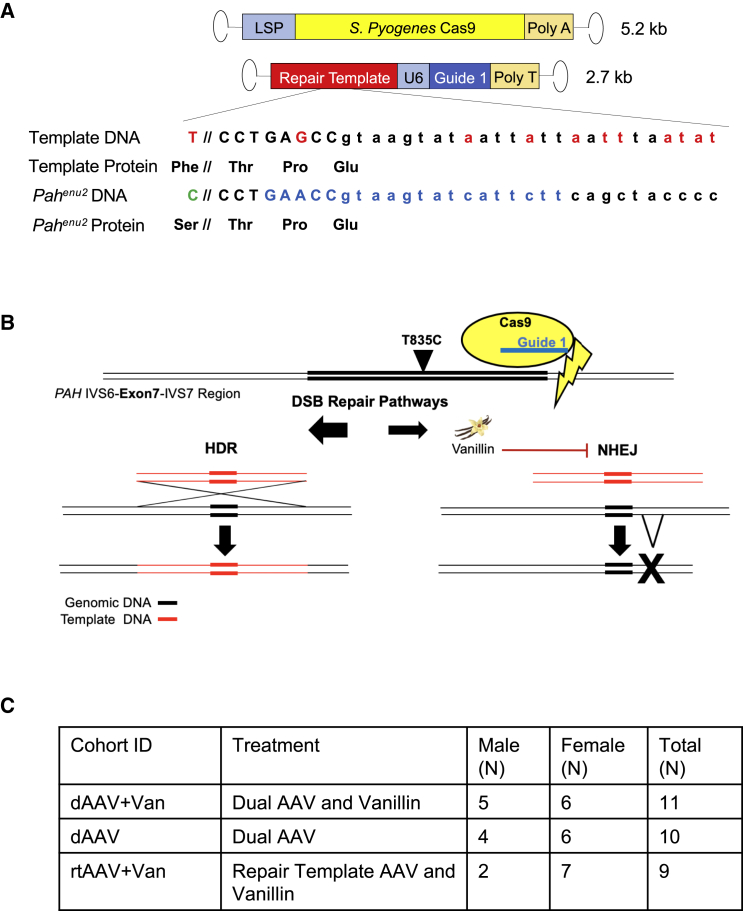
Phenylketonuria (PKU) due to recessively inherited phenylalanine hydroxylase (PAH) deficiency results in hyperphenylalaninemia, which is toxic to the central nervous system. Restriction of dietary phenylalanine intake remains the standard of PKU care and prevents the major neurologic manifestations of the disease, yet shortcomings of dietary therapy remain, including poor adherence to a difficult and unpalatable diet, an increased incidence of neuropsychiatric illness, and imperfect neurocognitive outcomes. Gene therapy for PKU is a promising novel approach to promote lifelong neurological protection while allowing unrestricted dietary phenylalanine intake. In this study, liver-tropic recombinant AAV2/8 vectors were used to deliver CRISPR/Cas9 machinery and facilitate correction of the allele by homologous recombination. Additionally, a non-homologous end joining (NHEJ) inhibitor, vanillin, was co-administered with the viral drug to promote homology-directed repair (HDR) with the AAV-provided repair template. This combinatorial drug administration allowed for lifelong, permanent correction of the allele in a portion of treated hepatocytes of mice with PKU, yielding partial restoration of liver PAH activity, substantial reduction of blood phenylalanine, and prevention of maternal PKU effects during breeding. This work reveals that CRISPR/Cas9 gene editing is a promising tool for permanent PKU gene editing.
由于隐性遗传的苯丙氨酸羟化酶(PAH)缺乏导致的苯丙酮尿症(PKU)会引起高苯丙氨酸血症,这对中枢神经系统有毒性。限制饮食中苯丙氨酸的摄入量仍然是PKU治疗的标准方法,可预防该疾病的主要神经学表现,但饮食疗法仍存在缺点,包括难以坚持难吃的饮食、神经精神疾病发病率增加以及神经认知结果不理想。PKU的基因治疗是一种有前景的新方法,可促进终身神经保护,同时允许不受限制地摄入饮食中的苯丙氨酸。在本研究中,使用肝脏靶向重组腺相关病毒2/8(AAV2/8)载体递送CRISPR/Cas9机制,并通过同源重组促进 等位基因的校正。此外,将一种非同源末端连接(NHEJ)抑制剂香草醛与病毒药物共同给药,以促进利用AAV提供的修复模板进行同源定向修复(HDR)。这种联合药物给药可在患有PKU的小鼠的一部分经治疗的肝细胞中对 等位基因进行终身、永久性校正,使肝脏PAH活性部分恢复,血液苯丙氨酸大幅降低,并防止繁殖期间母体PKU效应。这项工作表明,CRISPR/Cas9基因编辑是一种有前景的用于永久性PKU基因编辑的工具。