Dominic Erlangga, Brozek Wolfgang, Peter Raphael Simon, Fromm Ella, Ulmer Hanno, Rapp Kilian, Concin Hans, Nagel Gabriele
Agency for Preventive and Social Medicine, Rheinstr. 61, 6900 Bregenz, Austria.
Institute of Epidemiology and Medical Biometry, Ulm University, Helmholtzstr. 22, 89081 Ulm, Germany.
Bone Rep. 2020 Jan 13;12:100244. doi: 10.1016/j.bonr.2020.100244. eCollection 2020 Jun.
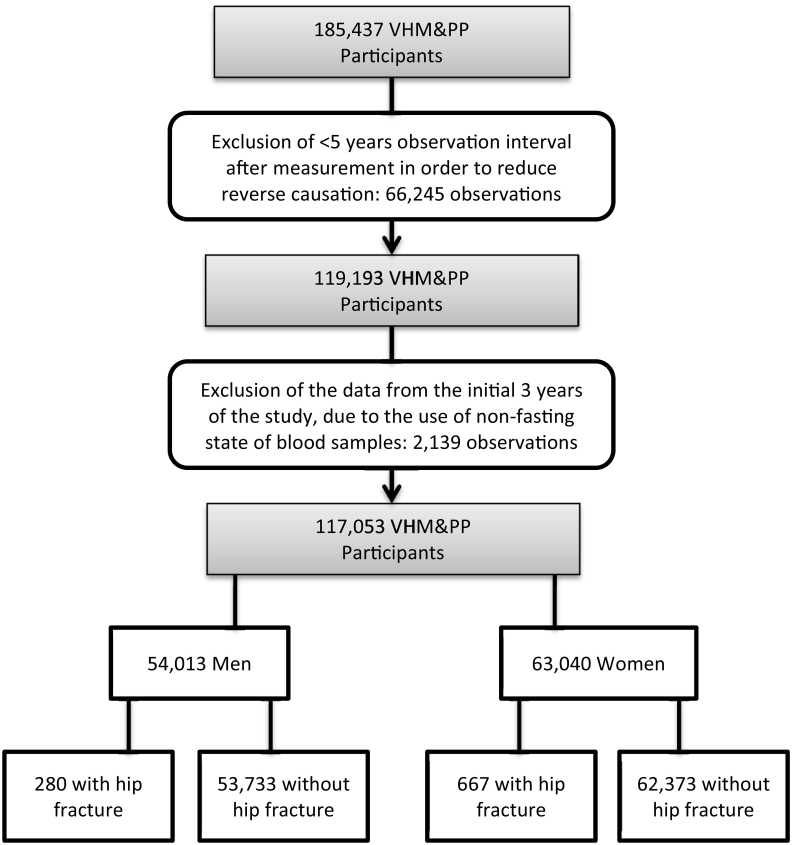
To explore the association of incident hip fractures with metabolic syndrome (MetS) and its single components, we designed a prospective cohort study of hip fracture incidence among 117,053 participants of a population-based health surveillance program in Vorarlberg, the westernmost Austrian province. Incident hip fractures were recorded between 5 and 10 years after inclusion at baseline from 2003 to 2009. Applying Cox proportional hazard models for each MetS component and for a composite z-score for MetS, hazards for fracture were estimated in quintiles, as continuous z-score variables, and as pathological cut off values. Mean age was 50.1 ± 15.6 years at baseline, 5-10 years after which 947 incident hip fractures occurred. An association of a higher composite MetS score with decreased hip fracture risk was observed in women (HR 0.80, 95%-CI 0.88-0.96, < 0.01) which disappeared upon adjustment for BMI. BMI was inversely associated with hip fracture risk in women and men (HR for the highest compared with the lowest quintile: 0.83 (95%-CI: 0.63-1.10, < 0.05) and 0.55 (95%-CI: 0.38-0.79, < 0.001), respectively). Only in women, hip fracture risk was reduced at high cholesterol levels (HR for the highest relative to the lowest quintile: 0.64, 95%-CI: 0.48-0.84, < 0.05) and in hypercholesterolemic patients (HR 0.82, 95%-CI: 0.67-0.99, < 0.05), but elevated in hyperglycemic patients (HR 1.33, 95%-CI: 1.05-1.70, < 0.05). Hypertriglyceridemia was associated with increased male hip fracture risk (HR 1.33, 95%-CI: 1.03-1.72, < 0.05). The inverse association between the MetS and hip fracture risk is mainly driven by one single component, namely BMI.
为探究新发髋部骨折与代谢综合征(MetS)及其单一成分之间的关联,我们设计了一项前瞻性队列研究,以调查奥地利最西部省份福拉尔贝格州一项基于人群的健康监测项目中117,053名参与者的髋部骨折发生率。2003年至2009年基线入组后5至10年间记录新发髋部骨折情况。针对每个MetS成分以及MetS的综合z评分应用Cox比例风险模型,按五分位数、作为连续z评分变量以及作为病理临界值来估计骨折风险。基线时平均年龄为50.1±15.6岁,5至10年后发生了947例新发髋部骨折。在女性中观察到较高的MetS综合评分与降低的髋部骨折风险相关(风险比[HR] 0.80,95%置信区间[CI] 0.88 - 0.96,P < 0.01),但在调整体重指数(BMI)后这种关联消失。BMI与女性和男性的髋部骨折风险呈负相关(最高五分位数与最低五分位数相比的HR:分别为0.83(95%CI:0.63 - 1.10,P < 0.05)和0.55(95%CI:0.38 - 0.79,P < 0.001))。仅在女性中,高胆固醇水平时髋部骨折风险降低(最高五分位数相对于最低五分位数的HR:0.64,95%CI:0.48 - 0.84,P < 0.05),在高胆固醇血症患者中也是如此(HR 0.82,95%CI:0.67 - 0.99,P < 0.05),但在高血糖患者中升高(HR 1.33,95%CI:1.05 - 1.70,P < 0.05)。高甘油三酯血症与男性髋部骨折风险增加相关(HR 1.33,95%CI:1.03 - 1.72,P < 0.05)。MetS与髋部骨折风险之间的负相关主要由一个单一成分即BMI驱动。