Samsami Alamtaj, Ghasmpour Leila, Davoodi Sara, Moradi Alamdarloo Shaghayegh, Rahmati Jamshid, Karimian Ali, Homayoon Hamide
Infertility Research Center, Department of Obstetrics and Gynecology, School of Medicine, Shiraz University of Medical Sciences, Shiraz, Iran.
Department of Anesthesiology, School of Medicine, Shiraz University of Medical Sciences, Shiraz, Iran.
Int J Reprod Biomed. 2019 Dec 30;17(12):915-922. doi: 10.18502/ijrm.v17i12.5793. eCollection 2019 Dec.
The endometrial preparation with stimulating natural cycles for frozen embryo transfer (FET) have benefits like lower cost and ease of use.
Comparing the clinical outcome of letrozole versus hormone replacement (HR) for endometrial preparation in women with normal menstrual cycles for FET in artificial reproduction techniques.
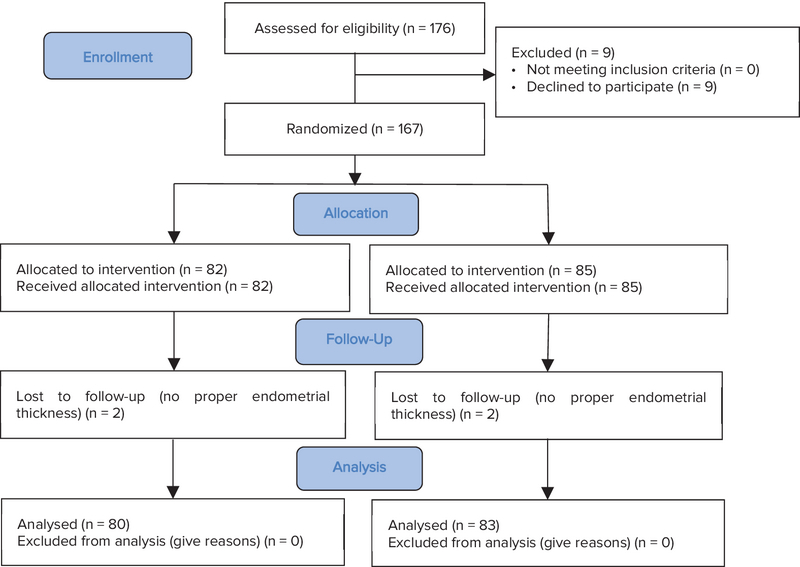
A total of 167 participants who had frozen embryos and regular ovulatory cycles were randomly divided into two groups for endometrial preparation. One group (82 women) was stimulated with letrozole 5mg/day and the other group (85 women) was hormonally stimulated by oral estradiol valerate (2 mg three times a day). All participants were followed serially by ultrasonography. Any patient who did not reach optimal endometrial thickness was excluded from the study. Implantation, biochemical and clinical pregnancy and abortion rate were reported.
There was no significant difference in the mean age, duration, and primary or secondary infertility, cause of the infertility, number, and quality of transferred embryos between the groups. The mean estradiol level on the day of transfer was 643 217 in the HR group and 547 212 in the letrozole group (P = 0.01), which was significantly different. The clinical pregnancy rate was 38.7 in the letrozole group, higher than the HR group (25.3) but not significantly different (P = 0.06).
For endometrial preparation in women with a normal cycle, letrozole yields higher pregnancy rate although it is not significant; due to its cost, ease in use, and lower side effects, letrozole is a good choice.
在冷冻胚胎移植(FET)中,采用刺激自然周期的子宫内膜准备方法具有成本较低和使用方便等优点。
比较来曲唑与激素替代(HR)在人工生殖技术中对月经周期正常的女性进行FET时子宫内膜准备的临床结局。
共有167名有冷冻胚胎且排卵周期规律的参与者被随机分为两组进行子宫内膜准备。一组(82名女性)用5mg/天的来曲唑刺激,另一组(85名女性)口服戊酸雌二醇(2mg,每日三次)进行激素刺激。所有参与者均通过超声进行连续监测。任何未达到最佳子宫内膜厚度的患者均被排除在研究之外。报告了着床、生化及临床妊娠情况和流产率。
两组之间在平均年龄、病程、原发或继发不孕、不孕原因、移植胚胎的数量和质量方面无显著差异。移植当天HR组的平均雌二醇水平为643±217,来曲唑组为547±212(P = 0.01),差异有统计学意义。来曲唑组的临床妊娠率为38.7%,高于HR组(25.3%),但差异无统计学意义(P = 0.06)。
对于月经周期正常的女性进行子宫内膜准备,来曲唑虽然妊娠率提高但差异不显著;由于其成本、使用便利性和较低的副作用,来曲唑是一个不错的选择。