Osté Maryse C J, Flores-Guerrero Jose L, Gruppen Eke G, Kieneker Lyanne M, Connelly Margery A, Otvos James D, Dullaart Robin P F, Bakker Stephan J L
Department of Internal Medicine, Division of Nephrology, University Medical Center Groningen, University of Groningen, 9700 RB Groningen, The Netherlands.
Department of Internal Medicine, Division of Endocrinology, University Medical Center Groningen, University of Groningen, 9700 RB Groningen, The Netherlands.
J Clin Med. 2020 Feb 13;9(2):511. doi: 10.3390/jcm9020511.
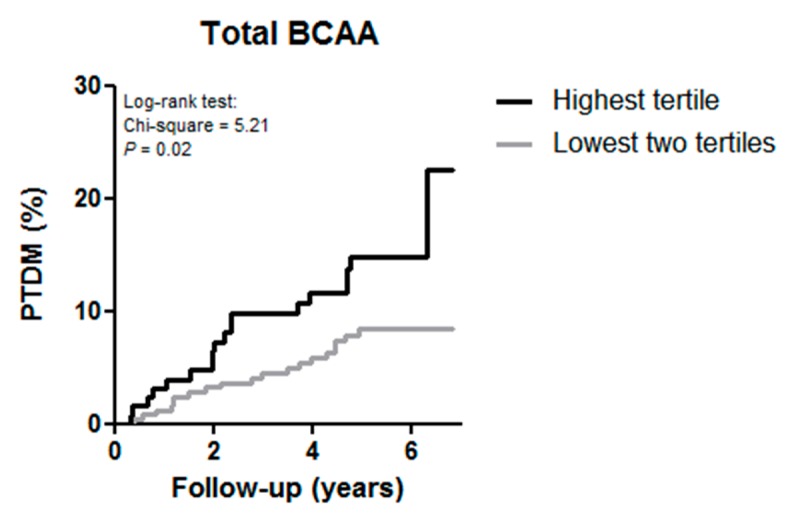
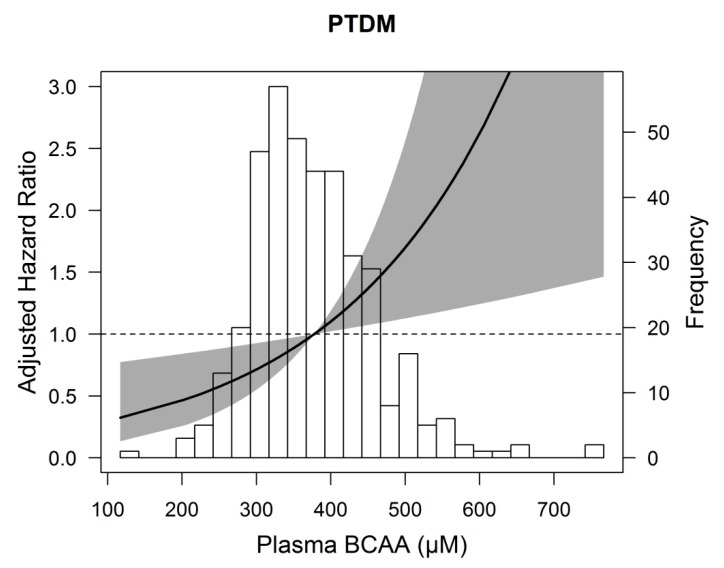
Post-transplant diabetes mellitus (PTDM) is a serious complication in renal transplant recipients. Branched-chain amino acids (BCAAs) are involved in the pathogenesis of insulin resistance. We determined the association of plasma BCAAs with PTDM and included adult renal transplant recipients (≥18 y) with a functioning graft for ≥1 year in this cross-sectional cohort study with prospective follow-up. Plasma BCAAs were measured in 518 subjects using nuclear magnetic resonance spectroscopy. We excluded subjects with a history of diabetes, leaving 368 non-diabetic renal transplant recipients eligible for analyses. Cox proportional hazards analyses were used to assess the association of BCAAs with the development of PTDM. Mean age was 51.1 ± 13.6 y (53.6% men) and plasma BCAA was 377.6 ± 82.5 µM. During median follow-up of 5.3 (IQR, 4.2-6.0) y, 38 (9.8%) patients developed PTDM. BCAAs were associated with a higher risk of developing PTDM (HR: 1.43, 95% CI 1.08-1.89) per SD change ( = 0.01), independent of age and sex. Adjustment for other potential confounders did not significantly change this association, although adjustment for HbA1c eliminated it. The association was mediated to a considerable extent (53%) by HbA1c. The association was also modified by HbA1c; BCAAs were only associated with renal transplant recipients without prediabetes (HbA1c < 5.7%). In conclusion, high concentrations of plasma BCAAs are associated with developing PTDM in renal transplant recipients. Alterations in BCAAs may represent an early predictive biomarker for PTDM.
移植后糖尿病(PTDM)是肾移植受者的一种严重并发症。支链氨基酸(BCAAs)参与胰岛素抵抗的发病机制。在这项具有前瞻性随访的横断面队列研究中,我们确定了血浆BCAAs与PTDM之间的关联,并纳入了移植肾有功能且时间≥1年的成年肾移植受者(≥18岁)。使用核磁共振波谱法对518名受试者的血浆BCAAs进行了测量。我们排除了有糖尿病病史的受试者,剩余368名非糖尿病肾移植受者符合分析条件。采用Cox比例风险分析来评估BCAAs与PTDM发生之间的关联。平均年龄为51.1±13.6岁(男性占53.6%),血浆BCAA为377.6±82.5µM。在中位随访5.3(四分位间距,4.2 - 6.0)年期间,38名(9.8%)患者发生了PTDM。每标准差变化( = 0.01)时,BCAAs与发生PTDM的较高风险相关(HR:1.43,95%CI 1.08 - 1.89),独立于年龄和性别。对其他潜在混杂因素进行调整后,这种关联没有显著变化,尽管对糖化血红蛋白(HbA1c)进行调整后消除了这种关联。这种关联在很大程度上(53%)由HbA1c介导。这种关联也受到HbA1c的影响;BCAAs仅与无糖尿病前期(HbA1c < 5.7%)的肾移植受者相关。总之,血浆BCAAs浓度高与肾移植受者发生PTDM相关。BCAAs的改变可能代表PTDM的一种早期预测生物标志物。