Gennari Arianna, Rios de la Rosa Julio M, Hohn Erwin, Pelliccia Maria, Lallana Enrique, Donno Roberto, Tirella Annalisa, Tirelli Nicola
Laboratory of Polymers and Biomaterials, Fondazione Istituto Italiano di Tecnologia, 16163 Genova, Italy.
NorthWest Centre for Advanced Drug Delivery (NoWCADD), School of Health Sciences, University of Manchester, Oxford Road, Manchester, M13 9PT, United Kingdom.
Beilstein J Nanotechnol. 2019 Dec 30;10:2594-2608. doi: 10.3762/bjnano.10.250. eCollection 2019.
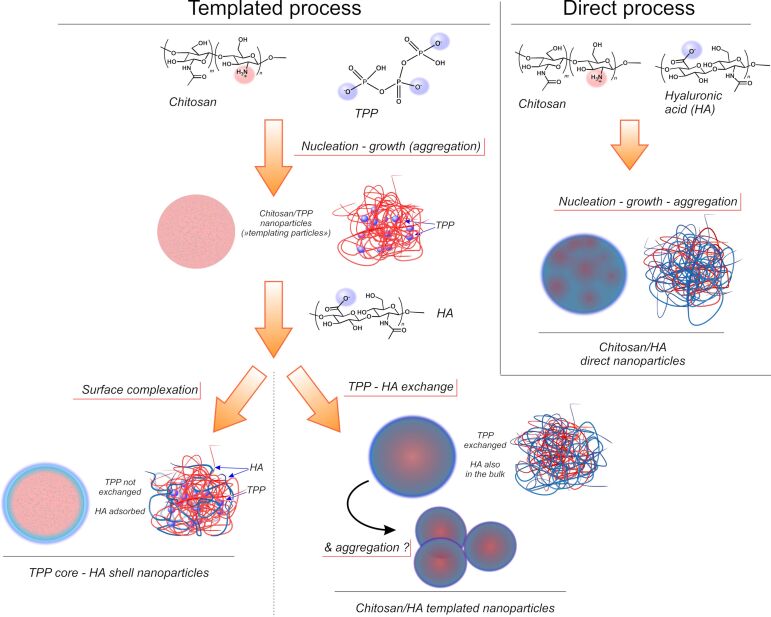
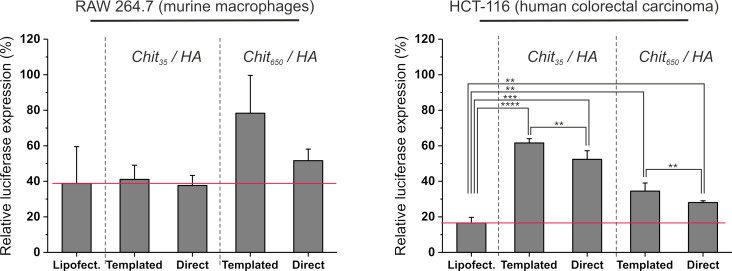
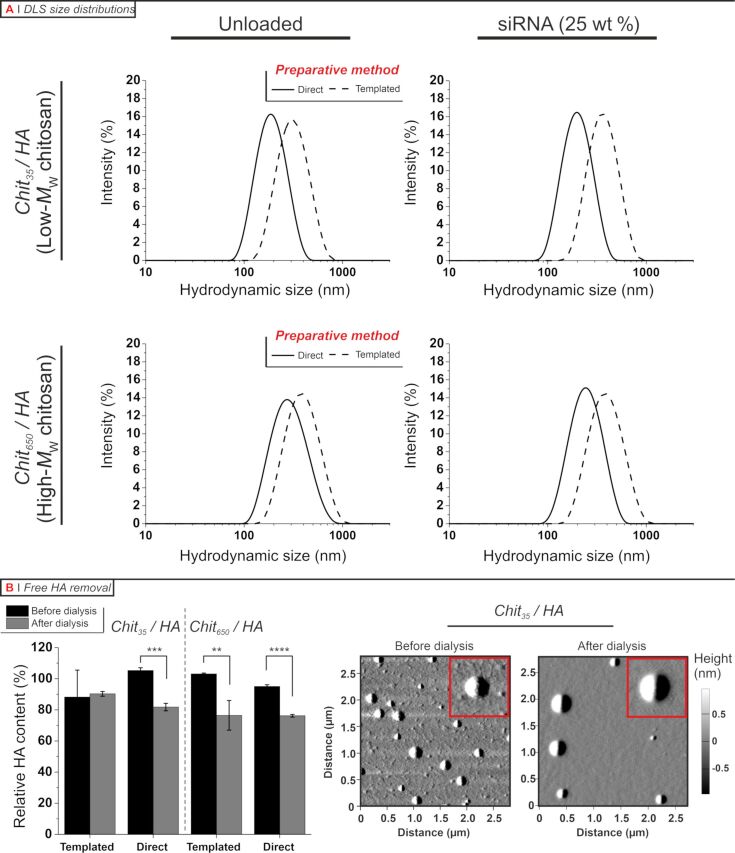
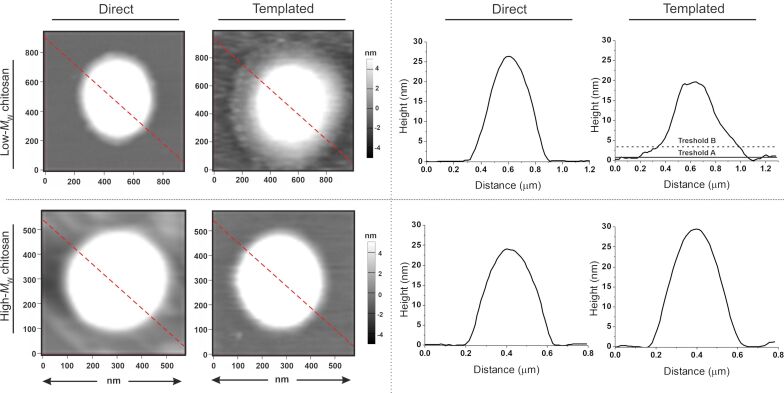
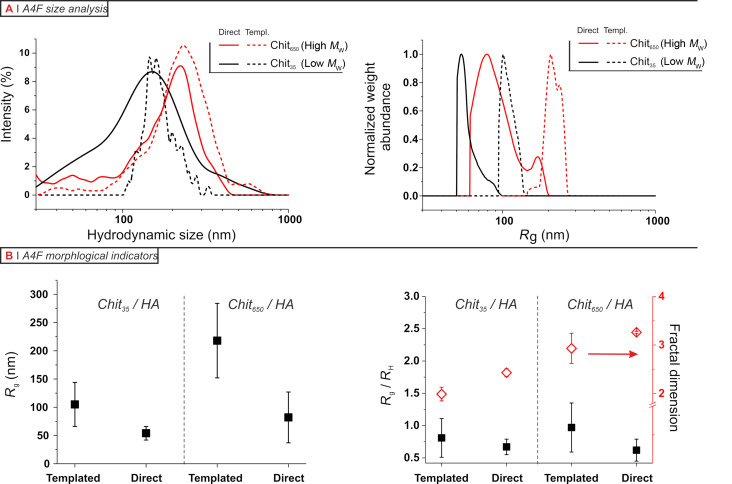
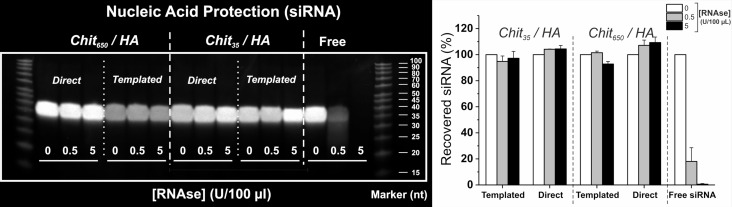
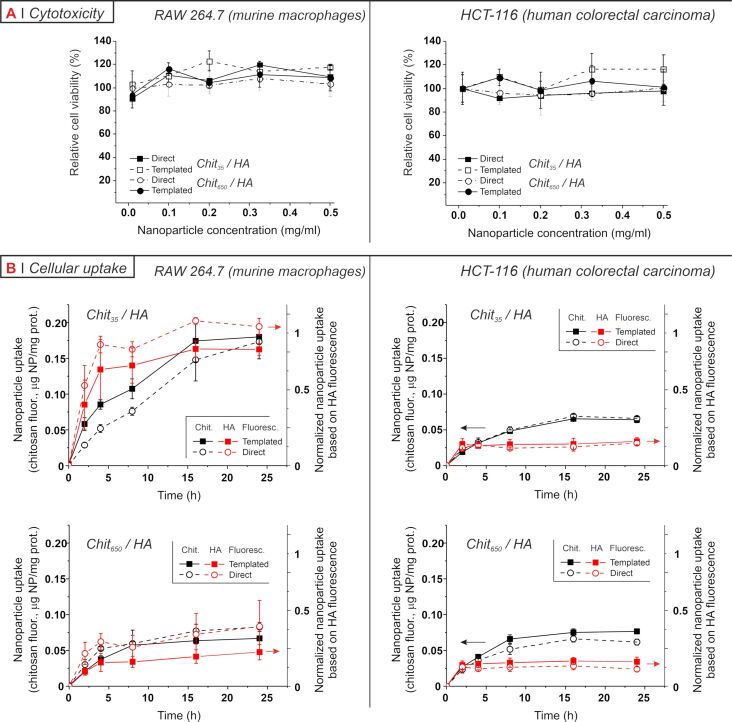
This study is about linking preparative processes of nanoparticles with the morphology of the nanoparticles and with their efficiency in delivering payloads intracellularly. The nanoparticles are composed of hyaluronic acid (HA) and chitosan; the former can address a nanoparticle to cell surface receptors such as CD44, the second allows both for entrapment of nucleic acids and for an endosomolytic activity that facilitates their liberation in the cytoplasm. Here, we have systematically compared nanoparticles prepared either A) through a two-step process based on intermediate (template) particles produced via ionotropic gelation of chitosan with triphosphate (TPP), which are then incubated with HA, or B) through direct polyelectrolyte complexation of chitosan and HA. Here we demonstrate that HA is capable to quantitatively replace TPP in the template process and significant aggregation takes place during the TPP-HA exchange. The templated chitosan/HA nanoparticles therefore have a mildly larger size (measured by dynamic light scattering alone or by field flow fractionation coupled to static or dynamic light scattering), and above all a higher aspect ratio ( / ) and a lower fractal dimension. We then compared the kinetics of uptake and the (antiluciferase) siRNA delivery performance in murine RAW 264.7 macrophages and in human HCT-116 colorectal tumor cells. The preparative method (and therefore the internal particle morphology) had little effect on the uptake kinetics and no statistically relevant influence on silencing (templated particles often showing a lower silencing). Cell-specific factors, on the contrary, overwhelmingly determined the efficacy of the carriers, with, e.g., those containing low-MW chitosan performing better in macrophages and those with high-MW chitosan in HCT-116.
本研究旨在将纳米颗粒的制备过程与纳米颗粒的形态及其在细胞内递送有效载荷的效率联系起来。这些纳米颗粒由透明质酸(HA)和壳聚糖组成;前者可使纳米颗粒靶向细胞表面受体,如CD44,后者既能包裹核酸,又具有溶酶体溶解活性,有助于核酸在细胞质中释放。在此,我们系统地比较了两种制备纳米颗粒的方法:A)两步法,基于壳聚糖与三磷酸(TPP)通过离子凝胶化产生的中间(模板)颗粒,然后与HA孵育;B)壳聚糖和HA直接进行聚电解质络合。我们在此证明,在模板法中HA能够定量替代TPP,并且在TPP - HA交换过程中会发生显著聚集。因此,模板化的壳聚糖/HA纳米颗粒尺寸略大(仅通过动态光散射或通过与静态或动态光散射耦合的场流分级法测量),最重要的是具有更高的纵横比(/)和更低的分形维数。然后,我们比较了在小鼠RAW 264.7巨噬细胞和人HCT - 116结肠直肠肿瘤细胞中的摄取动力学和(抗荧光素酶)siRNA递送性能。制备方法(以及因此内部颗粒形态)对摄取动力学影响很小,对沉默没有统计学上的显著影响(模板化颗粒通常显示较低的沉默效果)。相反,细胞特异性因素在很大程度上决定了载体的功效,例如,含有低分子量壳聚糖的载体在巨噬细胞中表现更好,而含有高分子量壳聚糖的载体在HCT - 116细胞中表现更好。