Taguchi Ayumi, Hara Konan, Tomio Jun, Kawana Kei, Tanaka Tomoki, Baba Satoshi, Kawata Akira, Eguchi Satoko, Tsuruga Tetsushi, Mori Mayuyo, Adachi Katsuyuki, Nagamatsu Takeshi, Oda Katsutoshi, Yasugi Toshiharu, Osuga Yutaka, Fujii Tomoyuki
Department of Obstetrics and Gynecology, Graduate School of Medicine, The University of Tokyo, Tokyo 113-8655, Japan.
Gynecology Division, Tokyo Metropolitan Cancer and Infectious Diseases Center, Komagome Hospital, Tokyo 113-8677, Japan.
Cancers (Basel). 2020 Jan 22;12(2):270. doi: 10.3390/cancers12020270.
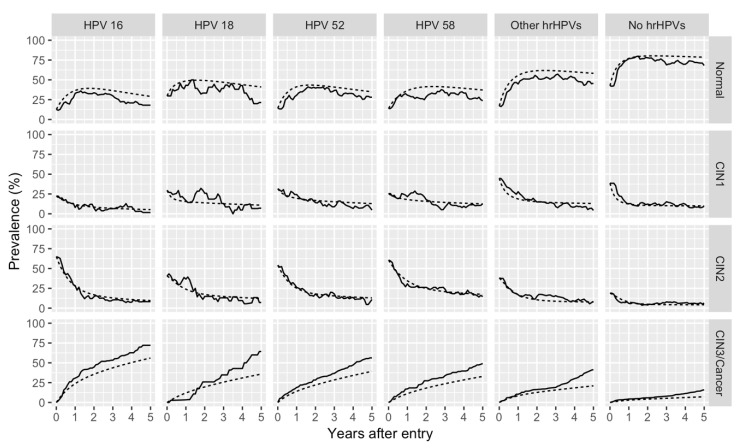
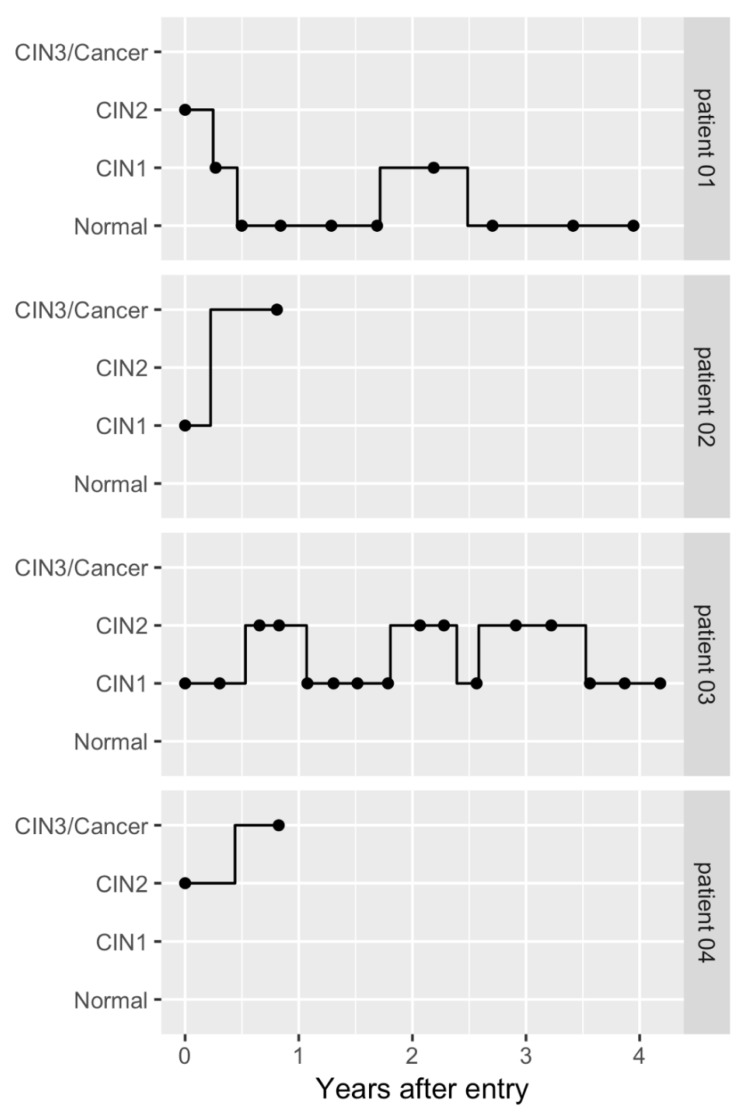
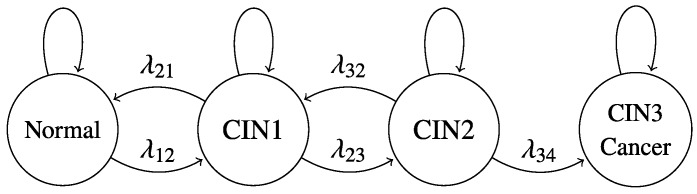
Cervical intraepithelial neoplasia (CIN) has a natural history of bidirectional transition between different states. Therefore, conventional statistical models assuming a unidirectional disease progression may oversimplify CIN fate. We applied a continuous-time multistate Markov model to predict this CIN fate by addressing the probability of transitions between multiple states according to the genotypes of high-risk human papillomavirus (HPV). This retrospective cohort comprised 6022 observations in 737 patients (195 normal, 259 CIN1, and 283 CIN2 patients at the time of entry in the cohort). Patients were followed up or treated at the University of Tokyo Hospital between 2008 and 2015. Our model captured the prevalence trend satisfactory, particularly for up to two years. The estimated probabilities for 2-year transition to CIN3 or more were the highest in HPV 16-positive patients (13%, 30%, and 42% from normal, CIN1, and CIN2, respectively) compared with those in the other genotype-positive patients (3.1%-9.6%, 7.6%-16%, and 21%-32% from normal, CIN1, and CIN2, respectively). Approximately 40% of HPV 52- or 58-related CINs remained at CIN1 and CIN2. The Markov model highlights the differences in transition and progression patterns between high-risk HPV-related CINs. HPV genotype-based management may be desirable for patients with cervical lesions.
宫颈上皮内瘤变(CIN)在不同状态之间具有双向转变的自然病程。因此,假设疾病单向进展的传统统计模型可能会过度简化CIN的转归。我们应用连续时间多状态马尔可夫模型,根据高危型人乳头瘤病毒(HPV)的基因型来预测CIN的转归,该模型考虑了多种状态之间转变的概率。这项回顾性队列研究纳入了737例患者的6022次观察结果(队列入组时195例正常、259例CIN1和283例CIN2患者)。患者于2008年至2015年期间在东京大学医院接受随访或治疗。我们的模型能够令人满意地捕捉患病率趋势,尤其是在长达两年的时间内。与其他基因型阳性患者相比,HPV 16阳性患者2年进展为CIN3或更高级别病变的估计概率最高(分别从正常、CIN1和CIN2进展的概率为13%、30%和42%)(分别从正常、CIN1和CIN2进展的概率为3.1%-9.6%、7.6%-16%和21%-32%)。约40%的HPV 52或58相关CIN仍处于CIN1和CIN2阶段。马尔可夫模型突出了高危型HPV相关CIN在转变和进展模式上的差异。对于宫颈病变患者,基于HPV基因型的管理可能是可取的。