Department of Otolaryngology-Head and Neck Surgery (JSG), Columbia University, New York, NY.
Department of Psychiatry (KKB, AHK, BRR), the New York State Psychiatric Institute, Columbia University, New York, NY.
Am J Geriatr Psychiatry. 2020 May;28(5):545-556. doi: 10.1016/j.jagp.2019.12.008. Epub 2020 Jan 21.
To assess whether the relationship between hearing and depressive symptoms is present among older adults classified as normal hearing (≤25 dB).
Cross-sectional epidemiologic study (Hispanic Community Health Study).
US multicentered.
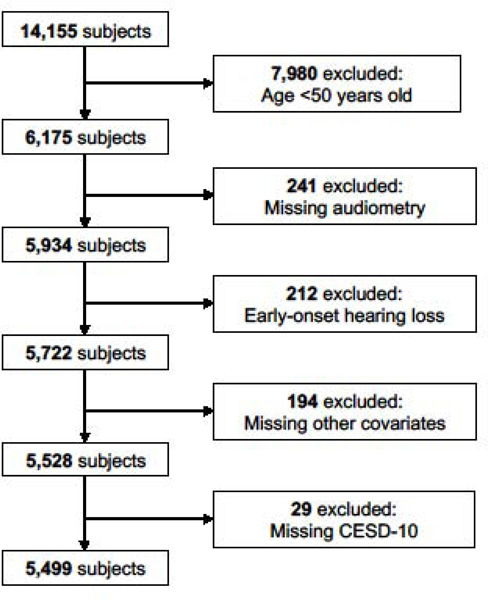
Adults ≥50 years old (n = 5,499) with normal hearing or hearing loss (HL).
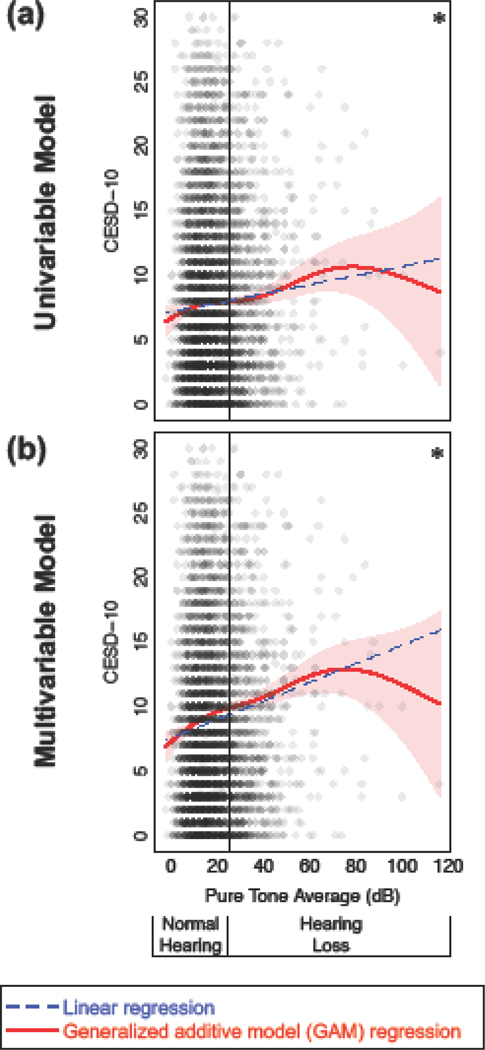
The primary exposure was hearing, defined continuously by the 4-frequency pure-tone average threshold (dB) on audiometry. Hearing was additionally categorized into normal hearing (≤25 dB) and HL (>25 dB). The main outcome was depressive symptoms, measured with the Center for Epidemiologic Studies Depression Scale-10 (CESD-10). Depressive symptoms were defined both continuously and binarily (where CESD-10 ≥10 was categorized as clinically significant depressive symptoms). Multivariable linear, logistic, and generalized additive modeling (GAM) regressions were performed.
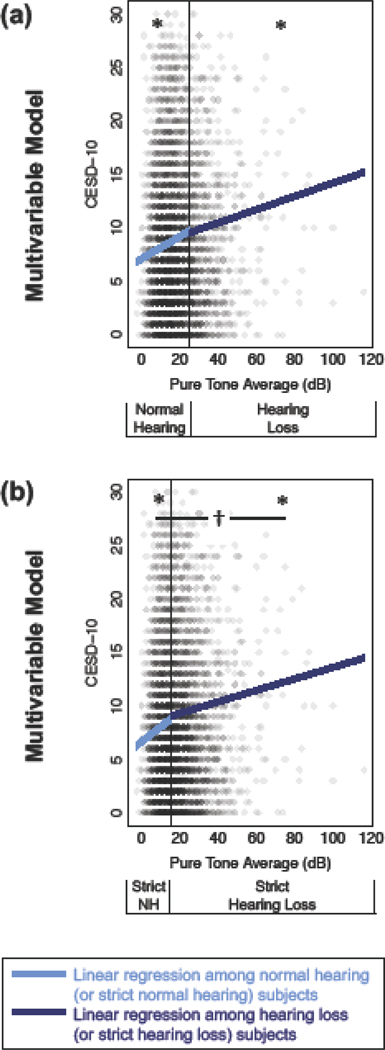
Among those with normal hearing, the CESD-10 score increased by 1.04 points (95% confidence interval [CI]: 0.70, 1.37) for every 10 dB decrease in hearing, adjusting for age, gender, education, cardiovascular disease, and hearing aid use. Among those with HL, the CESD-10 score increased by 0.62 points (95% CI: 0.23, 1.01) for every 10 dB decrease in hearing, adjusting for the same confounders. Similar findings were noted when the outcome was clinically significant depressive symptoms (adjusted odds ratio: 1.28 [1.14, 1.44] in normal hearing versus 1.26 [1.11, 1.44] in HL). In certain sensitivity analyses, the relationship between hearing and depressive symptoms was significantly stronger among those with normal hearing than in those with HL.
The relationship between hearing and clinically significant depressive symptoms is present among older adults with normal hearing (<25 dB). We introduce the term subclinical HL as imperfect hearing that is classically defined as normal (1-25 dB). The relationship between hearing and late life depressive symptoms may be more sensitive than previously recognized.
评估在被归类为正常听力(≤25dB)的老年人中,听力与抑郁症状之间的关系是否存在。
横断面流行病学研究(西班牙裔社区健康研究)。
美国多中心。
年龄在 50 岁及以上的成年人(n=5499),听力正常或有听力损失(HL)。
主要暴露因素为听力,通过听力计的 4 频纯音平均阈值(dB)连续定义。听力还分为正常听力(≤25dB)和 HL(>25dB)。主要结局是抑郁症状,使用流行病学研究中心抑郁量表-10(CESD-10)进行测量。抑郁症状连续和分类(CESD-10≥10 为临床显著抑郁症状)进行定义。进行多变量线性、逻辑和广义加性模型(GAM)回归。
在听力正常的人群中,每降低 10dB 听力,CESD-10 评分增加 1.04 分(95%置信区间[CI]:0.70,1.37),调整年龄、性别、教育程度、心血管疾病和助听器使用情况后。在听力损失的人群中,每降低 10dB 听力,CESD-10 评分增加 0.62 分(95%CI:0.23,1.01),调整相同的混杂因素后。当结局为临床显著抑郁症状时,也观察到类似的结果(听力正常的调整比值比:1.28[1.14,1.44]与 HL 的 1.26[1.11,1.44])。在某些敏感性分析中,听力与抑郁症状之间的关系在听力正常的人群中明显强于 HL 人群。
在听力正常(<25dB)的老年人中,听力与临床显著抑郁症状之间存在关系。我们提出了亚临床 HL 的概念,即经典定义为正常(1-25dB)的不完美听力。听力与晚年抑郁症状之间的关系可能比以前认识到的更为敏感。