Department of Preventive and Social Medicine, University of Otago, Dunedin, New Zealand.
Department of General Practice and Rural Health, University of Otago, Dunedin, New Zealand.
Health Expect. 2020 Apr;23(2):261-273. doi: 10.1111/hex.13017. Epub 2020 Jan 24.
Patient and public engagement in paediatric health-care decision making is under-researched, and there is a lack of systematically reviewed literature in this area.
To examine the extent, range and nature of published research investigating the engagement of children/youth, families and the public in paediatric service improvement, to summarize key aspects of the research identified and to identify gaps to help inform future research needs.
Literature was sought in MEDLINE, EMBASE, PsycINFO and CINAHL. Eligible articles presented research focused on patient, family and public engagement strategies in the paediatric health-care setting. Two reviewers extracted and charted data and analysed findings using a descriptive numerical summary analysis and a thematic analysis.
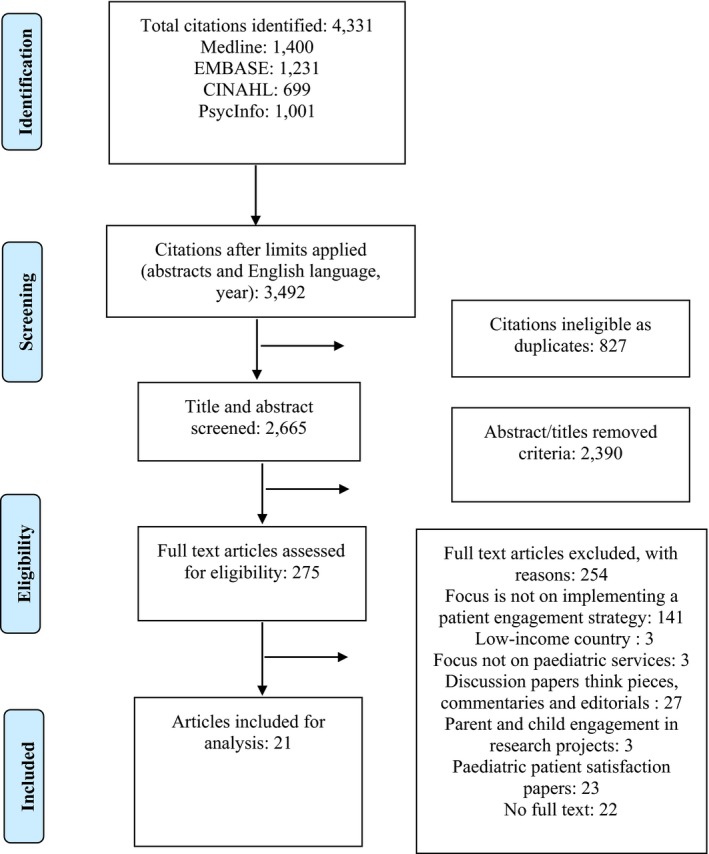
From 4331 articles, 21 were eligible. Most were from the United States. The majority of studies were undertaken in hospital settings and used quantitative methods. Various patient and public engagement strategies/interventions were examined, including shared decision-making tools, questionnaires, youth councils/family advisory groups, patient portals and online networks. Most of the studies examined child/youth/parent satisfaction, with fewer investigating treatment outcomes or service improvement. The majority of studies investigated an engagement strategy at the 'individual treatment' level of engagement. Regarding the continuum of engagement, most of the studies were at either the 'consultation' or 'involvement' stage.
Future research needs to focus on the investigation of engagement strategies delivered in primary care, and the use of more qualitative and mixed methods approaches is recommended. There is a gap in the area of engagement strategies directed towards 'service design and resources' and 'macro/policy' levels.
患者和公众参与儿科医疗决策的研究还不够深入,该领域缺乏系统审查的文献。
考察儿童/青少年、家庭和公众参与儿科服务改进的已发表研究的广度、范围和性质,总结已确定研究的关键方面,并确定差距,以帮助确定未来的研究需求。
在 MEDLINE、EMBASE、PsycINFO 和 CINAHL 中搜索文献。符合条件的文章展示了在儿科医疗环境中关注患者、家庭和公众参与策略的研究。两名审查员提取和图表数据,并使用描述性数值汇总分析和主题分析对发现进行分析。
从 4331 篇文章中,有 21 篇符合条件。大多数来自美国。大多数研究都是在医院进行的,采用了定量方法。研究考察了各种患者和公众参与策略/干预措施,包括共同决策工具、问卷、青年理事会/家庭咨询小组、患者门户和在线网络。大多数研究调查了儿童/青少年/家长的满意度,而调查治疗结果或服务改进的研究较少。大多数研究调查了参与度处于“个体治疗”层面的参与策略。关于参与度的连续体,大多数研究处于“咨询”或“参与”阶段。
未来的研究需要专注于在初级保健中调查参与策略的应用,建议使用更多定性和混合方法方法。在针对“服务设计和资源”以及“宏观/政策”层面的参与策略方面存在差距。