State Key Laboratory of Crop Stress Biology for Arid Areas and College of Plant Protection, Northwest A&F University, Yangling, Shaanxi, China.
State Key Laboratory of Crop Biology, Shandong Agricultural University, Tai'an, Shandong, China.
Plant Biotechnol J. 2020 Aug;18(8):1830-1842. doi: 10.1111/pbi.13345. Epub 2020 Mar 4.
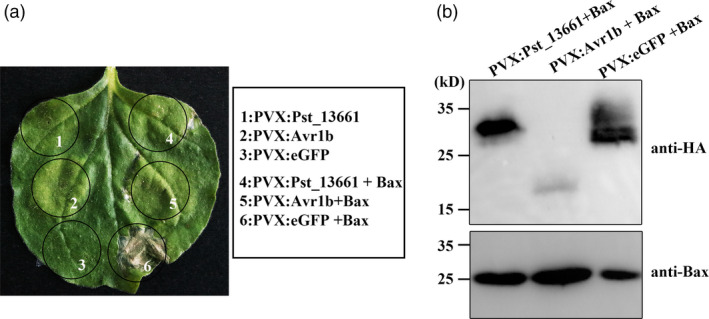
The cell wall of filamentous fungi, comprised of chitin, polysaccharide and glycoproteins, maintains the integrity of hyphae and protect them from defence responses by potential host plants. Here, we report that one polysaccharide deacetylase of Puccinia striiformis f. sp. tritici (Pst), Pst_13661, suppresses Bax-induced cell death in plants and Pst_13661 is highly induced during early stages of the interaction between wheat and Pst. Importantly, the transgenic wheat expressing the RNA interference (RNAi) construct of Pst_13661 exhibits high resistance to major Pst epidemic races CYR31, CYR32 and CYR33 by inhibiting growth and development of Pst, indicating that Pst_13661 is an available pathogenicity factor and is a potential target for generating broad-spectrum resistance breeding material of wheat. It forms a homo-polymer and has high affinity for chitin and germ tubes of Pst compared with the control. Besides, Pst_13661 suppresses chitin-induced plant defence in plants. Hence, we infer that Pst_13661 may modify the fungal cell wall to prevent recognition by apoplastic surveillance systems in plants. This study opens new approaches for developing durable disease-resistant germplasm by disturbing the growth and development of fungi and develops novel strategies to control crop diseases.
丝状真菌的细胞壁由几丁质、多糖和糖蛋白组成,它维持着菌丝的完整性,并保护它们免受潜在宿主植物的防御反应。在这里,我们报告称,小麦条锈菌(Puccinia striiformis f. sp. tritici)的一个多糖脱乙酰酶(Pst_13661)能够抑制 Bax 诱导的植物细胞死亡,并且在小麦与 Pst 互作的早期阶段,Pst_13661 高度诱导。重要的是,表达 Pst_13661 的 RNAi 构建体的转基因小麦对主要流行条锈菌生理小种 CYR31、CYR32 和 CYR33 表现出高抗性,通过抑制 Pst 的生长和发育,表明 Pst_13661 是一种可用的致病性因子,是培育小麦广谱抗性品种的潜在目标。它形成同源聚合物,与对照相比,它对 Pst 的几丁质和芽管具有高亲和力。此外,Pst_13661 还能抑制植物中几丁质诱导的植物防御反应。因此,我们推断 Pst_13661 可能通过修饰真菌细胞壁来防止植物质外体监测系统的识别。本研究为通过干扰真菌的生长和发育来开发持久的抗病种质提供了新的途径,并为控制作物病害开发了新的策略。