Department of Global Health, University of Washington, Seattle, WA, USA; Department of Epidemiology, University of Washington, Seattle, WA, USA; Childhood Acute Illness and Nutrition (CHAIN) Network, Nairobi, Kenya.
International Centre for Diarrheal Disease Research (icddr, b), Dhaka, Bangladesh.
Lancet Glob Health. 2020 Feb;8(2):e215-e224. doi: 10.1016/S2214-109X(19)30498-X.
Host vulnerabilities associated with acute malnutrition could facilitate the ability of specific enteric pathogens to cause diarrhoea and associated mortality. Using data from the Global Enteric Multicenter Study, we assessed whether acute malnutrition modifies the association between common enteric pathogens and moderate-to-severe diarrhoea, and whether associations between enteric pathogens and death were modified by acute malnutrition.
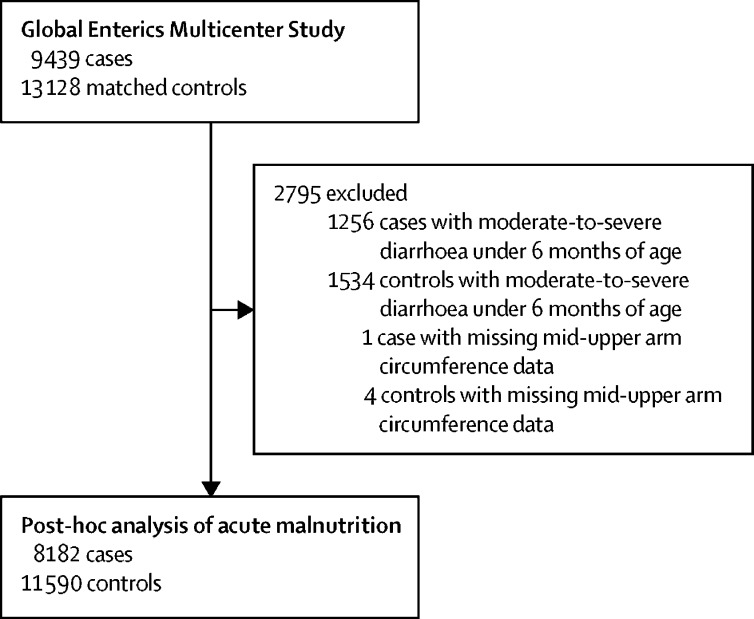
Children with moderate-to-severe diarrhoea and age-matched and community-matched controls were included in this post-hoc analysis if their mid-upper arm circumference had been measured and if they were older than 6 months of age. Acute malnutrition was defined as mid-upper arm circumference below 12·5 cm, capturing both severe acute malnutrition (<11·5 cm) and moderate acute malnutrition (≥11·5 cm and <12·5 cm). We tested whether acute malnutrition modified associations between enteric pathogens and moderate-to-severe diarrhoea in conditional logistic regression models. Among children with moderate-to-severe diarrhoea, Cox proportional hazards regression evaluated the modifying effect of acute malnutrition on the relationship between pathogens and 60-day fatality rate.
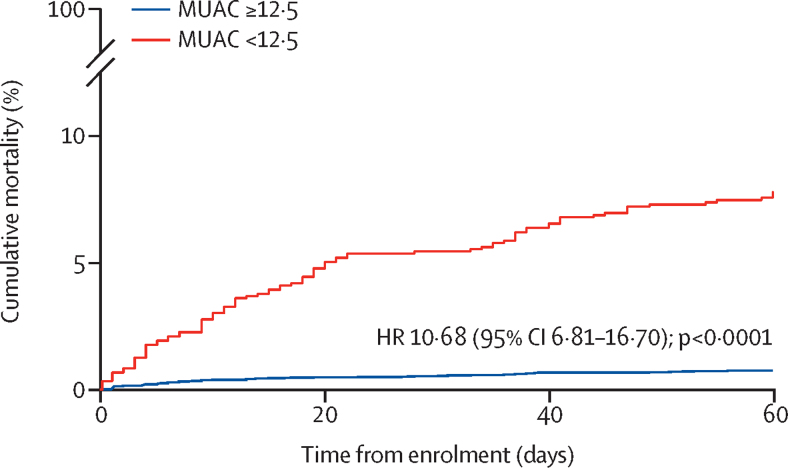
The age, site, and co-infection adjusted odds ratios (aORs) for moderate-to-severe diarrhoea associated with typical enteropathogenic Escherichia coli among children aged 6-11 months was 2·08 (95% CI 1·14-3·79) in children with acute malnutrition, and 0·97 (0·77-1·23) in children with better nutritional status, compared with healthy controls. Enterotoxigenic E coli producing heat-stable toxin among children aged 12-23 months also had a stronger association with moderate-to-severe diarrhoea in children with acute malnutrition (aOR 7·60 [2·63-21·95]) than among similarly aged children with better nutritional status (aOR 2·39 [1·76-3·25]). Results for Shigella spp, norovirus, and sapovirus suggested they had a stronger association with moderate-to-severe diarrhoea than other pathogens among children with better nutritional status, although Shigella spp remained associated with moderate-to-severe diarrhoea in both nutritional groups. 92 (64%) of 144 children with moderate-to-severe diarrhoea who died had acute malnutrition. Pathogen-specific 60-day fatality rates for all pathogens were higher among children with acute malnutrition, but no individual pathogen had a significantly larger increase in its relative association with mortality.
Acute malnutrition might strengthen associations between specific pathogens and moderate-to-severe diarrhoea. However, the strong link between acute malnutrition and mortality during moderate-to-severe diarrhoea in children is not limited to specific infections, and affects a broad spectrum of enteric pathogens. Interventions addressing acute malnutrition could be an effective way to lower the mortality of both childhood malnutrition and diarrhoea.
The Bill & Melinda Gates Foundation.
与急性营养不良相关的宿主易感性可能会增强特定肠道病原体引起腹泻和相关死亡的能力。我们利用全球肠道多中心研究的数据,评估了急性营养不良是否改变了常见肠道病原体与中重度腹泻之间的关联,以及肠道病原体与死亡之间的关联是否因急性营养不良而改变。
如果中重度腹泻患儿和年龄匹配及社区匹配的对照者的上臂中部周长已被测量且年龄大于 6 个月,则将其纳入本项基于后设分析。急性营养不良定义为上臂中部周长低于 12.5cm,同时包括严重急性营养不良(<11.5cm)和中度急性营养不良(≥11.5cm 和<12.5cm)。我们通过条件逻辑回归模型检验急性营养不良是否改变了肠道病原体与中重度腹泻之间的关联。对于中重度腹泻患儿,用 Cox 比例风险回归评估急性营养不良对病原体与 60 天病死率之间关系的修饰作用。
在 6-11 月龄儿童中,与急性营养不良相关的中重度腹泻的典型肠致病性大肠杆菌的年龄、地点和合并感染校正比值比(aOR)为 2.08(95%CI,1.14-3.79),在营养状况较好的儿童中为 0.97(0.77-1.23),与健康对照相比。在 12-23 月龄儿童中,产生热稳定毒素的肠产毒性大肠杆菌与急性营养不良儿童中中重度腹泻的相关性也更强(aOR,7.60[2.63-21.95]),而非营养状况较好的同年龄段儿童(aOR,2.39[1.76-3.25])。志贺氏菌属、诺如病毒和萨科病毒的结果表明,它们与营养状况较好的儿童中中重度腹泻的相关性比其他病原体更强,尽管志贺氏菌属在两组营养状况的儿童中都与中重度腹泻相关。在 144 例中重度腹泻死亡患儿中,92 例(64%)有急性营养不良。所有病原体的特定病原体 60 天病死率在急性营养不良儿童中更高,但没有单一病原体的相对关联性有显著增加。
急性营养不良可能会增强特定病原体与中重度腹泻之间的关联。然而,急性营养不良与儿童中重度腹泻相关死亡率之间的强关联不仅限于特定感染,还影响到广泛的肠道病原体。解决急性营养不良的干预措施可能是降低儿童营养不良和腹泻死亡率的有效途径。
比尔及梅琳达·盖茨基金会。