Department of Emergency Medicine, Weill Medical College of Cornell University, New York, NY, United States of America; Division of Pulmonary and Critical Care Medicine, Weill Medical College of Cornell University, New York, NY, United States of America; Department of Emergency Medicine, Albert Einstein College of Medicine, Bronx, NY, United States of America.
Department of Emergency Medicine, Weill Medical College of Cornell University, New York, NY, United States of America.
Am J Emerg Med. 2020 Dec;38(12):2607-2613. doi: 10.1016/j.ajem.2020.01.012. Epub 2020 Jan 7.
This study evaluates the utility of heart rate variability (HRV) for assessment of severity of illness and poor outcome in Emergency Department (ED) patients with sepsis. HRV measures evaluated included low frequency (LF) signal, high frequency (HF) signal, and deviations in LF and HF signal from age-adjusted reference values.
This was a prospective, observational study. Seventy-two adult ED patients were assessed within 6 h of arrival.
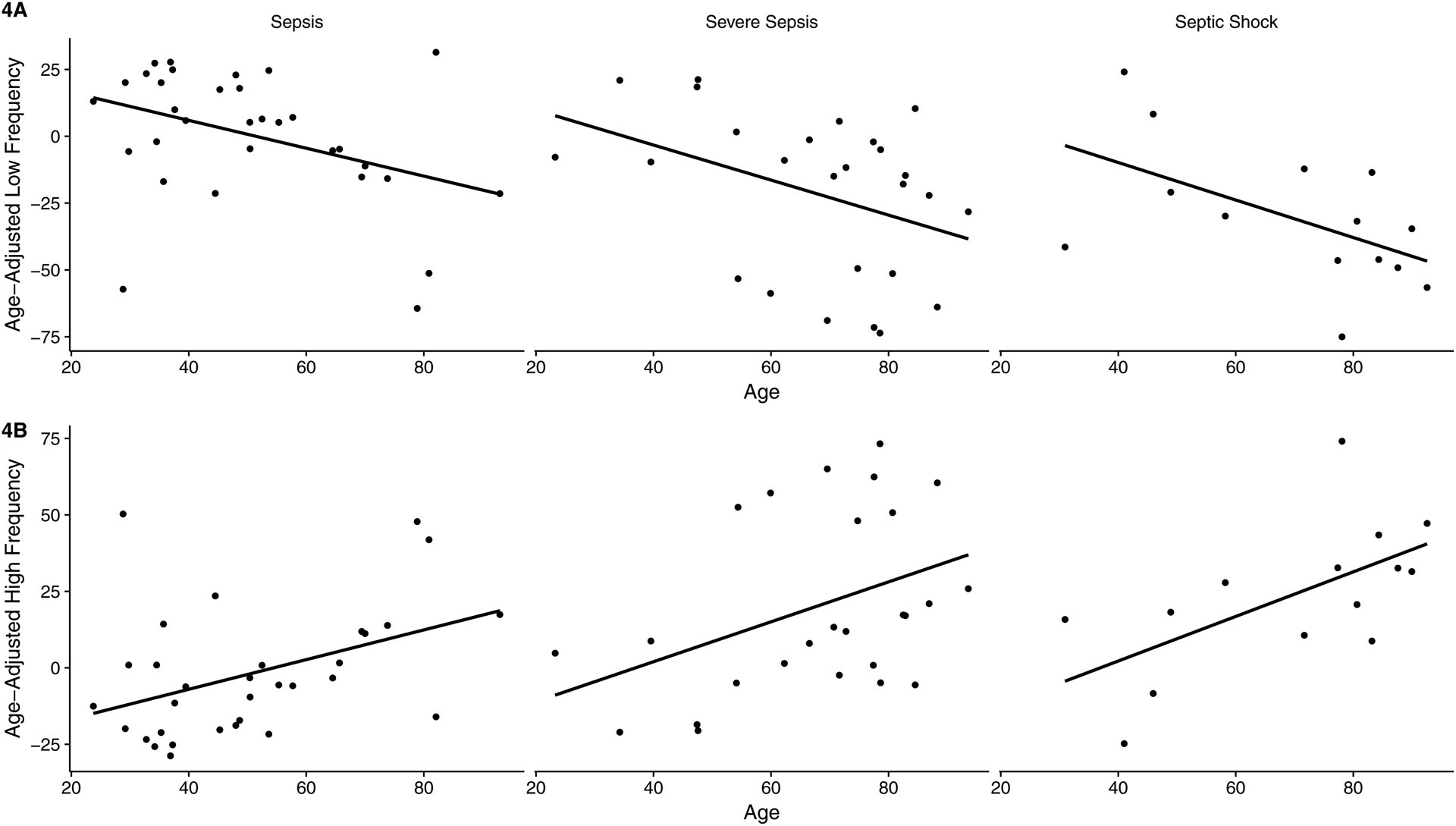
Severity of illness as defined by sepsis subtype correlated with decreased LF signal (sepsis: 70.68 ± 22.95, severe sepsis: 54.00 ± 28.41, septic shock: 45.54 ± 23.31, p = 0.02), increased HF signal (sepsis: 27.87 ± 19.42, severe sepsis: 44.63 ± 27.29, septic shock: 47.66 ± 20.98, p = 0.01), increasingly negative deviations in LF signal (sepsis: 0.41 ± 24.53, severe sepsis: -21.43 ± 30.09, septic shock -30.39 ± 26.09, p = 0.005) and increasingly positive deviations in HF signal (sepsis: -1.86 ± 21.09, severe sepsis: 20.07 ± 29.03, septic shock: 23.6 ± 24.17, p = 0.004). Composite poor outcome correlated with decreased LF signal (p = 0.008), increased HF signal (p = 0.03), large negative deviations in LF signal (p = 0.004) and large positive deviations in HF signal (p = 0.02). Deviations in LF and HF signal from age-adjusted reference values correlated with individual measures of poor outcome with greater consistency than LF or HF signal.
Accounting for the influence of age on baseline HRV signal improves the predictive value of HRV measures in ED patients with sepsis.
本研究评估了心率变异性(HRV)在评估急诊科(ED)脓毒症患者疾病严重程度和不良预后方面的作用。评估的 HRV 指标包括低频(LF)信号、高频(HF)信号以及 LF 和 HF 信号与年龄校正参考值的偏差。
这是一项前瞻性观察研究。72 名成年 ED 患者在入院后 6 小时内接受评估。
根据脓毒症亚型定义的疾病严重程度与 LF 信号降低相关(脓毒症:70.68±22.95,严重脓毒症:54.00±28.41,脓毒性休克:45.54±23.31,p=0.02),HF 信号升高(脓毒症:27.87±19.42,严重脓毒症:44.63±27.29,脓毒性休克:47.66±20.98,p=0.01),LF 信号的负偏差逐渐增加(脓毒症:0.41±24.53,严重脓毒症:-21.43±30.09,脓毒性休克:-30.39±26.09,p=0.005),HF 信号的正偏差逐渐增加(脓毒症:-1.86±21.09,严重脓毒症:20.07±29.03,脓毒性休克:23.6±24.17,p=0.004)。复合不良预后与 LF 信号降低相关(p=0.008),HF 信号升高(p=0.03),LF 信号的大负偏差(p=0.004)和 HF 信号的大正偏差(p=0.02)相关。LF 和 HF 信号与年龄校正参考值的偏差与单个不良预后指标相关,一致性优于 LF 或 HF 信号。
考虑到年龄对基线 HRV 信号的影响,可以提高 HRV 指标在 ED 脓毒症患者中的预测价值。