Lee Hyeonhoon, Yang Hyun-Lim, Ryu Ho Geol, Jung Chul-Woo, Cho Youn Joung, Yoon Soo Bin, Yoon Hyun-Kyu, Lee Hyung-Chul
Department of Anesthesiology and Pain Medicine, Seoul National University Hospital, Seoul, Republic of Korea.
Department of Data Science Research, Innovative Medical Technology Research Institute, Seoul National University Hospital, Seoul, Republic of Korea.
NPJ Digit Med. 2023 Nov 23;6(1):215. doi: 10.1038/s41746-023-00960-2.
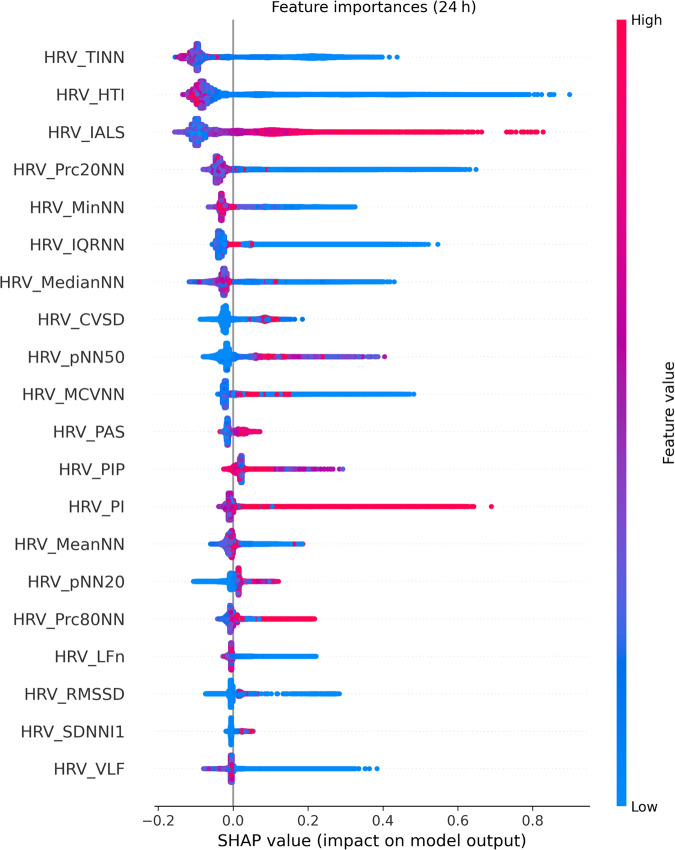
Predicting in-hospital cardiac arrest in patients admitted to an intensive care unit (ICU) allows prompt interventions to improve patient outcomes. We developed and validated a machine learning-based real-time model for in-hospital cardiac arrest predictions using electrocardiogram (ECG)-based heart rate variability (HRV) measures. The HRV measures, including time/frequency domains and nonlinear measures, were calculated from 5 min epochs of ECG signals from ICU patients. A light gradient boosting machine (LGBM) algorithm was used to develop the proposed model for predicting in-hospital cardiac arrest within 0.5-24 h. The LGBM model using 33 HRV measures achieved an area under the receiver operating characteristic curve of 0.881 (95% CI: 0.875-0.887) and an area under the precision-recall curve of 0.104 (95% CI: 0.093-0.116). The most important feature was the baseline width of the triangular interpolation of the RR interval histogram. As our model uses only ECG data, it can be easily applied in clinical practice.
预测重症监护病房(ICU)患者的院内心脏骤停情况,有助于及时采取干预措施以改善患者预后。我们开发并验证了一种基于机器学习的实时模型,用于使用基于心电图(ECG)的心率变异性(HRV)测量来预测院内心脏骤停。HRV测量包括时域/频域和非线性测量,是从ICU患者的5分钟心电图信号片段中计算得出的。使用轻量级梯度提升机(LGBM)算法开发了所提出的模型,用于预测0.5至24小时内的院内心脏骤停。使用33种HRV测量的LGBM模型在受试者工作特征曲线下的面积为0.881(95%CI:0.875 - 0.887),在精确召回率曲线下的面积为0.104(95%CI:0.093 - 0.116)。最重要的特征是RR间期直方图的三角插值的基线宽度。由于我们的模型仅使用心电图数据,因此可以很容易地应用于临床实践。