Center for Neuroscience at the University of Pittsburgh, Pittsburgh Center for Pain Research and Department of Neurobiology, University of Pittsburgh School of Medicine, Pittsburgh, PA, USA.
Center for Neuroscience at the University of Pittsburgh, Pittsburgh Center for Pain Research and Department of Neurobiology, University of Pittsburgh School of Medicine, Pittsburgh, PA, USA.
Trends Neurosci. 2020 Mar;43(3):170-181. doi: 10.1016/j.tins.2019.12.007. Epub 2020 Jan 23.
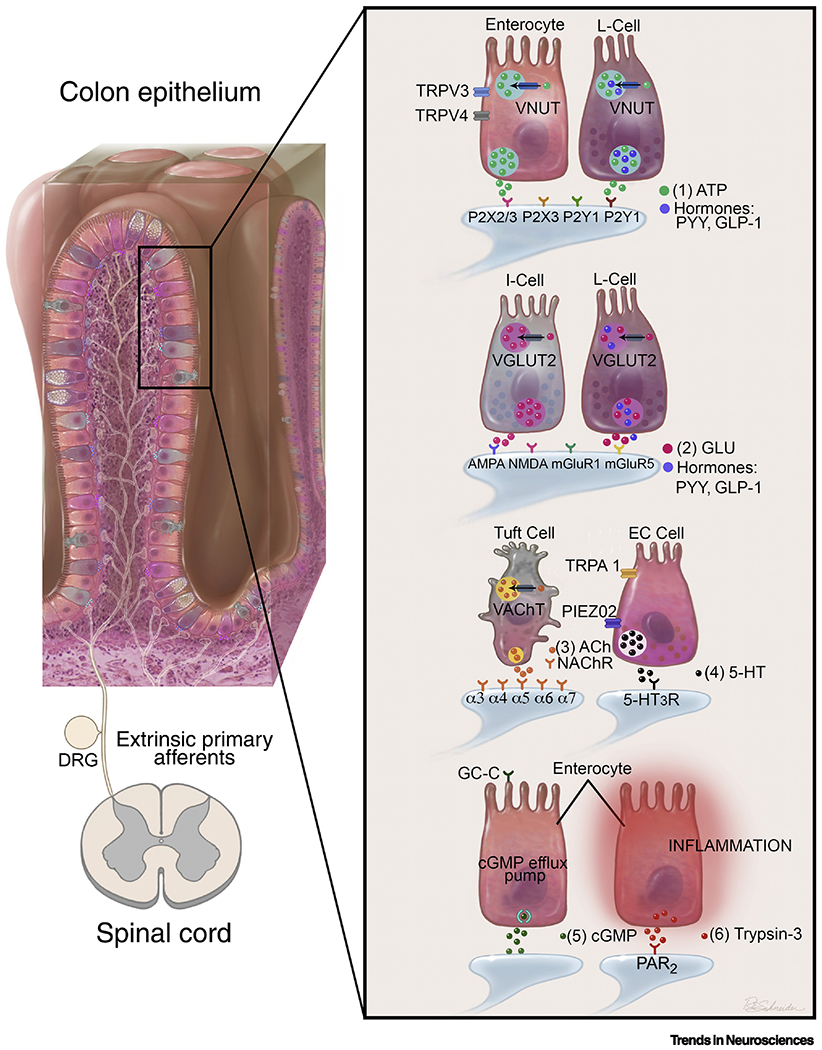
Visceral hypersensitivity and pain result, at least in part, from increased excitability of primary afferents that innervate the colon. In addition to intrinsic changes in these neurons, emerging evidence indicates that changes in lining epithelial cells may also contribute to increased excitability. Here we review recent studies on how colon epithelial cells communicate directly with colon afferents. Specifically, anatomical studies revealed specialized synaptic connections between epithelial cells and nerve fibers and studies using optogenetic activation of the epithelium showed initiation of pain-like responses. We review the possible mechanisms of epithelial-neuronal communication and provide an overview of the possible neurotransmitters and receptors involved. Understanding the biology of this interface and how it changes in pathological conditions may provide new treatments for visceral pain conditions.
内脏敏化和疼痛的产生,至少部分是由于支配结肠的初级传入纤维兴奋性增加所致。除了这些神经元的内在变化外,新出现的证据表明,衬里上皮细胞的变化也可能导致兴奋性增加。在这里,我们回顾了最近关于结肠上皮细胞如何与结肠传入神经直接通讯的研究。具体来说,解剖学研究揭示了上皮细胞和神经纤维之间的特殊突触连接,并且使用光遗传学激活上皮细胞的研究表明了引起类似疼痛的反应的起始。我们回顾了上皮细胞-神经元通讯的可能机制,并概述了涉及的可能神经递质和受体。了解这个界面的生物学特性以及它在病理条件下如何变化,可能为内脏疼痛状况提供新的治疗方法。