Riehl Lydia, Fürst Johannes, Kress Michaela, Rykalo Nadiia
Institute of Physiology, Department of Physiology and Medical Physics, Medical University Innsbruck, Innsbruck, Austria.
Front Neurosci. 2024 Jan 5;17:1302957. doi: 10.3389/fnins.2023.1302957. eCollection 2023.
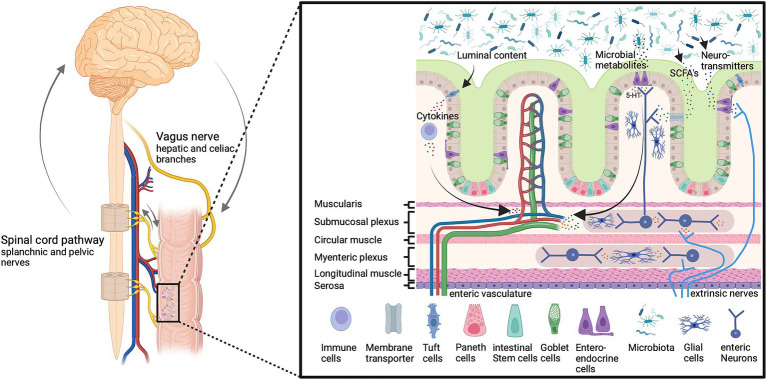
Increasing evidence links the gut microbiome and the nervous system in health and disease. This narrative review discusses current views on the interaction between the gut microbiota, the intestinal epithelium, and the brain, and provides an overview of the communication routes and signals of the bidirectional interactions between gut microbiota and the brain, including circulatory, immunological, neuroanatomical, and neuroendocrine pathways. Similarities and differences in healthy gut microbiota in humans and mice exist that are relevant for the translational gap between non-human model systems and patients. There is an increasing spectrum of metabolites and neurotransmitters that are released and/or modulated by the gut microbiota in both homeostatic and pathological conditions. Dysbiotic disruptions occur as consequences of critical illnesses such as cancer, cardiovascular and chronic kidney disease but also neurological, mental, and pain disorders, as well as ischemic and traumatic brain injury. Changes in the gut microbiota (dysbiosis) and a concomitant imbalance in the release of mediators may be cause or consequence of diseases of the central nervous system and are increasingly emerging as critical links to the disruption of healthy physiological function, alterations in nutrition intake, exposure to hypoxic conditions and others, observed in brain disorders. Despite the generally accepted importance of the gut microbiome, the bidirectional communication routes between brain and gut are not fully understood. Elucidating these routes and signaling pathways in more detail offers novel mechanistic insight into the pathophysiology and multifaceted aspects of brain disorders.
越来越多的证据表明,肠道微生物群与健康和疾病中的神经系统存在关联。这篇叙述性综述讨论了当前关于肠道微生物群、肠上皮和大脑之间相互作用的观点,并概述了肠道微生物群与大脑之间双向相互作用的通信途径和信号,包括循环、免疫、神经解剖和神经内分泌途径。人类和小鼠健康肠道微生物群存在的异同与非人类模型系统和患者之间的转化差距相关。在稳态和病理条件下,肠道微生物群释放和/或调节的代谢物和神经递质种类越来越多。生态失调是癌症、心血管疾病和慢性肾病等重大疾病的后果,但也是神经、精神和疼痛障碍以及缺血性和创伤性脑损伤的后果。肠道微生物群的变化(生态失调)以及介质释放的伴随失衡可能是中枢神经系统疾病的原因或后果,并且越来越多地成为与大脑疾病中观察到的健康生理功能破坏、营养摄入改变、暴露于缺氧条件等关键联系。尽管肠道微生物群的重要性已得到普遍认可,但大脑与肠道之间的双向通信途径尚未完全了解。更详细地阐明这些途径和信号通路,为深入了解脑部疾病的病理生理学和多方面情况提供了新的机制见解。