Department of Food and Drug , University of Parma , Parma 43124 , Italy.
Tissue Engineering Unit , Institute for Stem Cell Biology, Regenerative Medicine and Innovative Therapies-ISBReMIT, Fondazione IRCSS Casa Sollievo della Sofferenza , San Giovanni Rotondo 71013 , Foggia , Italy.
J Agric Food Chem. 2020 Feb 19;68(7):2082-2090. doi: 10.1021/acs.jafc.9b07361. Epub 2020 Feb 4.
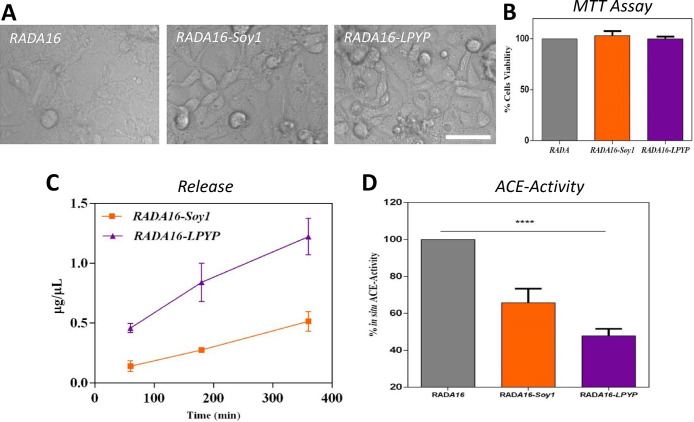
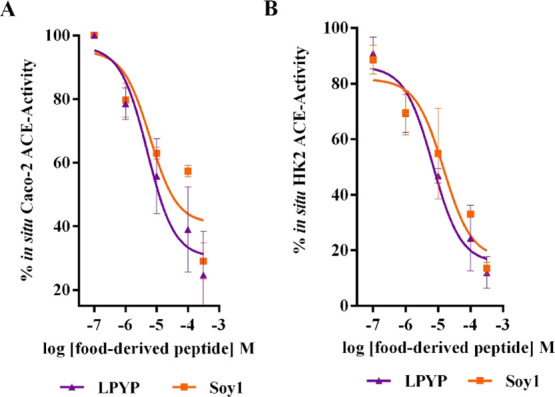
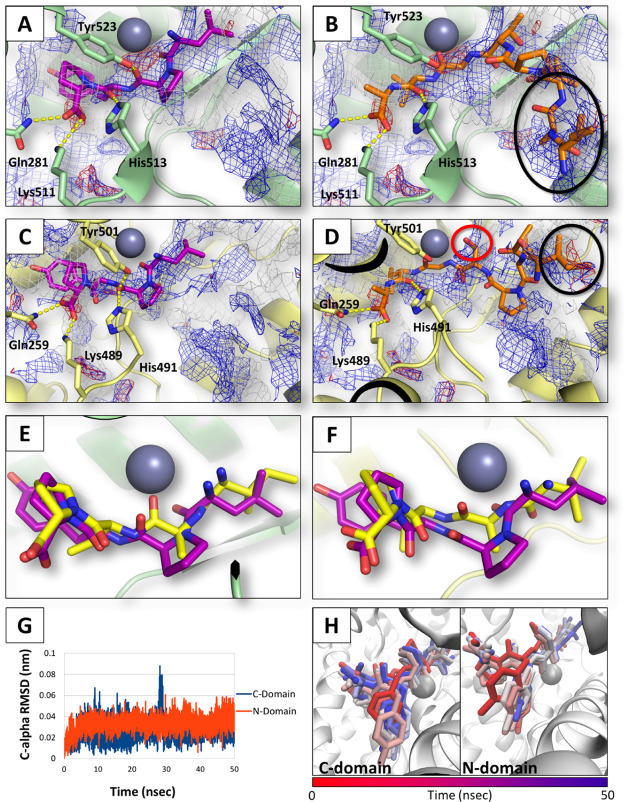
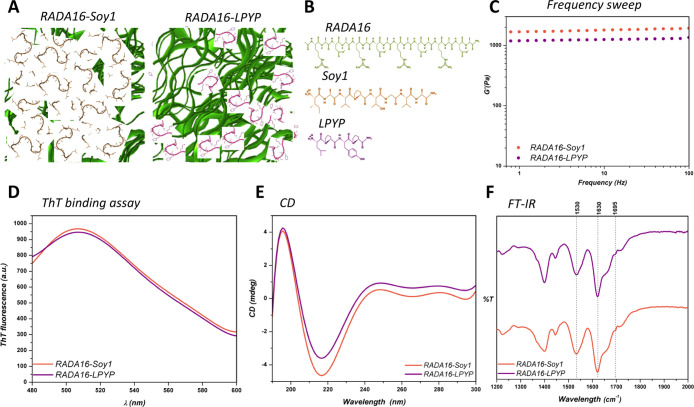
IAVPTGVA (Soy1) and LPYP are two soybean peptides, which display a multifunctional behavior, showing in vitro hypocholesterolemic and hypoglycemic activities. A preliminary screening of their structures using BIOPEP suggested that they might be potential angiotensin-converting enzyme (ACE) inhibitors. Therefore, a bottom-up-aided approach was developed in order to clarify the in vitro hypotensive activity. Soy1 and LPYP dropped the intestinal and renal ACE enzyme activity with IC values equal to 14.7 ± 0.28 and 5.0 ± 0.28 μM (Caco-2 cells), and 6.0 ± 0.35 and 6.8 ± 0.20 μM (HK-2 cells), respectively. In parallel, a molecular modeling study suggested their capability to act as competitive inhibitors of this enzyme. Finally, in order to increase both their stability and hypotensive properties, a suitable strategy for the harmless control of their release from a nanomaterial was developed through their encapsulation into the RADA16-assembling peptide.
IAVPTGVA(大豆 1 号)和 LPYP 是两种大豆肽,具有多种功能,表现出体外降胆固醇和降血糖活性。使用 BIOPEP 对其结构进行初步筛选表明,它们可能是潜在的血管紧张素转化酶 (ACE) 抑制剂。因此,开发了一种自下而上辅助的方法来阐明体外降压活性。大豆 1 号和 LPYP 降低了肠和肾 ACE 酶的活性,IC 值分别为 14.7±0.28 和 5.0±0.28μM(Caco-2 细胞),6.0±0.35 和 6.8±0.20μM(HK-2 细胞)。平行地,分子建模研究表明它们能够作为该酶的竞争性抑制剂发挥作用。最后,为了提高它们的稳定性和降压特性,通过将它们包封到 RADA16 组装肽中,开发了一种将它们从纳米材料中无害释放的合适策略。