Department of Zoology, Universidad de Granada, Granada, Spain.
Agencia de Medio Ambiente y Agua (Consejería de Agricultura, Ganadería, Pesca y Desarrollo Sostenible, Junta de Andalucía), Gerencia de Granada, Edificio Zeus III, Granada, Spain.
PLoS One. 2020 Jan 28;15(1):e0227708. doi: 10.1371/journal.pone.0227708. eCollection 2020.
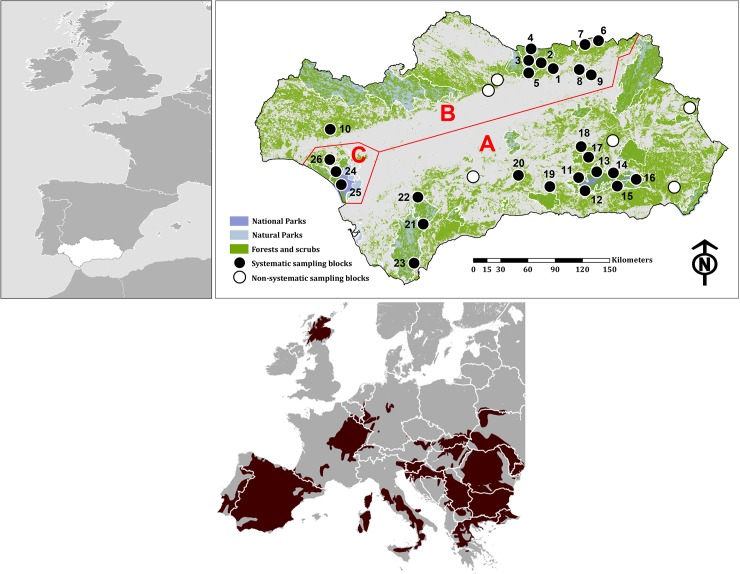
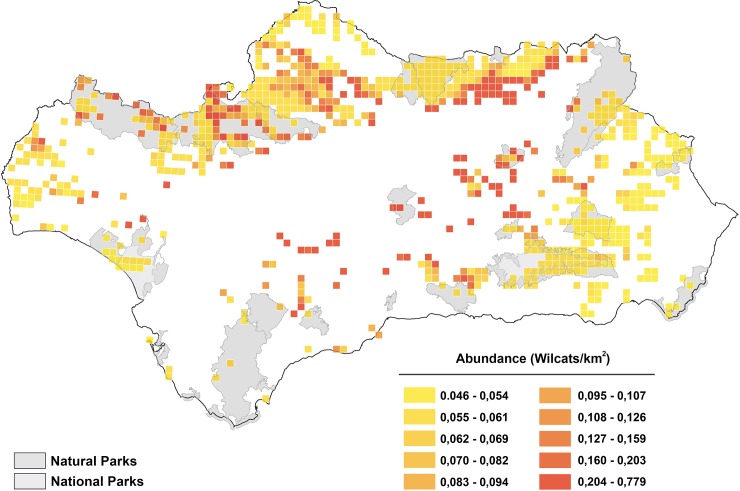
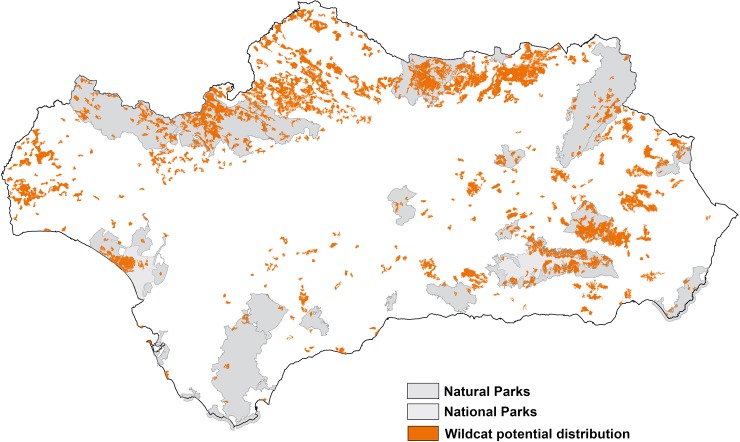
Knowledge of population dynamics of threatened species in the wild is key to effective conservation actions. However, at present, there are many examples of endangered animals for which their current situation is unknown, and not just in remote areas and less developed countries. We have explored this topic by studying the paradigmatic case of the European wildcat (Felis silvestris silvestris), an endangered small carnivore whose status has been subjectively established on the basis of non-systematic approaches and opportunistic records. Little is known about its demographic situation, prompting the need for information to improve conservation measures. However, the secretive behaviour of felines along with its low density in natural conditions have prevented the gathering of sufficient data. We developed a field sampling strategy for one of the largest populations (Andalusia, South Spain, 87,268 km2), based on a logistically viable systematic non-intrusive survey by camera-trapping. This study offers the first large-scale estimation for any European wildcat population, based on analytical approaches applied on Species Distribution Models. A hierarchical approach based on a Maxent model for distribution estimation was used, along with Generalised Linear Models for density estimation from explicit spatial capture-recapture data. Our results show that the distribution range is smaller and more highly fragmented than previously assumed. The overall estimated density was very low (0.069 ±0.0019 wildcats/km2) and the protected areas network seems to be insufficient to cover a significant part of the population or a viable nucleus in demographic terms. Indeed, the most important areas remain unprotected. Our main recommendations are to improve the protected area network and/or vigilance programs in hunting estates, in addition to studying and improving connectivity between the main population patches.
了解野生濒危物种的种群动态是采取有效保护措施的关键。然而,目前许多濒危动物的现状尚不清楚,而且不仅仅是在偏远地区和欠发达国家。我们通过研究欧洲野生猫(Felis silvestris silvestris)这一典型案例来探讨这个话题,这是一种濒危的小型食肉动物,其状况是基于非系统方法和机会性记录主观确定的。关于其种群状况,人们知之甚少,这促使人们需要更多的信息来改善保护措施。然而,猫科动物的隐秘行为及其在自然条件下的低密度使得难以收集足够的数据。我们制定了一种基于摄像监测的、在逻辑上可行的、非侵入性的系统抽样策略,用于对一个最大的种群(西班牙南部的安达卢西亚,面积 87268 平方公里)进行抽样。本研究基于物种分布模型上应用的分析方法,对任何欧洲野生猫种群进行了首次大规模的估计。我们使用了一种基于最大熵模型的分布估计分层方法,以及基于明确空间捕获-再捕获数据的广义线性模型进行密度估计。我们的研究结果表明,分布范围比以前假设的更小,且更加碎片化。总体估计密度非常低(0.069±0.0019 只野生猫/平方公里),而且保护区域网络似乎不足以覆盖人口的重要部分或在人口统计学上具有可行性的核心区域。事实上,最重要的区域仍然没有得到保护。我们的主要建议是改进保护区域网络和/或狩猎区的警戒计划,此外还需要研究和改善主要种群斑块之间的连通性。