Centro de Ecología, Instituto Venezolano de Investigaciones Científicas (IVIC), Caracas, Venezuela.
Panthera, New York, United States of America.
PLoS One. 2018 Mar 26;13(3):e0194719. doi: 10.1371/journal.pone.0194719. eCollection 2018.
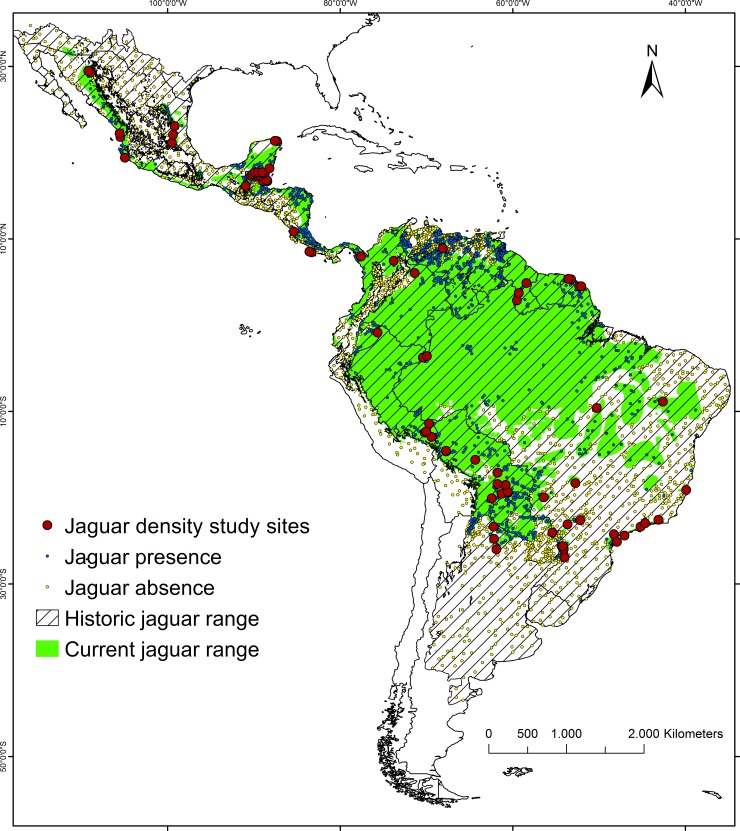
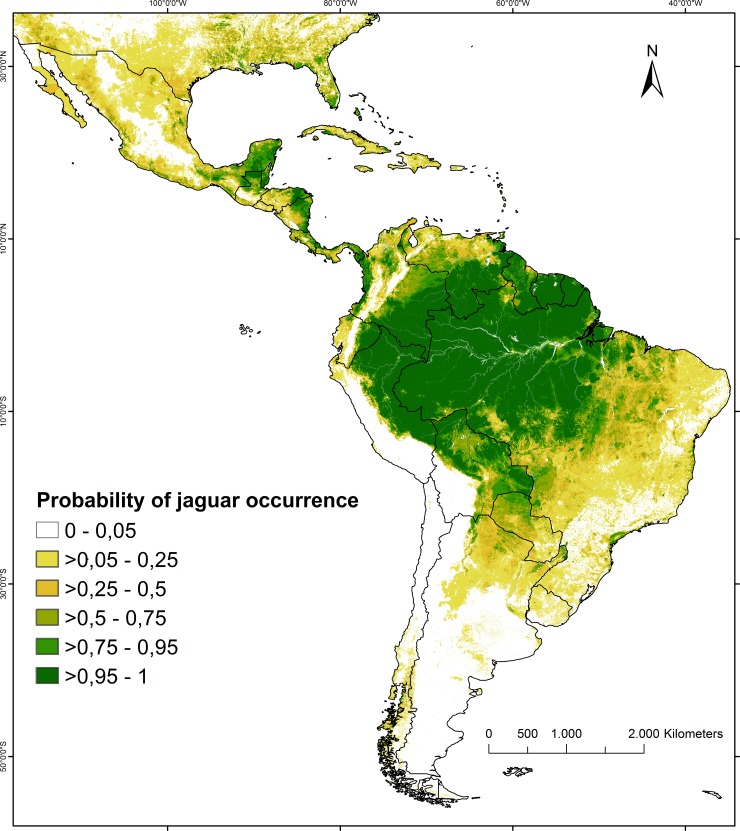
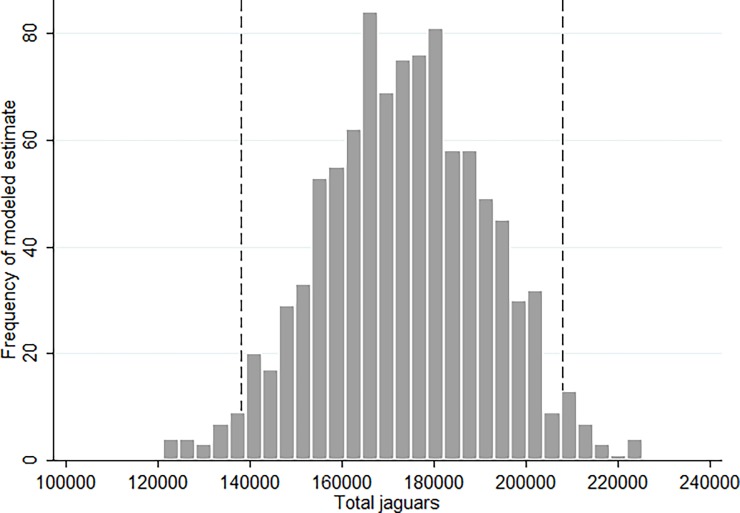
Broad scale population estimates of declining species are desired for conservation efforts. However, for many secretive species including large carnivores, such estimates are often difficult. Based on published density estimates obtained through camera trapping, presence/absence data, and globally available predictive variables derived from satellite imagery, we modelled density and occurrence of a large carnivore, the jaguar, across the species' entire range. We then combined these models in a hierarchical framework to estimate the total population. Our models indicate that potential jaguar density is best predicted by measures of primary productivity, with the highest densities in the most productive tropical habitats and a clear declining gradient with distance from the equator. Jaguar distribution, in contrast, is determined by the combined effects of human impacts and environmental factors: probability of jaguar occurrence increased with forest cover, mean temperature, and annual precipitation and declined with increases in human foot print index and human density. Probability of occurrence was also significantly higher for protected areas than outside of them. We estimated the world's jaguar population at 173,000 (95% CI: 138,000-208,000) individuals, mostly concentrated in the Amazon Basin; elsewhere, populations tend to be small and fragmented. The high number of jaguars results from the large total area still occupied (almost 9 million km2) and low human densities (< 1 person/km2) coinciding with high primary productivity in the core area of jaguar range. Our results show the importance of protected areas for jaguar persistence. We conclude that combining modelling of density and distribution can reveal ecological patterns and processes at global scales, can provide robust estimates for use in species assessments, and can guide broad-scale conservation actions.
为了进行保护工作,人们希望对大量物种的种群数量进行估算。然而,对于许多包括大型食肉动物在内的隐秘物种来说,这种估算往往很困难。本研究基于已发表的通过相机陷阱获得的密度估算值、存在/缺失数据以及可从卫星图像获取的全球预测变量,建立了模型来估算整个物种范围内大型食肉动物——美洲虎的密度和出现率。然后,我们将这些模型结合在一个分层框架中,以估算总种群数量。我们的模型表明,潜在的美洲虎密度与初级生产力的衡量标准最为相关,在生产力最高的热带栖息地密度最高,并且随着与赤道距离的增加而呈现明显的下降梯度。相比之下,美洲虎的分布由人类影响和环境因素的综合效应决定:美洲虎出现的概率随着森林覆盖率、平均温度和年降水量的增加而增加,随着人类足迹指数和人口密度的增加而下降。保护区内美洲虎出现的概率也明显高于保护区外。我们估计全世界的美洲虎数量为 173,000 只(95%置信区间:138,000-208,000),主要集中在亚马逊流域;其他地区的种群数量往往较小且分散。如此多的美洲虎数量是由于其仍占据着巨大的总区域(近 900 万平方公里),而且人类密度较低(<1 人/平方公里),与美洲虎活动范围核心区的高初级生产力相一致。我们的研究结果表明了保护区对美洲虎生存的重要性。我们得出的结论是,通过对密度和分布的建模可以揭示全球范围内的生态模式和过程,可以提供用于物种评估的稳健估计,并可以指导大规模的保护行动。