Department of Oncology, The Third Affiliated Hospital of Soochow University, Changzhou, China.
Department of Oncology, Shanghai Pulmonary Hospital, Tongji University School of Medicine, Shanghai, China.
Cancer Med. 2020 Mar;9(6):2085-2095. doi: 10.1002/cam4.2869. Epub 2020 Jan 28.
Next-generation sequencing (NGS) and digital polymerase chain reaction (PCR) based platforms have been used to detect EGFR mutations in plasma circulating tumor DNA (ctDNA) with high accuracy. Generally, molecular testing is performed after histopathological analysis. However, many patients with suspected advanced nonsmall cell lung cancer are unable to undergo biopsy thus forgoing potential treatment with highly effective tyrosine kinase inhibitors (TKIs) in patients with sensitizing EGFR mutations. We examined the utility of ctDNA testing to detect EGFR mutations in patients' plasma, where tissue biopsy is not feasible.
We conducted a single-center, prospective study of 30 Chinese patients with suspected advanced lung cancer, who were unable to undergo a biopsy for initial diagnosis due to comorbidities or poor performance status. Patients with plasma EGFR sensitizing mutations were treated with first-generation EGFR TKIs.
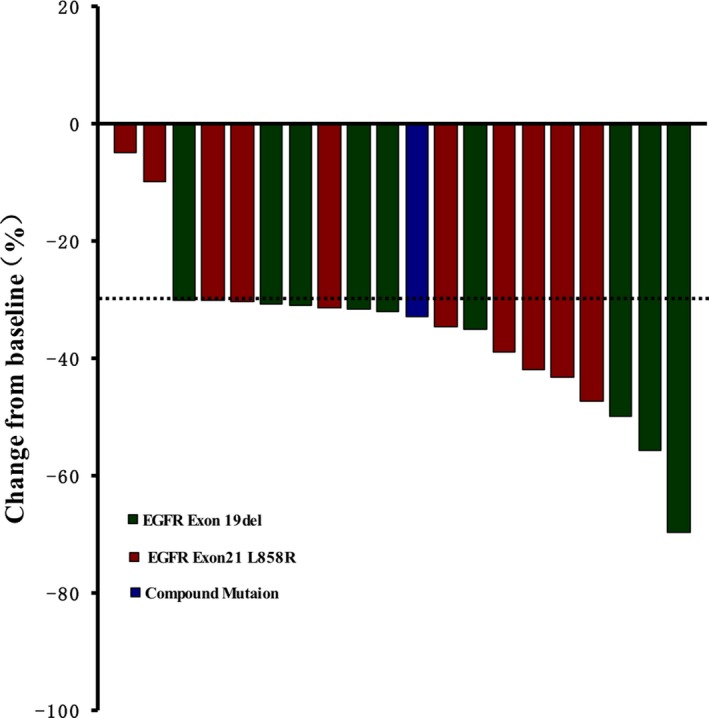
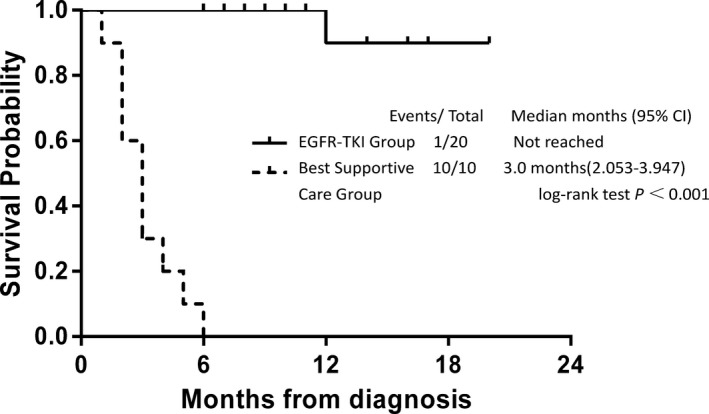
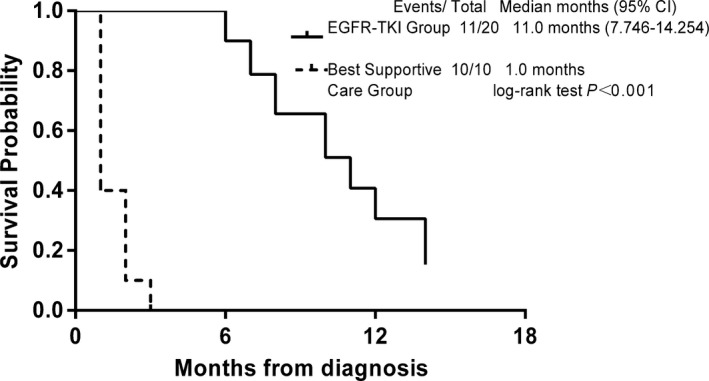
Twenty of 30 patients enrolled had sensitizing EGFR mutations in ctDNA and were started on EGFR TKIs. After a median follow-up of 12 months, median progression-free survival (PFS) was 10 months and median overall survival (OS) was not reached. The median OS for the 10 untreated patients was 3 months.
In our study, patients with plasma EGFR mutations treated with TKIs showed disease control rate (DCR) and PFS similar to historical controls that were treated based on tissue testing. This is the first prospective study showing that ctDNA genotyping provides a feasible diagnostic approach for frail lung cancer patients who are unable to undergo biopsy, which subsequently leads to EGFR-targeted therapy, and improved outcomes in this subgroup of patients.
下一代测序(NGS)和基于数字聚合酶链反应(PCR)的平台已被用于检测血浆循环肿瘤 DNA(ctDNA)中的 EGFR 突变,具有很高的准确性。一般来说,分子检测是在组织病理学分析之后进行的。然而,许多疑似晚期非小细胞肺癌的患者无法进行活检,从而错失了对具有敏感 EGFR 突变的患者进行高效酪氨酸激酶抑制剂(TKI)治疗的机会。我们研究了 ctDNA 检测在组织活检不可行的情况下,用于检测患者血浆中 EGFR 突变的效用。
我们进行了一项单中心前瞻性研究,共纳入 30 名因合并症或较差的体能状态而无法进行初始诊断活检的疑似晚期肺癌中国患者。具有血浆 EGFR 敏感突变的患者接受第一代 EGFR TKI 治疗。
30 名入组患者中有 20 名患者 ctDNA 中存在敏感 EGFR 突变,并开始接受 EGFR TKI 治疗。中位随访 12 个月后,中位无进展生存期(PFS)为 10 个月,中位总生存期(OS)未达到。10 名未接受治疗患者的中位 OS 为 3 个月。
在我们的研究中,接受 TKI 治疗的血浆 EGFR 突变患者的疾病控制率(DCR)和 PFS 与基于组织检测的历史对照患者相似。这是第一项前瞻性研究表明,ctDNA 基因分型为无法进行活检的虚弱肺癌患者提供了一种可行的诊断方法,随后为这组患者提供了 EGFR 靶向治疗,并改善了他们的预后。