Fani Negar, Jain Jahnvi, Hudak Lauren A, Rothbaum Barbara O, Ressler Kerry J, Michopoulos Vasiliki
Emory University School of Medicine, Department of Psychiatry and Behavioral Sciences, USA.
Emory University School of Medicine, Department of Psychiatry and Behavioral Sciences, USA.
Psychiatry Res. 2020 Jan 9;285:112777. doi: 10.1016/j.psychres.2020.112777.
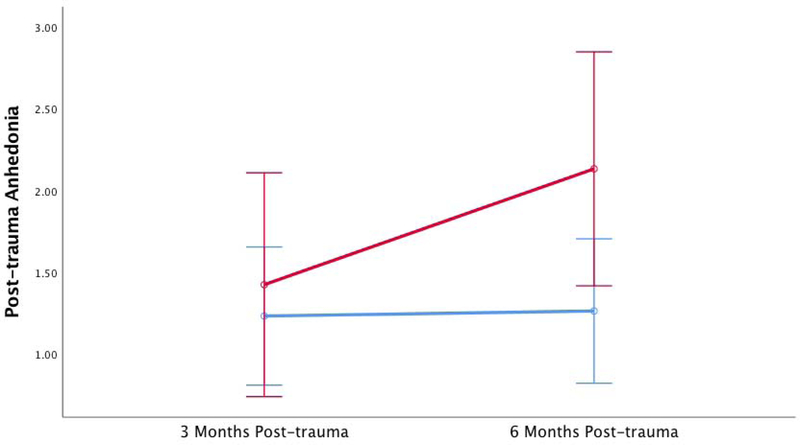
Recreational substance use (SU) can emerge or worsen in the aftermath of psychological trauma. Anhedonia is one reason for this problematic SU. Symptoms of posttraumatic stress disorder (PTSD) that represent anhedonia (post-trauma anhedonia; PTA) have been consistently linked to SU disorders. However, no prospective studies have examined whether changes in PTA over time are associated with problematic SU in recently-traumatized people, which was the goal of this study. 165 men and women were recruited as part of a prospective PTSD study in the emergency department of a Level 1 trauma center. Clinical assessments of PTSD and SU were administered at three and six months post-trauma. Compared to participants with minimal SU at six months post-trauma, high substance users at six months post-trauma showed significant increases in PTA during the three to six month time period. This relationship was significant even after accounting for variance associated with other factors, including PTSD symptoms such as re-experiencing and hyperarousal. Participants who demonstrated increases in SU during this time also showed significant increases in PTA, unlike those who demonstrated consistently minimal/no SU during this time. These findings indicate that PTA may be a mechanism through which SU problems emerge in recently-traumatized individuals.
消遣性物质使用(SU)可能在心理创伤后出现或恶化。快感缺乏是这种问题性SU的一个原因。代表快感缺乏的创伤后应激障碍(PTSD)症状(创伤后快感缺乏;PTA)一直与SU障碍有关。然而,尚无前瞻性研究考察PTA随时间的变化是否与近期受过创伤的人的问题性SU相关,这正是本研究的目的。165名男性和女性作为一级创伤中心急诊科一项前瞻性PTSD研究的一部分被招募。在创伤后三个月和六个月对PTSD和SU进行临床评估。与创伤后六个月SU最少的参与者相比,创伤后六个月大量使用物质的参与者在创伤后三至六个月期间PTA显著增加。即使在考虑了与其他因素相关的方差后,这种关系仍然显著,这些因素包括PTSD症状,如再体验和过度觉醒。在此期间SU增加的参与者PTA也显著增加,而在此期间SU一直最少/无SU的参与者则不然。这些发现表明,PTA可能是近期受过创伤的个体出现SU问题的一种机制。