Instituto Madrileño de Estudios Avanzados en Nanociencia (IMDEA Nanociencia), Faraday 9, Campus de Cantoblanco, Madrid, 28049, Spain.
Centro Nacional de Biotecnología, Consejo Superior de Investigaciones Científicas (CSIC), Darwin 3, Campus de Cantoblanco, Madrid, 28049, Spain.
Nat Commun. 2020 Jan 28;11(1):540. doi: 10.1038/s41467-019-14217-8.
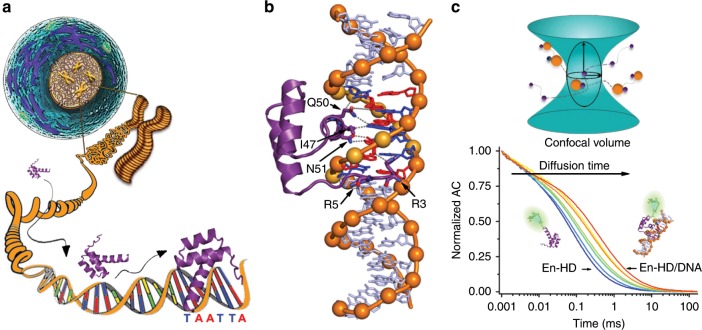
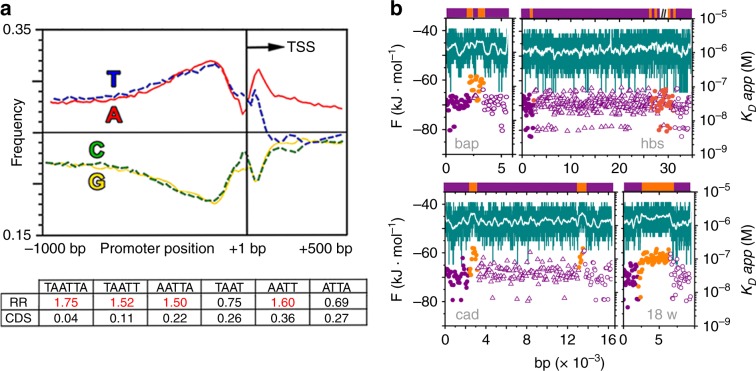
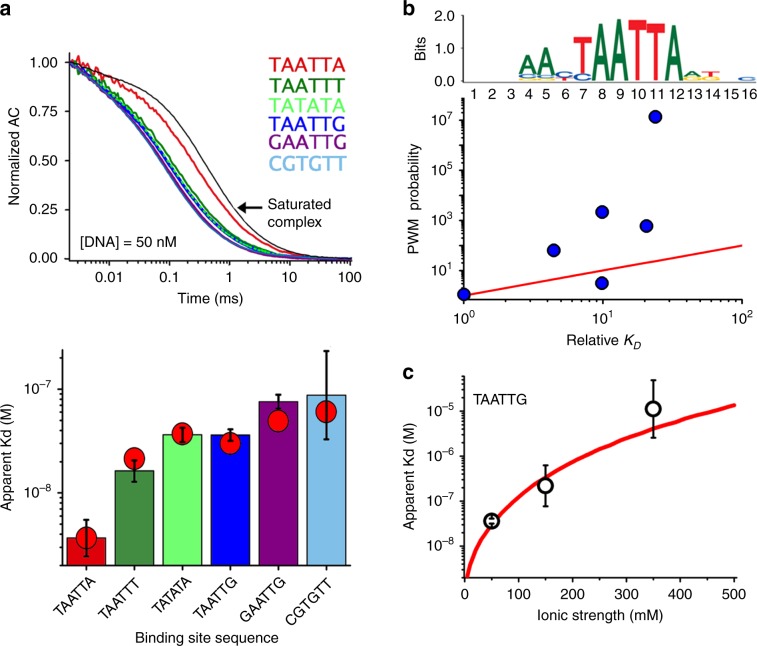
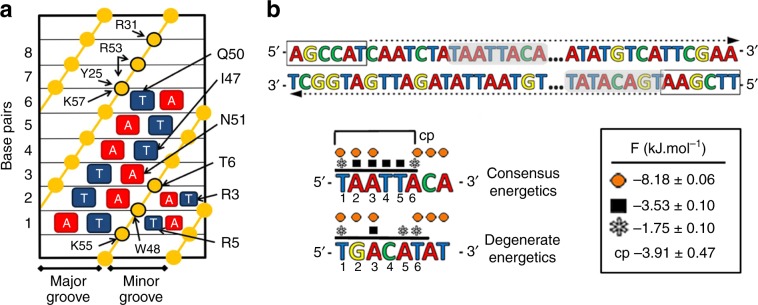
Eukaryotic transcription factors (TF) function by binding to short 6-10 bp DNA recognition sites located near their target genes, which are scattered through vast genomes. Such process surmounts enormous specificity, efficiency and celerity challenges using a molecular mechanism that remains poorly understood. Combining biophysical experiments, theory and bioinformatics, we dissect the interplay between the DNA-binding domain of Engrailed, a Drosophila TF, and the regulatory regions of its target genes. We find that Engrailed binding affinity is strongly amplified by the DNA regions flanking the recognition site, which contain long tracts of degenerate recognition-site repeats. Such DNA organization operates as an antenna that attracts TF molecules in a promiscuous exchange among myriads of intermediate affinity binding sites. The antenna ensures a local TF supply, enables gene tracking and fine control of the target site's basal occupancy. This mechanism illuminates puzzling gene expression data and suggests novel engineering strategies to control gene expression.
真核转录因子(TF)通过结合位于其靶基因附近的短 6-10bp DNA 识别位点来发挥作用,这些识别位点散布在庞大的基因组中。这种过程利用分子机制克服了巨大的特异性、效率和速度挑战,而这种分子机制仍知之甚少。我们结合生物物理实验、理论和生物信息学,剖析了果蝇 TF Engrailed 的 DNA 结合域与其靶基因的调控区域之间的相互作用。我们发现,识别位点侧翼的 DNA 区域强烈放大了 Engrailed 的结合亲和力,这些区域包含长串退化的识别位点重复序列。这种 DNA 组织作为一个天线,在无数具有中等亲和力的结合位点之间进行混杂交换,吸引 TF 分子。天线确保了局部 TF 的供应,使基因能够跟踪,并对靶位点的基础占有率进行精细控制。该机制阐明了令人费解的基因表达数据,并提出了控制基因表达的新的工程策略。