Moodie Crawford, Brose Leonie S, Lee Hyun S, Power Emily, Bauld Linda
Institute for Social Marketing, Faculty of Health Sciences and Sport, University of Stirling, Stirlingshire, Scotland, UK.
UK Centre for Tobacco & Alcohol Studies, Nottingham, UK.
Addict Res Theory. 2020;28(1):53-61. doi: 10.1080/16066359.2019.1579803. Epub 2019 Mar 19.
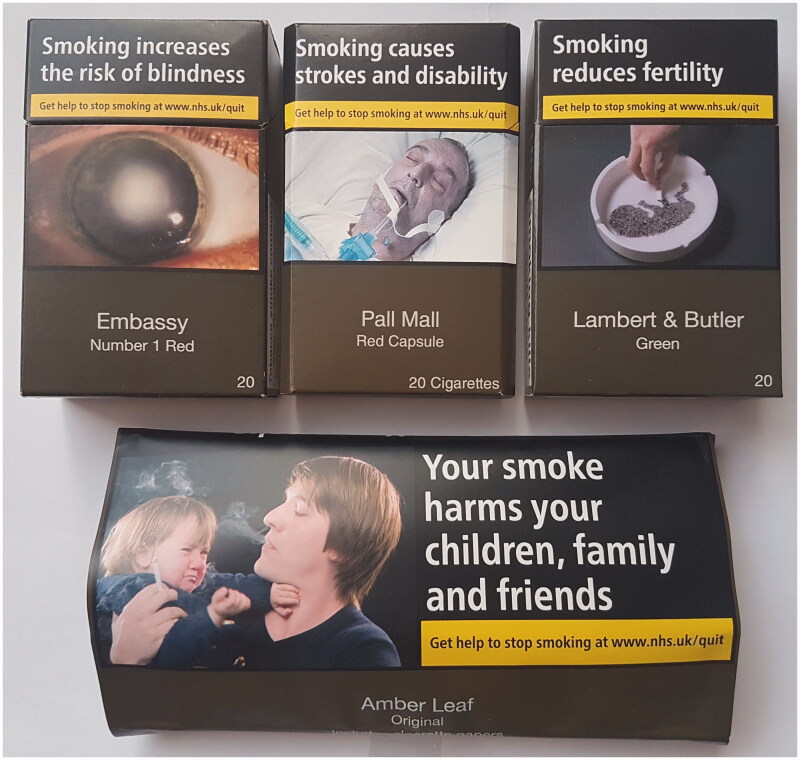
In the United Kingdom, standardised packaging for cigarettes was phased in between May 2016 and May 2017. We assessed whether there was an association between using standardised packs and warning salience, thoughts about the risks of smoking, thoughts about quitting, and awareness and use of stop-smoking websites.
We conducted a cross-sectional online survey with current smokers aged 16 and over ( = 1865) recruited in two regions of England between February-April 2017, when both standardised and fully-branded packs were on the market. Participants were asked about use of standardised packs, warning salience (noticing, reading closely), and whether the packs they were using increased thoughts of the risks of smoking and quitting. They were also asked about awareness of stop-smoking websites, source of awareness (including warnings on packs), and whether they had visited a stop-smoking website.
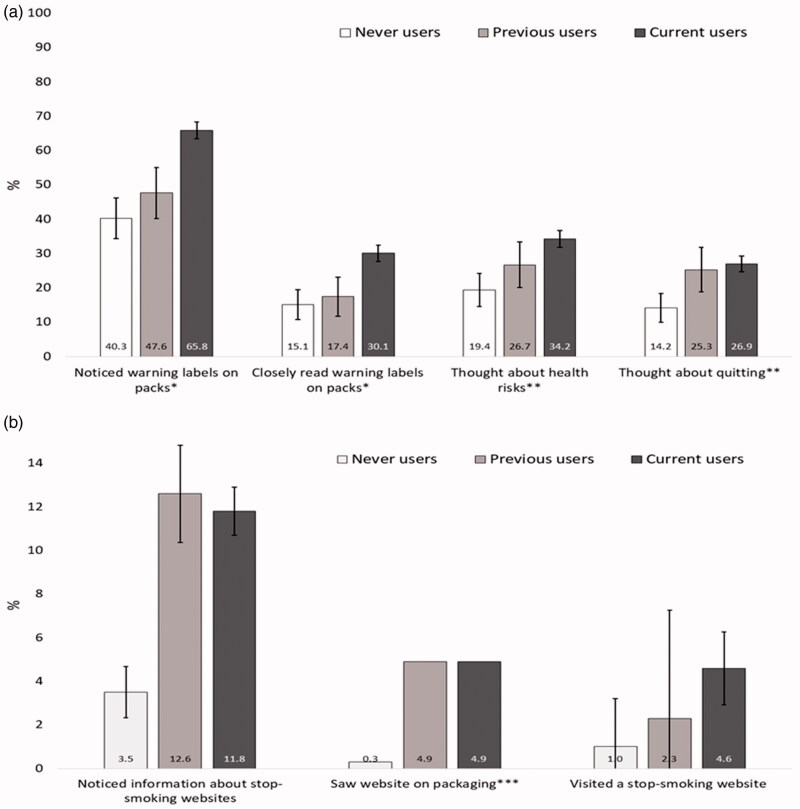
Most participants reported currently using standardised packs (76.4%), 9.3% were not currently using them but had previously used them, and 14.3% had never used them. Compared with never users, current users were more likely to have noticed the warnings on packs often/very often (AOR (95%CI) = 2.76 (2.10, 3.63)), read them closely often/very often (AOR(95%CI) = 2.16 (1.51, 3.10)), thought somewhat/a lot about the health risks of smoking (AOR(95%CI) = 1.92 (1.38, 2.68)), and thought somewhat/a lot about quitting (AOR(95%CI) = 1.90 (1.30, 2.77)). They were also more likely to have noticed a stop-smoking website on packs.
Consistent with the broad objectives of standardised packaging, we found that it was associated with increased warning salience and thoughts about risks and quitting.
在英国,香烟标准化包装于2016年5月至2017年5月逐步推行。我们评估了使用标准化包装与警示显著性、对吸烟风险的思考、戒烟想法以及戒烟网站的知晓度和使用之间是否存在关联。
我们于2017年2月至4月在英格兰的两个地区对16岁及以上的现吸烟者(n = 1865)进行了一项横断面在线调查,当时标准化包装和全品牌包装均已上市。参与者被问及标准化包装的使用情况、警示显著性(注意到、仔细阅读),以及他们正在使用的包装是否增加了对吸烟风险和戒烟的思考。他们还被问及对戒烟网站的知晓度、知晓来源(包括包装上的警示),以及是否访问过戒烟网站。
大多数参与者报告目前正在使用标准化包装(76.4%),9.3%目前未使用但以前使用过,14.3%从未使用过。与从未使用者相比,目前使用者更有可能经常/非常频繁地注意到包装上的警示(优势比(95%置信区间)= 2.76(2.10,3.63)),经常/非常频繁地仔细阅读它们(优势比(95%置信区间)= 2.16(1.51,3.10)),对吸烟的健康风险有一定/很多思考(优势比(95%置信区间)= 1.92(1.38,2.68)),以及对戒烟有一定/很多思考(优势比(95%置信区间)= 1.90(1.30,2.77))。他们也更有可能注意到包装上的戒烟网站。
与标准化包装的广泛目标一致,我们发现它与警示显著性增加以及对风险和戒烟的思考有关。