Marillier Mathieu, Bernard Anne-Catherine, Vergès Samuel, Neder J Alberto
Laboratory of Clinical Exercise Physiology, Kingston General Hospital, Queen's University, Kingston, ON, Canada.
HP2 Laboratory, INSERM, CHU Grenoble Alpes, Grenoble Alpes University, Grenoble, France.
Front Physiol. 2020 Jan 14;10:1590. doi: 10.3389/fphys.2019.01590. eCollection 2019.
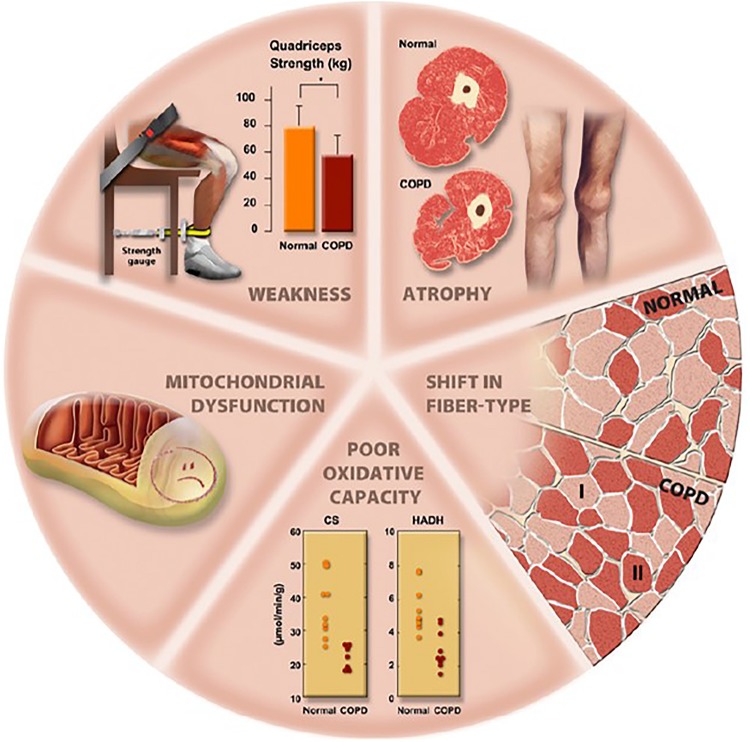
Exercise training as part of pulmonary rehabilitation is arguably the most effective intervention to improve tolerance to physical exertion in patients with chronic obstructive pulmonary disease (COPD). Owing to the fact that exercise training has modest effects on exertional ventilation, operating lung volumes and respiratory muscle performance, improving locomotor muscle structure and function are key targets for pulmonary rehabilitation in COPD. In the current concise review, we initially discuss whether patients' muscles are exposed to deleterious factors. After presenting corroboratory evidence on this regard (e.g., oxidative stress, inflammation, hypoxemia, inactivity, and medications), we outline their effects on muscle macro- and micro-structure and related functional properties. We then finalize by addressing the potential beneficial consequences of different training strategies on these muscle-centered outcomes. This review provides, therefore, an up-to-date outline of the rationale for rehabilitative exercise training approaches focusing on the locomotor muscles in this patient population.
作为肺康复一部分的运动训练,可以说是改善慢性阻塞性肺疾病(COPD)患者体力活动耐量最有效的干预措施。由于运动训练对运动性通气、有效肺容积和呼吸肌性能的影响较小,因此改善运动肌肉的结构和功能是COPD肺康复的关键目标。在当前这篇简要综述中,我们首先讨论患者的肌肉是否暴露于有害因素。在提供这方面的确证证据(如氧化应激、炎症、低氧血症、缺乏运动和药物)后,我们概述它们对肌肉宏观和微观结构以及相关功能特性的影响。然后,我们通过阐述不同训练策略对这些以肌肉为中心的结果的潜在有益影响来完成综述。因此,本综述提供了一个最新的概述,说明了针对该患者群体中运动肌肉的康复运动训练方法的基本原理。