Department of Medical Biophysics, University of Toronto, Toronto, ON, Canada.
Department of Biological Sciences, Sunnybrook Research Institute, Toronto, ON, Canada.
Front Immunol. 2020 Jan 14;10:3014. doi: 10.3389/fimmu.2019.03014. eCollection 2019.
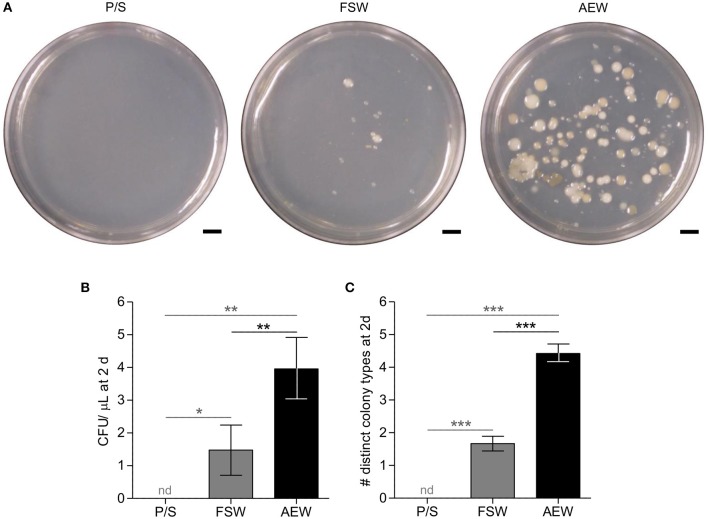
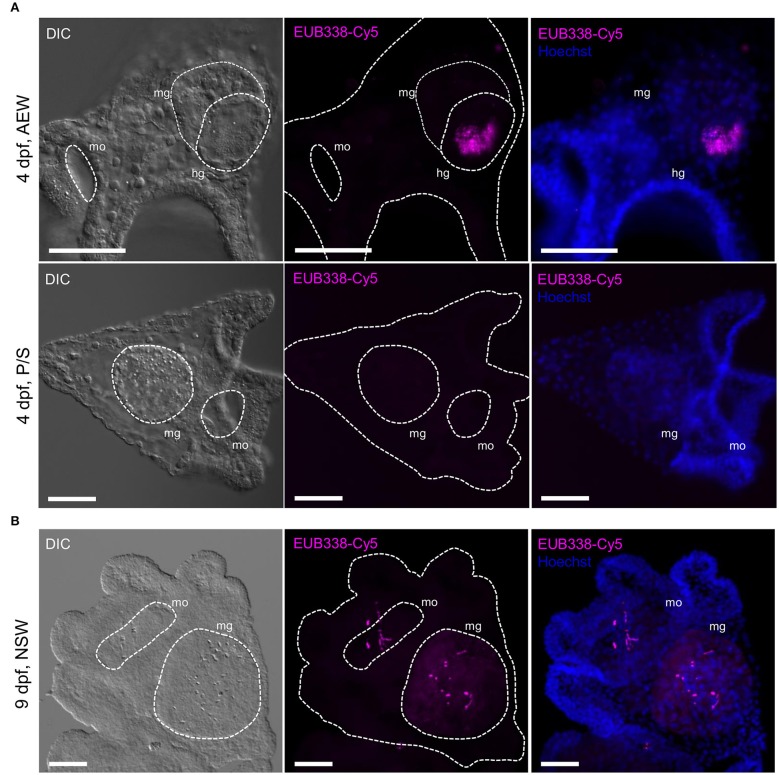
Exposure to and colonization by bacteria during development have wide-ranging beneficial effects on animal biology but can also inhibit growth or cause disease. The immune system is the prime mediator of these microbial interactions and is itself shaped by them. Studies using diverse animal taxa have begun to elucidate the mechanisms underlying the acquisition and transmission of bacterial symbionts and their interactions with developing immune systems. Moreover, the contexts of these associations are often confounded by stark differences between "wild type" microbiota and the bacterial communities associated with animals raised in conventional or germ-free laboratories. In this study, we investigate the spatio-temporal kinetics of bacterial colonization and associated effects on growth and immune function in larvae of the purple sea urchin () as a model for host-microbe interactions and immune system development. We also compare the host-associated microbiota of developing embryos and larvae raised in natural seawater or exposed to adult-associated bacteria in the laboratory. Bacteria associated with zygotes, embryos, and early larvae are detectable with 16S amplicon sequencing, but 16S-FISH indicates that the vast majority of larval bacterial load is acquired after feeding begins and is localized to the gut lumen. The bacterial communities of laboratory-cultured embryos are significantly less diverse than the natural microbiota but recapitulate its major components (Alphaproteobacteria, Gammaproteobacteria, and Bacteroidetes), suggesting that biologically relevant host-microbe interactions can be studied in the laboratory. We also demonstrate that bacterial exposure in early development induces changes in morphology and in the immune system. In the absence of bacteria, larvae grow larger at the 4-arm stage. Additionally, bacteria-exposed larvae are significantly more resistant to lethal infection with the larva-associated pathogen suggesting that early exposure to high levels of microbes, as would be expected in natural conditions, affects the immune state in later larvae. These results expand our knowledge of microbial influences on early sea urchin development and establish a model in which to study the interactions between the developing larval immune system and the acquisition of larval microbiota.
在发育过程中,动物接触和定植细菌会对其生物学产生广泛的有益影响,但也可能抑制生长或导致疾病。免疫系统是这些微生物相互作用的主要介导者,其本身也受其塑造。使用不同动物类群的研究已经开始阐明获得和传播细菌共生体的机制及其与正在发育的免疫系统的相互作用。此外,这些关联的背景通常因“野生型”微生物群与在常规或无菌实验室中饲养的动物相关的细菌群落之间的明显差异而变得复杂。在这项研究中,我们以紫色海胆幼虫为模型,研究细菌定植的时空动力学及其对生长和免疫功能的影响,以研究宿主-微生物相互作用和免疫系统发育。我们还比较了在天然海水中或在实验室中暴露于成年相关细菌条件下发育的胚胎和幼虫的宿主相关微生物群。通过 16S 扩增子测序可检测到与受精卵、胚胎和早期幼虫相关的细菌,但 16S-FISH 表明,绝大多数幼虫的细菌负荷是在开始进食后获得的,并且定位于肠道腔中。实验室培养的胚胎的细菌群落的多样性明显低于天然微生物群,但可重现其主要成分(α变形菌门、γ变形菌门和拟杆菌门),这表明在实验室中可以研究具有生物学相关性的宿主-微生物相互作用。我们还证明,早期发育中的细菌暴露会引起形态和免疫系统的变化。在没有细菌的情况下,幼虫在 4 腕期生长得更大。此外,暴露于细菌的幼虫对与幼虫相关的病原体的致死性感染的抵抗力显著增强,这表明在自然条件下,早期暴露于高水平的微生物会影响后期幼虫的免疫状态。这些结果扩展了我们对微生物对早期海胆发育影响的认识,并建立了一个模型,可用于研究正在发育的幼虫免疫系统与获得幼虫微生物群之间的相互作用。