Institute of Experimental Psychology, Heinrich-Heine University Düsseldorf, 40225 Düsseldorf, Germany.
Faculty of Psychology, Clinical Neuropsychology, Neuropsychological Therapy Centre, Ruhr University Bochum, 44780 Bochum, Germany.
Soc Cogn Affect Neurosci. 2020 Jan 30;15(1):53-61. doi: 10.1093/scan/nsaa009.
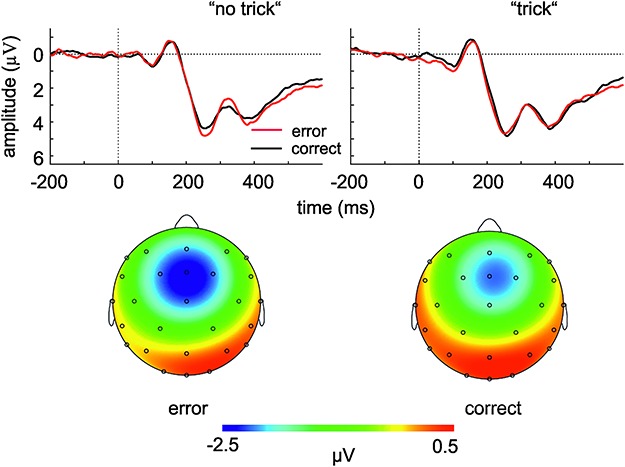
Empathic brain responses are characterized by overlapping activations between active experience and observation of an emotion in another person, with the pattern for observation being modulated by trait empathy. Also for self-performed and observed errors, similar brain activity has been described, but findings concerning the role of empathy are mixed. We hypothesized that trait empathy modulates the processing of observed responses if expectations concerning the response are based on the beliefs of the observed person. In the present study, we utilized a false-belief task in which observed person's and observer's task-related knowledge were dissociated and errors and correct responses could be expected or unexpected. While theta power was generally modulated by the expectancy of the observed response, a negative mediofrontal event-related potential (ERP) component was more pronounced for unexpected observed actions only in participants with higher trait empathy (assessed by the Empathy Quotient), as revealed by linear mixed effects analyses. Cognitive and affective empathy, assessed by the Interpersonal Reactivity Index, were not significantly related to the ERP component. The results suggest that trait empathy can facilitate the generation of predictions and thereby modulate specific aspects of the processing of observed actions, while the contributions of specific empathy components remain unclear.
共情大脑反应的特征是主动体验和观察他人情绪之间的重叠激活,而观察模式则受到特质共情的调节。对于自我执行和观察到的错误,也描述了类似的大脑活动,但关于共情作用的研究结果存在分歧。我们假设,如果对反应的期望基于观察到的人的信念,那么特质共情会调节对观察到的反应的处理。在本研究中,我们使用了一种错误信念任务,其中观察到的人和观察者的任务相关知识被分离,并且可以预期或不预期错误和正确的反应。虽然theta 功率通常受到观察到的反应的期望的调节,但只有在特质共情较高的参与者中(通过共情商数评估),对于意外观察到的动作,负性中前额事件相关电位(ERP)成分更为明显,这是通过线性混合效应分析揭示的。通过人际反应指数评估的认知和情感共情与 ERP 成分没有显著关系。研究结果表明,特质共情可以促进预测的产生,从而调节对观察到的动作的特定方面的处理,而特定共情成分的贡献仍不清楚。