Müller-Hermes Christoph, Creutznacher Robert, Mallagaray Alvaro
Center of Structural and Cell Biology in Medicine (CSCM), Institute of Chemistry and Metabolomics, University of Lübeck, Ratzeburger Allee 160, 23562, Lübeck, Germany.
Biomol NMR Assign. 2020 Apr;14(1):123-130. doi: 10.1007/s12104-020-09932-z. Epub 2020 Jan 28.
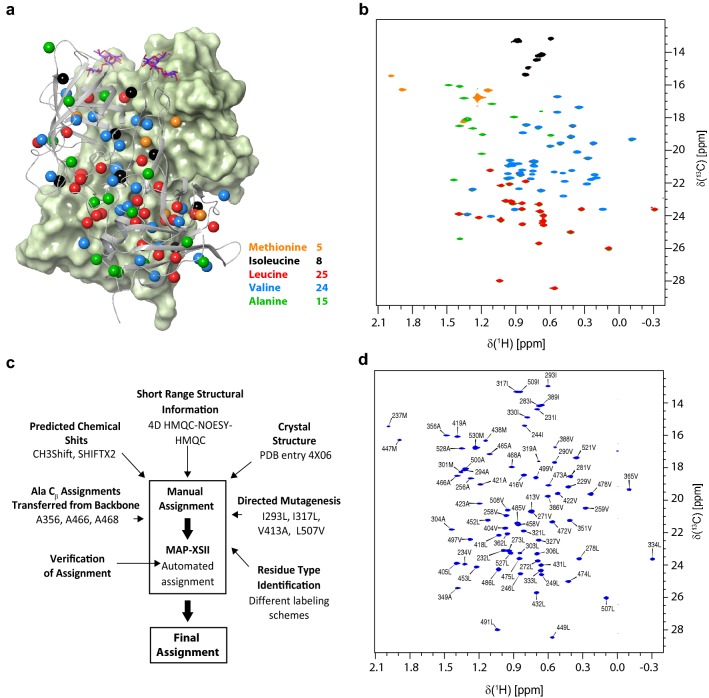
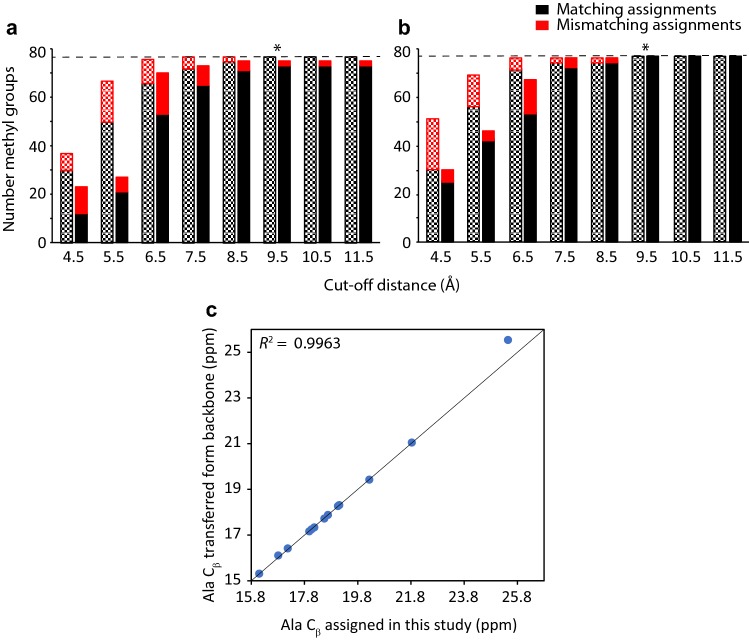
Attachment of human noroviruses to histo blood group antigens (HBGAs) is thought to be essential for infection, although how this binding event promotes infection is unknown. Recent studies have shown that 60% of all GII.4 epidemic strains may undergo a spontaneous post-translational modification (PTM) in an amino acid located adjacent to the binding pocket for HBGAs. This transformation proceeds with an estimated half-life of 1-2 days under physiological conditions, dramatically affecting HBGA recognition. The surface-exposed position of this PTM and its sequence conservation suggests a relevant role in immune escape and host-cell recognition. As a first step towards the understanding of the biological implications of this PTM at atomic resolution, we report the complete assignment of methyl resonances of a MILVA methyl-labeled sample of a 72 kDa protruding domain from a GII.4 Saga human norovirus strain. Assignments were obtained from methyl-methyl NOESY experiments combined with site-directed mutagenesis and automated assignment. This data provides the basis for a detailed characterization of the PTM-driven modulation of immune recognition in human norovirus on a molecular level.
人诺如病毒与组织血型抗原(HBGAs)的结合被认为是感染所必需的,尽管这种结合事件如何促进感染尚不清楚。最近的研究表明,所有GII.4流行株中有60%可能在与HBGAs结合口袋相邻的氨基酸处发生自发的翻译后修饰(PTM)。在生理条件下,这种转变的半衰期估计为1-2天,会显著影响HBGA的识别。这种PTM的表面暴露位置及其序列保守性表明其在免疫逃逸和宿主细胞识别中具有相关作用。作为在原子分辨率下理解这种PTM生物学意义的第一步,我们报告了来自GII.4佐贺人诺如病毒株的72 kDa突出结构域的MILVA甲基标记样品的甲基共振的完整归属。通过甲基-甲基NOESY实验结合定点诱变和自动归属获得了归属。这些数据为在分子水平上详细表征PTM驱动的人诺如病毒免疫识别调节提供了基础。