Department of Bioengineering, Stanford University, Stanford, United States.
Department of Molecular and Cell Biology, University of California, Berkeley, Berkeley, United States.
Elife. 2020 Jan 29;9:e51493. doi: 10.7554/eLife.51493.
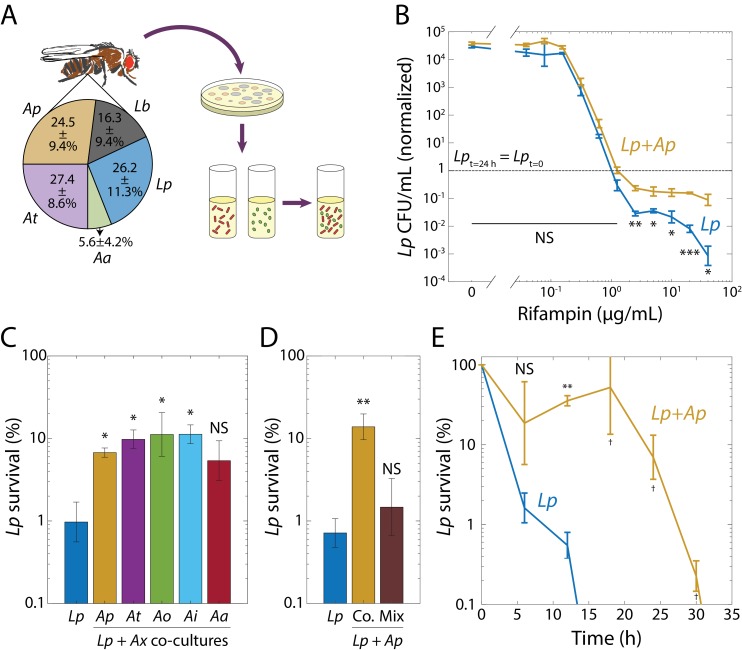
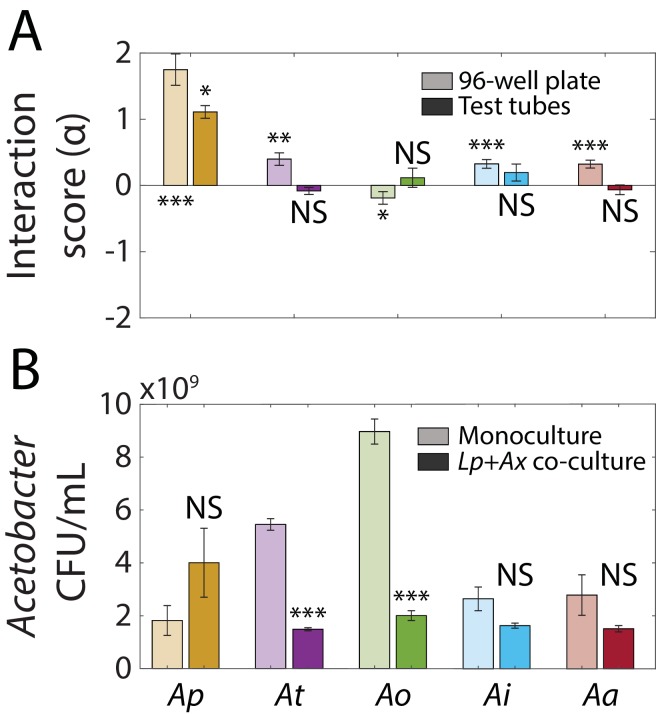
Predicting antibiotic efficacy within microbial communities remains highly challenging. Interspecies interactions can impact antibiotic activity through many mechanisms, including alterations to bacterial physiology. Here, we studied synthetic communities constructed from the core members of the fruit fly gut microbiota. Co-culturing of with species altered its tolerance to the transcriptional inhibitor rifampin. By measuring key metabolites and environmental pH, we determined that species counter the acidification driven by production of lactate. Shifts in pH were sufficient to modulate tolerance to rifampin and the translational inhibitor erythromycin. A reduction in lag time exiting stationary phase was linked to tolerance to rifampicin, opposite to a previously identified mode of tolerance to ampicillin in . This mechanistic understanding of the coupling among interspecies interactions, environmental pH, and antibiotic tolerance enables future predictions of growth and the effects of antibiotics in more complex communities.
预测微生物群落内的抗生素疗效仍然极具挑战性。种间相互作用可以通过多种机制影响抗生素的活性,包括改变细菌的生理机能。在这里,我们研究了由果蝇肠道微生物群的核心成员构建的合成群落。与 种共培养改变了其对转录抑制剂利福平的耐受性。通过测量关键代谢物和环境 pH 值,我们确定 种通过中和由 产生的乳酸引起的酸化来对抗酸化。pH 值的变化足以调节 对利福平的耐受性和翻译抑制剂红霉素的耐受性。从静止期退出的滞后时间的减少与 对利福平的耐受性有关,与之前在 中鉴定的对氨苄西林的耐受性模式相反。这种对种间相互作用、环境 pH 值和抗生素耐受性之间耦合的机制理解,使我们能够对更复杂群落中的生长和抗生素作用进行未来预测。